Infrared Optical Materials and Coating Guide
A practical guide to common infrared optical materials, coating bands, environmental durability risks, and RFQ checks for UV, VIS, MWIR, and LWIR optics.
Infrared Coatings Are Now a Material Selection Issue
Infrared optical coatings have developed alongside better deposition tools, tighter process control, plasma-enhanced chemical vapor deposition, electron-beam evaporation, ion-assisted deposition, sputtering, and resistive-source coating processes. The coating is no longer a simple final surface treatment. For many IR optics, it is part of the material decision.
New chalcogenide materials, multispectral imaging systems, and commercial or defense optical assemblies increasingly require one aperture to support visible, MWIR, and LWIR bands. That creates demand for coating designs that balance transmission, reflection, absorption, adhesion, abrasion resistance, humidity exposure, thermal cycling, and cleaning behavior.
This guide summarizes common infrared optical materials and practical coating considerations. Values below are engineering references for early comparison. Final design should use confirmed supplier data, wavelength band, thickness, coating stack, operating temperature, and environmental test requirements.
Start with Wavelength, Then Add Environment
The first filter is wavelength. The second is exposure. A material that is excellent in a dry FTIR bench may fail in a humid field instrument. A high-transmission material can still be the wrong choice if it is too soft, too soluble, too heavy, too temperature-sensitive, or difficult to coat for the required band.
| Design question | Why it matters | What to specify |
|---|---|---|
| Operating band | Transmission range alone does not define usable performance | Exact wavelength or band, such as 0.8-2.5 µm, 3-5 µm, 8-12 µm, or 10.6 µm |
| Exposure | Humidity, salt fog, dust, cleaning, shock, and temperature cycling can dominate failure risk | Indoor, sealed, outdoor, airborne, high-humidity, or laser process environment |
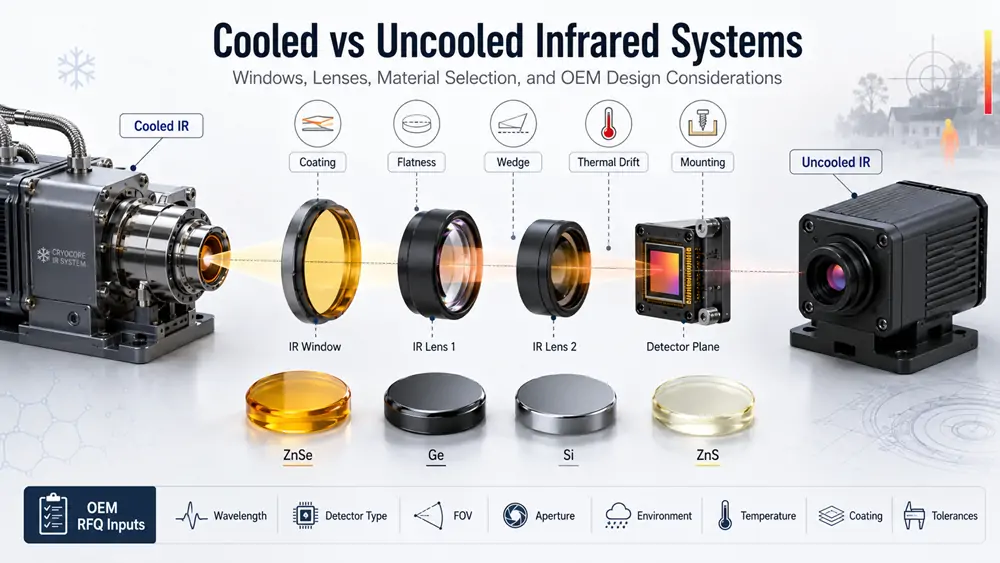
| Optical function | Windows, lenses, domes, filters, and prisms carry different coating and surface risks | Component type, clear aperture, angle of incidence, surface quality, and mounting method |
| Coating target | Coating absorption and durability affect real system performance | AR, BBAR, dual-band AR, DLC, moisture-protective AR, or custom spectral stack |
Common Infrared Materials at a Glance
| Material | Typical usable range | Strengths | Main risks |
|---|---|---|---|
| BaF2 | About 0.25-9.5 µm | Good UV, VIS, NIR, and MWIR transmission | Lower hardness and strength than CaF2; more thermal-shock sensitive |
| CaF2 | About 0.13-10 µm | Broad UV-to-IR range, low dispersion, practical availability | Brittleness and coating/mounting stress must be managed |
| CsBr | About 0.35-32 µm | Very broad IR transmission | Water soluble, fragile, and requires moisture protection |
| CsI | About 0.42-40 µm | Among the broadest common IR transmission ranges | Water soluble and extremely fragile |
| Chalcogenide glass | Often optimized for MWIR/LWIR | Useful for athermal IR lens design and molding routes | Grade, thermal limit, and cost vary by composition |
| IR fused silica | About 0.25-3.5 µm | High uniformity and strong VIS/NIR handling | Not diamond-turnable; limited for longer IR transmission |
| GaAs | About 2-15 µm | Durable IR semiconductor material with low absorption in selected bands | Cost, toxicity handling, and coating requirements need review |
| Germanium | About 2-14 µm | High refractive index for compact MWIR/LWIR designs | High density, large dn/dT, and high-temperature transmission risk |
| LiF | About 0.12-8.5 µm | Very low refractive index and DUV usefulness | Softness, plastic deformation, and high thermal expansion |
| MgF2 | About 0.11-7.5 µm | Low index, UV usefulness, and better shock resistance than many fluoride crystals | Birefringence must be considered |
| KBr / KCl / NaCl | Broad UV-to-far-IR ranges | Useful in FTIR and analytical instruments | Water soluble, fragile, and moisture-protection dependent |
| Sapphire | About 0.17-5.5 µm | Very high hardness and environmental durability | Anisotropy and non-diamond-turning fabrication route |
| Silicon | About 1.2-7 µm for common transmission use | Low density, high hardness, practical MWIR use | Not a normal 8-14 µm transmissive LWIR material |
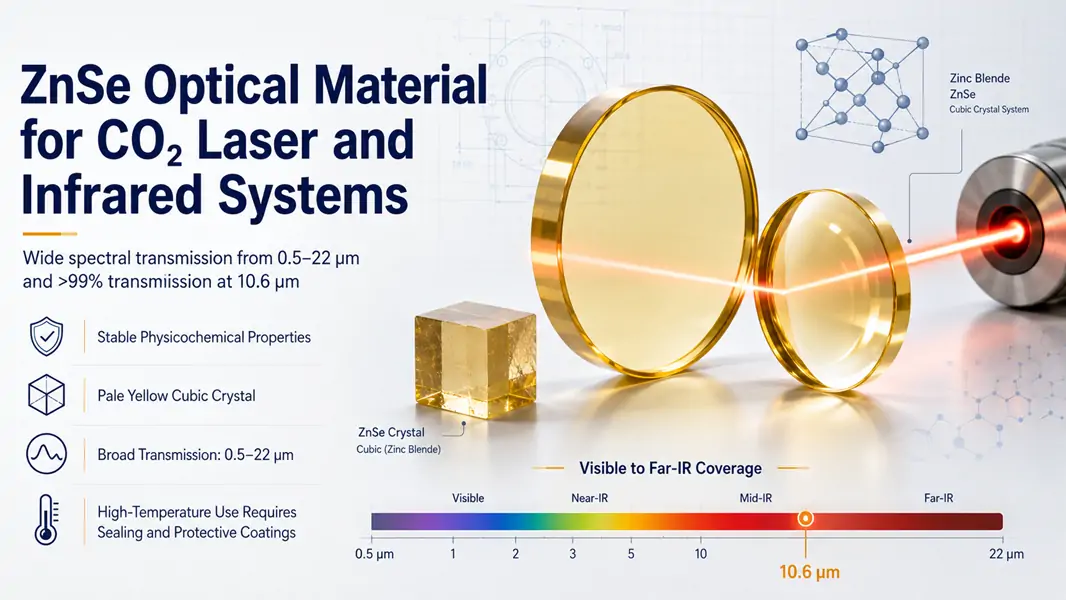
| ZnSe | About 0.6-16 µm | Established CO2 laser and broad IR material route | Soft material; cleaning, coating, and contamination control are critical |
| ZnS / Cleartran ZnS | Standard ZnS often 3-12 µm; Cleartran about 0.4-12 µm | Rugged IR windows and multispectral apertures | Grade, scatter, coating, and cost must be specified clearly |
Coating Families Used on IR Materials
| Coating family | Typical use | Engineering caution |
|---|---|---|
| Single-band AR | One laser line or a narrow detection band | Confirm angle of incidence, polarization, and bandwidth tolerance |
| BBAR | Broadband transmission such as 0.8-2.5 µm, 3-5 µm, 8-12 µm, or custom bands | Wider bands can increase design tradeoffs and coating complexity |
| Dual-band or triple-band AR | Systems combining NIR, MWIR, and LWIR channels | Requires careful target definition and environmental qualification |
| DLC / hard carbon | Exposed Germanium, Silicon, ZnSe, or ZnS optics where abrasion resistance matters | Transmission, stress, adhesion, and wavelength band must be validated |
| Moisture-protective AR | Water-soluble salts such as KBr, KCl, NaCl, CsBr, and CsI | Uncoated edges and handling must remain protected from humidity |
| Metal or mirror coatings | Reflective IR optics and metal mirror materials | Substrate finish, coating adhesion, and thermal load are critical |
Material-Specific Engineering Notes
Barium Fluoride (BaF2)
BaF2 offers useful UV, visible, near-infrared, and mid-infrared transmission. It is softer and mechanically weaker than CaF2 and is more sensitive to thermal shock. It can be reviewed for thermal imaging, astronomy, and laser optics when the environment and mounting are controlled.
Calcium Fluoride (CaF2)
CaF2 is a practical broadband material for UV-to-IR windows, lenses, beamsplitters, filters, wedges, and prisms. It is harder and more available in larger sizes than BaF2 in many supply contexts. Review CaF2 material guidance when low dispersion and broad transmission are important.
Water-Soluble IR Salts
CsBr, CsI, KBr, KCl, and NaCl can provide very broad IR transmission and are often discussed for FTIR spectroscopy, laser protectors, analytical instruments, and far-infrared use. Their main risk is moisture. These materials need moisture-protective AR coating or dry, controlled handling and storage.
Chalcogenide Glass
Chalcogenide glasses are used in MWIR and LWIR lens systems and can help simplify athermal design because selected compositions have lower dn/dT than materials such as germanium. They can be generated, polished, diamond turned, magnetorheologically finished, or molded depending on composition and geometry.
Germanium (Ge)
Germanium has one of the highest refractive indices among common IR transmission materials, making it useful for compact MWIR and LWIR lenses. It is dense and temperature-sensitive, with focus shift and transmission degradation risk at elevated temperature. Review Germanium material guidance before using it in high-temperature or weight-sensitive systems.
Silicon (Si)
Silicon is useful for NIR and selected MWIR optical systems. It is light compared with germanium, hard, and practical for many windows and lens elements. It should not be used as a normal transmissive material for standard 8-14 µm LWIR thermal imaging.
ZnSe
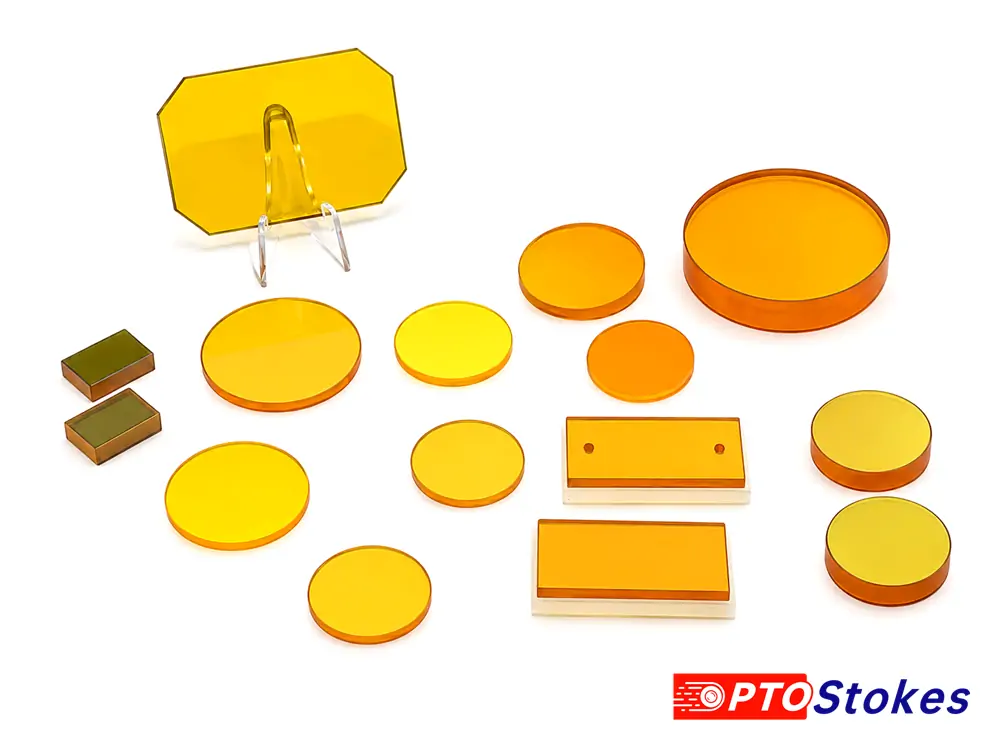
CVD ZnSe is widely used for CO2 laser optics and broad IR windows or lenses. It is relatively soft, so AR coating, cleaning method, contamination control, surface quality, and packaging must be specified carefully. Review ZnSe material and CVD ZnSe material for related component paths.
ZnS and Cleartran ZnS
Standard ZnS is used for rugged MWIR/LWIR windows, while Cleartran ZnS is refined for multispectral visible-to-IR use. Cleartran is useful when a visible camera and IR detector need a shared aperture. Review ZnS material and Cleartran ZnS windows when durability and multispectral transmission are both important.
Environmental Durability Testing to Define Early
IR coating success should be proven against the real service environment. Useful qualification discussions often include humidity exposure, adhesion, abrasion, salt fog, temperature cycling, thermal shock, cleaning resistance, laser exposure, and contamination sensitivity.
| Test or review item | Why it matters |
|---|---|
| Humidity or moisture exposure | Critical for soluble salts and important for coating edge protection |
| Abrasion and cleaning durability | Important for exposed windows, domes, protective optics, and field service |
| Thermal cycling | Reveals coating stress, substrate expansion mismatch, and mounting risk |
| Adhesion | Required when coatings face temperature, cleaning, or outdoor exposure |
| Laser exposure | Needed where absorption, contamination, or coating defects can create local heating |
| Salt fog or corrosive atmosphere | Relevant for marine, aerospace, and outdoor sensor windows |
RFQ Checklist for IR Materials and Coatings
- Specify the exact wavelength band or laser line.
- State the component function: window, lens, dome, filter, beamsplitter, prism, wedge, blank, or mirror.
- Provide dimensions, clear aperture, thickness, wedge, chamfer, and drawing tolerances.
- Define surface quality, surface figure, wavefront, parallelism, or roughness requirements.
- Define coating type, target reflection or transmission, angle of incidence, and coating side.
- Describe the operating environment, cleaning method, humidity, temperature, shock, vibration, and storage conditions.
- For laser optics, provide wavelength, beam size, power, duty cycle, pulse condition, contamination risk, and cooling method.
- State inspection documents, sample quantity, production quantity, packaging, and target schedule.
Practical Recommendation
Do not choose an infrared material or coating from a transmission range alone. Start with the wavelength, then check environment, mechanical load, thermal behavior, coating durability, and manufacturability. A material with lower theoretical transmission may be the better system choice if it survives cleaning, humidity, thermal cycling, and field exposure more reliably.
For adjacent material pages, compare the optical material index, CaF2, Germanium, LiF, MgF2, Silicon, ZnSe, and ZnS. For coating or drawing review, use the contact form or email [email protected].