CVD ZnSe Material: Properties, Applications and Selection
A practical guide to CVD ZnSe infrared optical material properties, applications, advantages and RFQ checks for windows, lenses and CO2 laser optics.
CVD ZnSe Is a Practical Infrared Optical Material
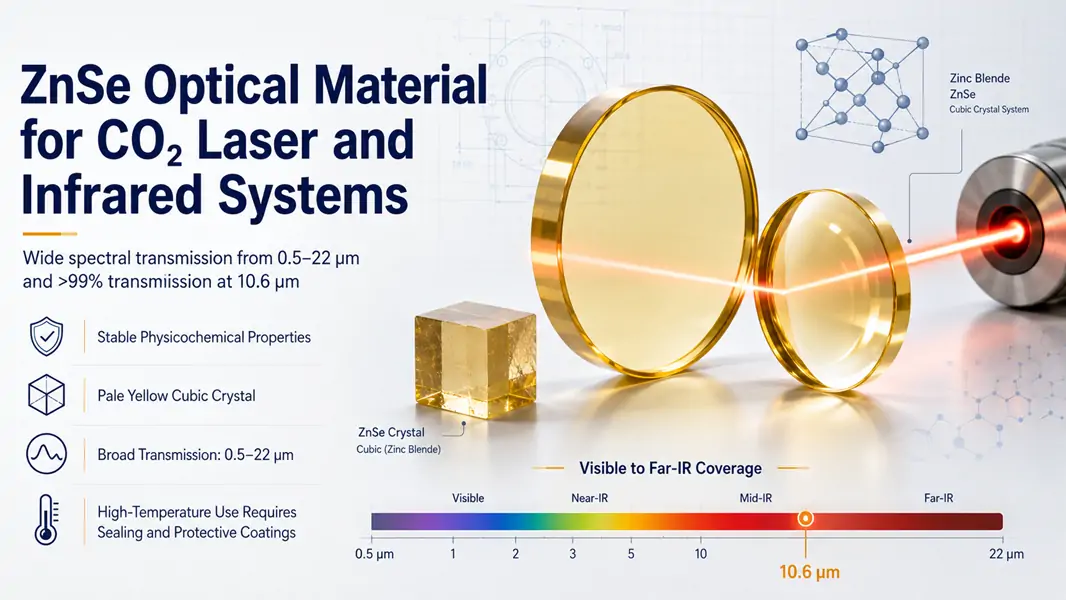
Zinc selenide (ZnSe) is widely used in infrared optical systems because it can support important IR transmission paths, including thermal imaging, CO2 laser optics, spectroscopy and custom beam-control components. In production optics, the most common route is CVD ZnSe, where material grade, homogeneity, polishing, coating and inspection determine final performance.
For engineers and OEM buyers, ZnSe should not be selected only by a broad transmission range. The final component must be reviewed against wavelength, optical function, laser power if relevant, surface quality, coating, clear aperture, geometry, mounting method and operating environment.
This article focuses on ZnSe material characteristics, typical applications and selection checks for infrared windows, lenses, prisms, blanks and CO2 laser optical components.
Key ZnSe Material Characteristics to Review
ZnSe material data is useful as a starting point, but final acceptance should be tied to the supplier grade, drawing, coating specification and inspection method. Values can vary by material grade, wavelength, temperature and part geometry.
| Characteristic | Typical engineering meaning | Selection note |
|---|---|---|
| Infrared transmission | ZnSe is commonly reviewed for MWIR, LWIR and CO2 laser-related transmission paths | Confirm the actual wavelength range, thickness and coating instead of relying on a generic material name |
| Refractive index | The relatively high IR refractive index supports compact lens and prism designs | Use wavelength-specific design data for final optical modeling |
| Absorption | Low absorption is important for CO2 laser optics and high-duty IR systems | Review absorption, coating loss, contamination and thermal load together |
| Thermal behavior | Thermal expansion and refractive-index shift can affect focus and beam quality | Confirm temperature range, mounting stress and laser duty cycle |
| Mechanical hardness | ZnSe is relatively soft compared with many visible optical materials | Define cleaning, handling, protective coating, packaging and edge requirements |
| Manufacturing quality | Homogeneity, surface quality, edge condition and subsurface damage affect final optics | Specify inspection criteria before production release |
Why CVD ZnSe Is Used for Infrared Windows
ZnSe windows are used where the system needs infrared transmission and a controlled optical barrier. Typical positions include thermal imaging front windows, CO2 laser protective windows, spectroscopy windows and custom sealed optical paths.
Window selection should account for more than material transmission. A window may be exposed to dust, smoke, oil, cleaning contact, humidity, pressure load or mounting stress. If the coating or surface becomes contaminated, absorbed energy can increase and reduce service life, especially in laser-related systems.
Window data to confirm
- Operating wavelength or band, such as MWIR, LWIR or 10.6 µm
- Outside diameter or length and width, thickness and clear aperture
- Surface quality, flatness, parallelism or wedge requirement
- AR coating, protective coating, coating side and angle of incidence
- Cleaning method, sealing method, environmental exposure and packaging
Why CVD ZnSe Is Used for Infrared Lenses
ZnSe lenses are used in selected infrared imaging, beam delivery and laser-related optical systems. A lens must form, focus or relay the beam, so material selection must be reviewed with focal length, F-number, detector or beam size, field requirement, surface form, centering and coating loss.
In CO2 laser paths, ZnSe lenses are commonly reviewed because the material route is established for transmissive 10.6 µm optics. In thermal imaging or sensing systems, ZnSe may be selected when wavelength fit, broadband transmission or custom geometry makes it practical. Final suitability still depends on the optical design and operating environment.
Lens data to confirm
- Focal length, lens form, diameter, center thickness and edge thickness
- Detector size, field of view, beam diameter or target spot requirement
- Surface quality, centering, radius tolerance and transmitted wavefront if required
- Coating band, coating loss and ghost-reflection sensitivity
- Thermal environment, mount design and cleaning exposure
CO2 Laser Applications: Useful but Not Automatic
ZnSe is widely used for CO2 laser optics because 10.6 µm transmission is a common requirement for cutting, welding, marking, engraving and beam delivery systems. However, CO2 laser use does not mean that any ZnSe part is suitable.
Laser optics require careful review of power condition, beam diameter, duty cycle, coating absorption, surface contamination, thermal lensing risk and replacement strategy. Surface scratches, coating defects, oil, dust or smoke deposits can create local heating and shorten part life.
| CO2 laser component | Common function | Critical review point |
|---|---|---|
| Protective window | Separates the beam path from dust, smoke, spatter or process gas | Cleaning durability, coating, clear aperture and contamination risk |
| Focusing lens | Forms the working spot for cutting, welding, marking or engraving | Focal length, surface quality, coating absorption and thermal stability |
| Beam expander optics | Adjusts beam diameter before delivery or focusing | Alignment, lens geometry, coating and transmitted wavefront |
| Prism or beam-control optic | Redirects, divides, combines or monitors the beam path | Angle tolerance, coating design, reflected path and power density |
Thermal Imaging and IR Sensing Applications
ZnSe can be reviewed for thermal imaging windows, selected IR lens elements, spectroscopy components and other infrared sensing applications. Its broad IR usefulness makes it a practical candidate in systems where the wavelength band and component function match the material.
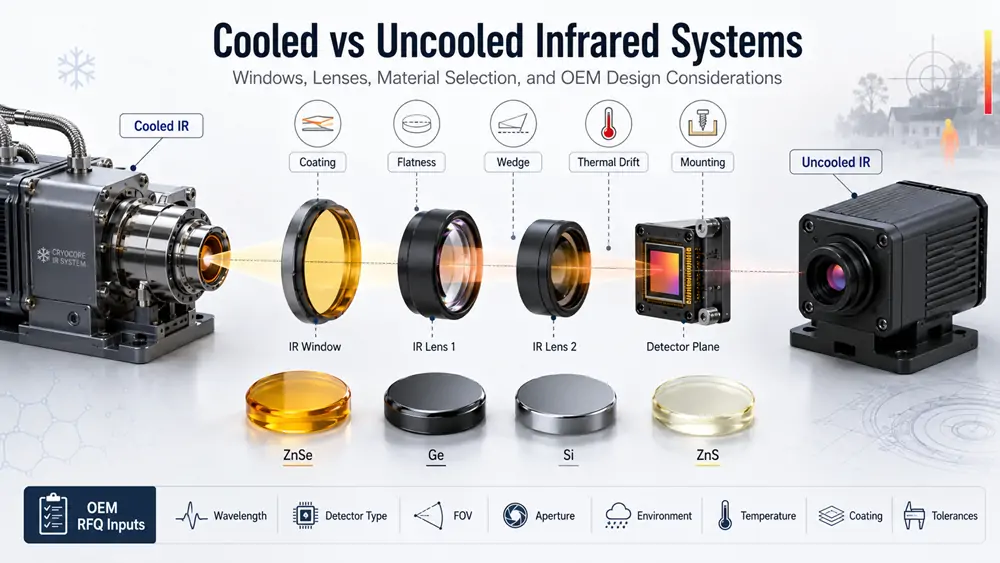
For LWIR thermal imaging, ZnSe may be considered alongside germanium, ZnS, chalcogenide glass and other IR materials. The final choice depends on image quality, durability, cost, coating, operating temperature and whether the optic is protected or exposed.
ZnSe Compared with Other IR Materials
ZnSe is not always the correct choice. It should be compared with other IR materials according to wavelength, mechanical load, durability and manufacturing risk.
| Material | Where it is often reviewed | Why it may be chosen | Main caution |
|---|---|---|---|
| CVD ZnSe | CO2 laser optics, IR windows, selected LWIR optics and spectroscopy | Broad IR usefulness and established CO2 laser component path | Relatively soft; coating, cleaning and handling must be controlled |
| Germanium | MWIR/LWIR thermal imaging lenses and windows | High refractive index and compact LWIR lens designs | Temperature behavior, density and coating durability require review |
| Silicon | SWIR and selected MWIR optics | Mechanical strength and practical manufacturability | Not a normal 8-14 µm LWIR transmission material |
| ZnS / Cleartran ZnS | Rugged windows, domes and multispectral optical paths | Durability direction for exposed or harsh environments | Grade, scatter, transmission and cost must be specified clearly |
| CaF2 | UV, visible, SWIR and selected MWIR components | Broad transmission and low refractive index in suitable bands | Mechanical fragility and wavelength cutoff must be reviewed |
Coating, Handling and Manufacturing Risks
The most common ZnSe project risks are not only material selection. They come from under-specified coating, poor handling, contamination, unclear inspection criteria or mechanical stress during assembly.
- Coating: Specify wavelength band, angle, side, target reflection and whether the optic needs protective behavior.
- Surface quality: Scratches, digs and edge chips can increase scatter or local heating, especially in laser paths.
- Cleaning: ZnSe should be handled carefully because the material is relatively soft.
- Mounting: Retaining rings, adhesives and seals can introduce stress if the mechanical design is not controlled.
- Packaging: Protective packaging matters for coated parts and polished surfaces.
RFQ Checklist for ZnSe Optical Components
For a useful engineering review and quotation, provide the following data where available.
- Application: CO2 laser, thermal imaging, spectroscopy, IR sensing, beam delivery or custom optical system.
- Wavelength: Exact band or wavelength, such as 3-5 µm, 8-14 µm or 10.6 µm.
- Component type: Window, lens, prism, beam expander element, blank, substrate or drawing-based custom part.
- Geometry: Diameter, length, width, thickness, clear aperture, focal length, wedge, radius, chamfer and tolerance.
- Optical requirements: Surface quality, flatness, wavefront, centering, parallelism and coating target.
- Laser condition: Power, duty cycle, beam diameter, cooling, contamination and replacement strategy if laser energy is involved.
- Environment: Temperature, humidity, dust, oil, salt fog, vibration, shock, cleaning and mounting method.
- Commercial data: Prototype quantity, production quantity, inspection documents, packaging and target schedule.
Related ZnSe Material and Product Paths
For material-level review, compare ZnSe material and CVD ZnSe material. For component directions, review CVD ZnSe flat windows, CVD ZnSe blanks, ZnSe windows, ZnSe lenses, ZnSe prisms and ZnSe laser system optics.
Practical Recommendation
CVD ZnSe is a strong candidate when the system requires infrared transmission, CO2 laser compatibility or custom IR windows and lenses. It should be selected through a controlled engineering review, not by material name alone.
OPTOStokes-IROptical supports ZnSe windows, lenses, prisms, blanks and drawing-based infrared optical components for laser, imaging and sensing systems. For material selection, drawing review, sample evaluation or quotation, use the contact form or email [email protected].