Cooled vs Uncooled IR Systems: Window and Lens Requirements
A practical guide to how cooled and uncooled infrared systems change requirements for IR windows, lenses, materials, coatings and OEM drawings.
Cooled and Uncooled IR Systems Need Different Front-End Optics
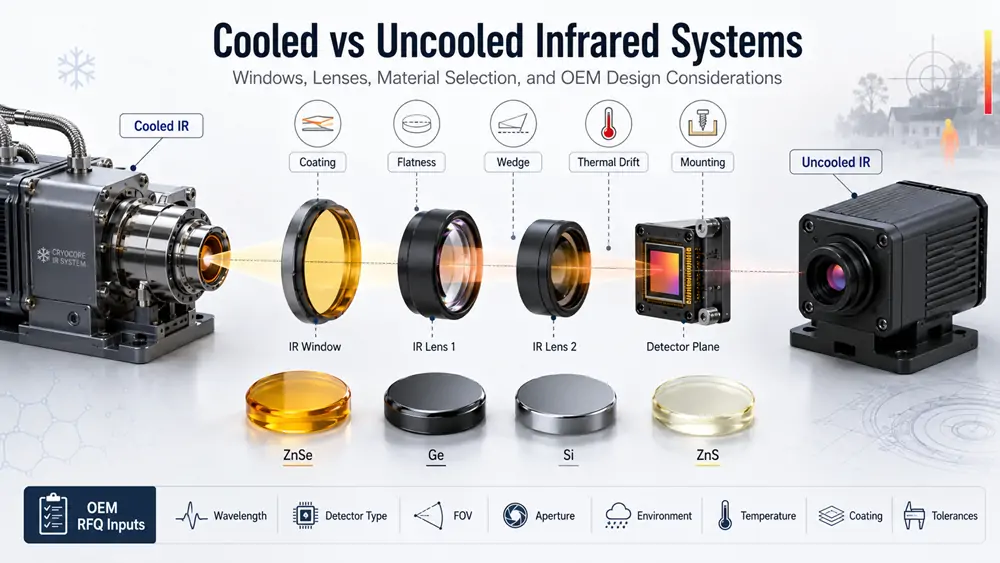
In infrared system design, many decisions begin with the detector: cooled or uncooled, MWIR or LWIR, sensitivity, frame rate and system cost. For optical engineers and OEM buyers, the front-end optics deserve the same level of review. The infrared window, lens, protective cover, coating and mechanical mount determine how much usable radiation reaches the detector and how stable the system remains in real operating conditions.
A cooled infrared system and an uncooled infrared system do not place the same requirements on windows and lenses. They differ in sensitivity, thermal environment, optical loss budget, package size, cost target and application distance. Treating the front-end optic as a generic infrared part can create avoidable risk in imaging performance, coating selection, assembly stress and production repeatability.
Why Detector Type Changes Optical Requirements
The detector architecture affects the optical component in several practical ways. A cooled detector is usually selected when the system requires higher sensitivity, longer detection range, faster response or stronger image quality. An uncooled detector is often selected when compact size, lower power, lower cost and easier integration matter more.
| Design factor | Impact on IR windows and lenses |
|---|---|
| Operating band | Defines material transmission range and coating target, such as 3-5 µm, 8-12 µm, 8-14 µm or 10.6 µm. |
| Sensitivity target | Changes tolerance for reflection loss, absorption, scattering, surface quality and stray light. |
| Thermal environment | Affects material expansion, refractive index shift, focus drift, mount stress and coating reliability. |
| Package size | Controls lens diameter, focal length, clear aperture, window thickness and mechanical envelope. |
| Application distance | Influences aperture, focal length, image quality, wavefront requirement and coating loss budget. |
| Cost target | Determines whether the design can support higher-grade material, tighter tolerances or more complex coatings. |
For this reason, an infrared window or lens should not be reviewed as an isolated part. It should be evaluated together with detector band, optical path, housing design, environmental exposure and production quantity.
Optical Priorities in Cooled Infrared Systems
Cooled infrared systems are often used where high sensitivity, long-range detection, fast response or high image quality is required. They are common in MWIR imaging, high-performance LWIR systems, scientific instruments, surveillance systems and demanding industrial inspection platforms.
Lower tolerance for optical loss
Because the detector side is designed for high sensitivity, every front-end optical surface matters. Absorption in the substrate, reflection from uncoated surfaces, coating mismatch and scattering can reduce the usable signal. In a multi-element lens assembly, small per-surface losses can accumulate into a meaningful system-level penalty.
For cooled systems, engineers usually need to confirm material transmission, AR coating band, angle of incidence, surface quality, stray-light behavior, coating absorption and the total number of optical interfaces.
Higher sensitivity to image quality and thermal stability
Cooled systems are more likely to require tighter control of focal length, field performance, aberration, surface form, center thickness and assembly alignment. If the operating temperature changes, material expansion and refractive-index change can move the focus or reduce image quality.
Flatness, parallelism, wedge, mounting stress and optical-axis control should be reviewed early, especially when the window is near the detector or the lens is part of a high-performance imaging path.
Higher system cost, lower room for optical mistakes
A cooled infrared platform usually carries higher system cost. A wrong material choice, poor coating match or stressed window can compromise the whole system. For this reason, cooled-system optics should not be selected only by lowest unit price. The safer approach is to define band, environment, optical function and mechanical limits before quotation.
Optical Priorities in Uncooled Infrared Systems
Uncooled infrared systems are widely used in thermal cameras, industrial temperature measurement, security monitoring, smart sensing, portable devices and embedded perception systems. They usually require a different balance between optical performance, manufacturability and cost.
Size, weight and production cost matter more
Uncooled systems are often compact and cost-sensitive. The window, lens and housing must support stable performance while remaining easy to assemble and suitable for production. In many volume projects, yield, repeatability and supply stability are more important than chasing the highest single-unit optical specification.
LWIR thermal imaging is common
Many uncooled thermal imaging systems operate in the LWIR band, often around 8-14 µm. The front-end optic must transmit the target band and also survive dust, moisture, cleaning, vibration, sealing load and outdoor exposure when the window is at the front of the system.
Low cost should not replace basic optical requirements
Uncooled systems can be cost-sensitive, but the optics still need proper material, thickness, coating, parallelism and mounting control. A low-cost window that introduces reflection, ghosting, image blur, stress or inconsistent transmission can increase downstream cost through rejects, field issues or customer complaints.
Window Requirements: Cooled vs Uncooled
An infrared window protects the detector, sensor package or sealed optical path while transmitting the required infrared band. The same material name can lead to different specifications depending on whether the system is cooled or uncooled.
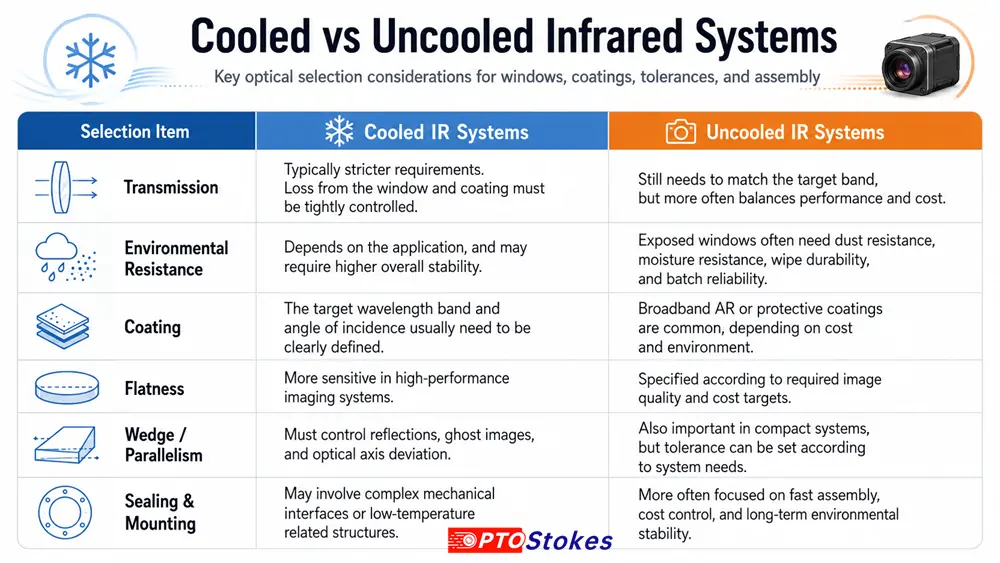
| Requirement | Cooled IR system | Uncooled IR system |
|---|---|---|
| Transmission | Usually stricter; window and coating loss must be included in the system loss budget. | Must match the detector band, but performance is often balanced with cost and manufacturability. |
| Surface quality | More sensitive in high-performance imaging paths and near-detector locations. | Defined according to image-quality target, cost and production quantity. |
| Flatness | Important when the window affects wavefront, alignment or system calibration. | Still relevant, but tolerance can often be set by the practical camera requirement. |
| Wedge or parallelism | Used to control ghost reflection, beam deviation and optical-axis errors. | Needed when reflection or ghosting affects image quality, especially in compact modules. |
| Coating | Usually requires a defined band, angle and substrate-specific AR design. | Often uses broadband AR or protective coating depending on environment and budget. |
| Mechanical exposure | May involve sealed assemblies, cold-shield geometry or sensitive alignment constraints. | Often emphasizes cleaning durability, sealing, abrasion resistance and fast assembly. |
Cooled-system windows
For cooled systems, review target-band transmission, surface quality, flatness, wedge, AR coating, stray reflection, mounting stress and thermal conditions. If the window is close to the detector or sits in a critical imaging path, small surface or alignment errors can affect final performance.
Uncooled-system windows
For uncooled systems, review cost, repeatability, environmental durability, cleaning method, coating robustness, thickness and assembly process. Exposed windows should be treated as both optical parts and mechanical barriers.
Lens Requirements: Cooled vs Uncooled
An infrared lens is more complex than a window because it forms, focuses or relays the image. Detector type changes the lens priorities because it changes the band, sensitivity, package constraints and cost target.
| Requirement | Cooled IR system | Uncooled IR system |
|---|---|---|
| Focal length | Often tied closely to detection range, field of view and image-quality target. | Often constrained by compact housing, application distance and module cost. |
| Material choice | Prioritizes band transmission, aberration control, thermal behavior and coating performance. | Prioritizes cost, weight, availability, manufacturability and consistency. |
| Coating loss | Multi-surface reflection loss can strongly affect total system performance. | Coating must be good enough for the target band and durable enough for production use. |
| Thermal drift | More critical for high-performance imaging and calibrated systems. | Still important, but tolerance is usually set by application class and cost target. |
| Mechanical envelope | May be constrained by cooled assemblies, cold shields or precision alignment. | Usually emphasizes small size, low weight and simple assembly. |
Cooled systems may need a more complete lens design review, including detector size, F-number, field angle, aperture, thermal compensation and alignment reference. Uncooled systems may accept a more cost-balanced design, but it still needs stable imaging, coating consistency and production repeatability.
Material Selection: ZnSe, Germanium, Silicon and ZnS
Material choice should start with the actual operating band, not only the detector type. The table below is a practical starting point, not a substitute for final optical design review.
| Material | Common IR use | Main strengths | Selection cautions |
|---|---|---|---|
| CVD ZnSe | IR windows, lenses, prisms and CO2 laser optics | Broad IR transmission and frequent use around 10.6 µm | Relatively soft; cleaning, handling, coating and packaging require care |
| Germanium | LWIR thermal imaging lenses and windows | High refractive index and strong use in compact LWIR imaging optics | High density, higher cost and temperature-dependent transmission behavior |
| Silicon | NIR, SWIR and selected MWIR windows or substrates | Good mechanical properties, lower density than germanium and practical manufacturability | Not a normal 8-14 µm LWIR transmission material; band must be confirmed |
| ZnS / Cleartran ZnS | MWIR/LWIR windows, multispectral windows and protective covers | Useful where broader IR transmission or exposed-window durability is required | Grade, scattering, transmission range, cost and supply condition must be confirmed |
Material tendency in cooled systems
Cooled systems usually place stronger emphasis on optical performance, coating control and thermal stability. MWIR systems may review silicon, germanium, ZnSe or ZnS. LWIR systems may review germanium, ZnSe, ZnS and selected specialty IR materials. CO2 laser optics commonly bring CVD ZnSe into early review.
Material tendency in uncooled systems
Uncooled systems usually place stronger emphasis on cost, weight, compact geometry and production consistency. Exposed windows may need protective coatings. Portable systems may prioritize low weight and mechanical strength. Volume thermal cameras may prioritize process yield, coating repeatability and supply continuity.
Coating and Surface Requirements
Coating should never be specified only as AR coating. A useful coating request should include substrate material, wavelength band, angle of incidence, one-side or two-side coating, environmental exposure and whether laser power is involved.
- MWIR coating: Often specified around 3-5 µm for cooled imaging or gas-sensing systems.
- LWIR coating: Often specified around 8-12 µm or 8-14 µm for thermal imaging systems.
- CO2 laser coating: Often specified at 10.6 µm, with attention to absorption, beam size, power density and contamination control.
- Protective coating: May be needed for exposed windows that face wiping, dust, humidity or abrasion.
- DLC coating: Often reviewed for selected germanium windows, but it should not be assumed suitable for every material or wavelength.
Common Specification Mistakes
| Mistake | Why it creates risk | Better approach |
|---|---|---|
| Only saying thermal imaging window | The supplier cannot know whether the system is cooled, uncooled, MWIR or LWIR. | State detector type, operating band and application environment. |
| Choosing only by material transmission | Flatness, wedge, coating, stress and temperature can dominate final performance. | Review optical, mechanical and environmental constraints together. |
| Treating low cost as the only uncooled-system target | Inconsistent windows can reduce image quality and increase field risk. | Balance cost with repeatability, coating durability and assembly stability. |
| Ignoring thermal drift | Focus shift can reduce image quality across temperature. | Share operating temperature range and mounting method during review. |
| Requesting exact quotation without a drawing | Geometry, chamfer, clear aperture and coating zone affect manufacturability. | Provide a drawing or at least dimensions, tolerance and coating target. |
OEM Inquiry Checklist
For a practical review of cooled or uncooled infrared windows and lenses, prepare the following information before quotation.
- System type: Cooled or uncooled detector, imaging, sensing, spectroscopy or laser use.
- Wavelength: Exact operating band such as 3-5 µm, 8-14 µm or 10.6 µm.
- Component type: Window, lens, protective cover, prism, blank or drawing-based custom part.
- Optical requirements: Clear aperture, transmission target, surface quality, flatness, parallelism, wedge and coating curve if available.
- Mechanical data: Diameter, length, width, thickness, tolerance, chamfer, steps, holes, slots and drawing files.
- Coating details: AR band, one-side or two-side coating, protective coating, DLC requirement or laser power condition.
- Environment: Temperature range, indoor or outdoor use, humidity, dust, oil, salt fog, vibration, shock and sealing method.
- Commercial data: Prototype quantity, production quantity, target delivery schedule, inspection report and packaging requirements.
Related IR Material and Product Paths
For material comparison, review ZnSe material, germanium material, silicon material and ZnS material. For component directions, compare ZnSe windows, germanium windows, ZnSe lenses and the broader IR optical components catalog.
Engineering Recommendation
The safest selection flow is straightforward: confirm whether the system is cooled or uncooled, define the actual wavelength band, review the application environment, choose the material route, and then release the drawing and coating target for manufacturing review.
Cooled systems usually require tighter control of transmission, surface quality, thermal stability and stray loss. Uncooled systems usually require a stronger balance of cost, size, repeatability and environmental durability. Neither path should be specified by material name alone.
For drawing review, material selection, coating direction, sample evaluation or quotation, send the wavelength band, component type, drawing, coating target, environment and quantity through the contact form or email [email protected]. OPTOStokes-IROptical can help review whether ZnSe, germanium, silicon, ZnS or another IR material route is practical for your cooled or uncooled infrared system.