Infrared Atmospheric Windows and Material Selection
A practical guide to how the 3-5 um and 8-14 um infrared atmospheric windows affect IR material selection, coatings, windows, lenses and protective optics.
Start with the Infrared Window
Infrared material selection should start with the operating wavelength, not the material name. In thermal imaging, gas detection, spectroscopy, CO2 laser delivery and IR sensing, the first engineering question is whether the system works inside a useful infrared atmospheric window.
Infrared radiation does not travel through air equally at all wavelengths. Water vapor, carbon dioxide, ozone, methane and other atmospheric gases absorb selected bands. The wavelength regions with lower absorption and better transmission are commonly called infrared atmospheric windows.
For many engineering projects, the most important windows are the 3-5 µm MWIR window and the 8-14 µm LWIR window. These bands influence the material, coating, lens form, window thickness, inspection method and environmental design of the optical component.
Why 3-5 um and 8-14 um Matter
| Atmospheric window | Common name | Typical range | Engineering use | Common applications |
|---|---|---|---|---|
| Mid-wave infrared window | MWIR | 3-5 µm | Useful for hot targets and selected gas absorption features | MWIR imaging, gas detection, high-temperature monitoring and IR search systems |
| Long-wave infrared window | LWIR | 8-14 µm | Useful for passive thermal imaging of room-temperature targets | Thermal cameras, night vision, industrial thermography, security and environmental monitoring |
| CO2 laser wavelength | CO2 laser | 10.6 µm | Laser transmission and beam delivery inside the LWIR region | CO2 laser protective windows, focusing lenses and beam-control optics |
The exact operating wavelength should still be specified. A request that only says MWIR or LWIR is often too broad for coating design, material confirmation and production quotation. A drawing or inquiry should state values such as 3-5 µm, 8-12 µm, 8-14 µm or 10.6 µm.
Atmospheric Transmission Is Only the First Filter
A material transmission curve is useful, but it is not enough for a production decision. A material that transmits the target band may still fail if it is too fragile, too soft, too heavy, thermally unstable, difficult to coat or unsuitable for the installation environment.
Mechanical strength
IR windows and protective covers often face sealing load, wiping, dust, airflow, vibration, impact and temperature cycling. Fluoride materials can offer broad transmission, but mechanical strength and thermal shock must be reviewed. Germanium is common in LWIR optics, but its density affects weight-sensitive systems. ZnSe is important for CO2 laser and IR optics, but surface handling and cleaning require care.
Thermal behavior
Temperature change can shift focus in an IR lens system and create stress in windows, coatings and mounts. For high-power laser optics, even low absorption can create thermal effects. The material review should consider thermal expansion, thermal conductivity, refractive index change with temperature and the mounting design.
Coating compatibility
Infrared materials usually need coatings. Germanium, silicon and ZnSe have relatively high refractive indices, so uncoated surfaces can create significant reflection loss. AR coating, protective coating and DLC coating decisions should be made together with the material choice, not after the component has already been released for quotation.
Common Infrared Materials by Window
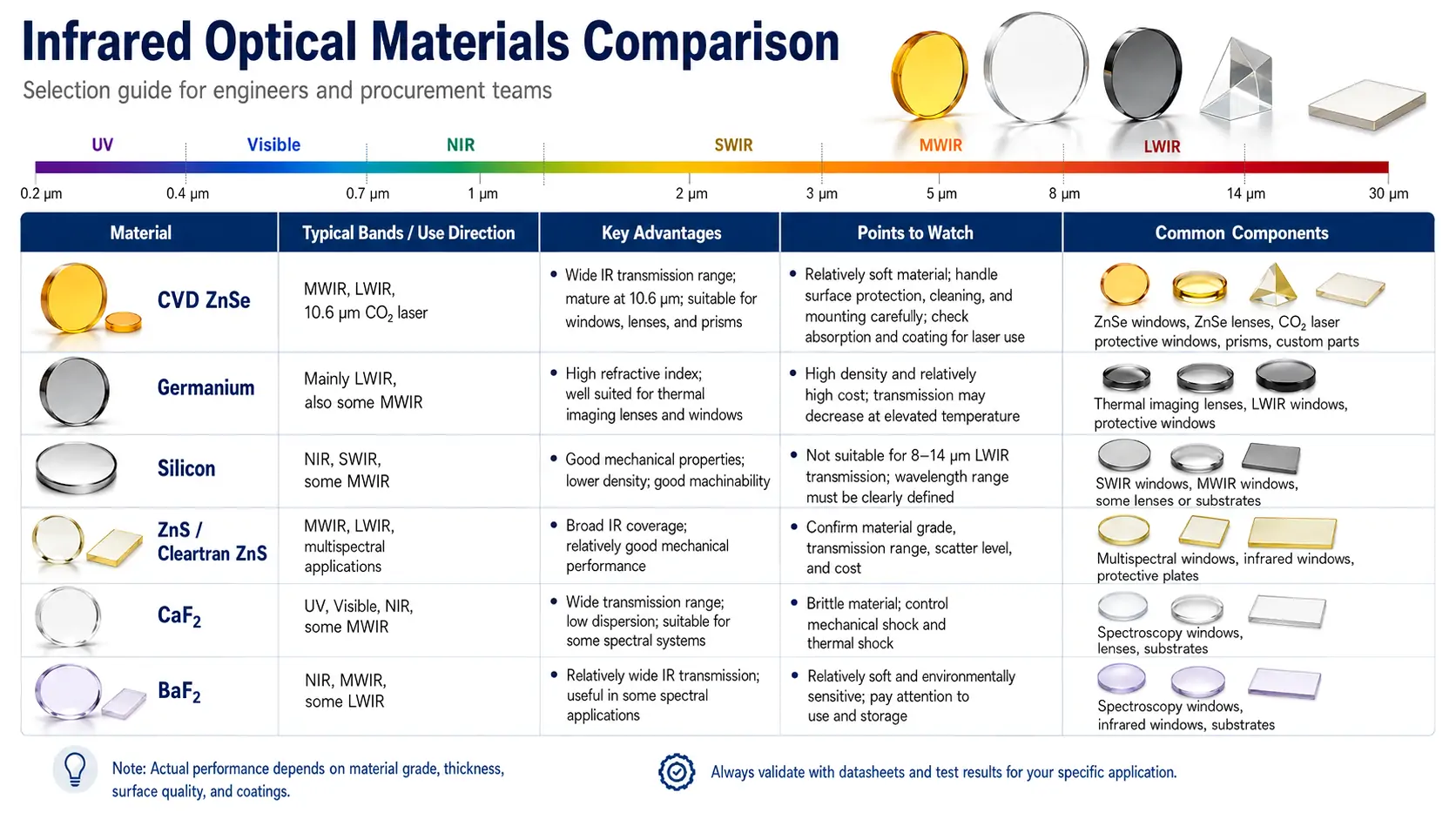
| Material | Typical review band | Main strengths | Selection cautions | Common components |
|---|---|---|---|---|
| CVD ZnSe | MWIR, LWIR and 10.6 µm CO2 laser | Broad IR transmission and mature use in CO2 laser optics | Relatively soft; coating, polishing, cleaning and handling must be controlled | ZnSe windows, lenses, mirrors, prisms, protective covers and custom parts |
| Germanium | Mainly LWIR, also selected MWIR | High refractive index and common use in thermal imaging optics | High density, higher cost and possible transmission reduction at elevated temperature | Thermal imaging lenses, LWIR windows and protective covers |
| Silicon | NIR, SWIR and selected MWIR | Good mechanical properties, lower density than germanium and practical manufacturability | Usually not suitable as an 8-14 µm LWIR transmission material | SWIR windows, MWIR windows, substrates and selected lenses |
| ZnS / Cleartran ZnS | MWIR and LWIR | Useful for multispectral IR windows and more exposed environments | Grade, scattering, transmission range and cost must be confirmed | Multispectral windows, IR windows and protective covers |
| CaF2 | UV, visible, NIR and selected MWIR | Broad transmission and low dispersion | Mechanical fragility and thermal shock should be reviewed | Spectroscopy windows, lenses and substrates |
| BaF2 | NIR, MWIR and selected LWIR use | Wide spectral transmission for selected spectroscopy systems | Softness and environmental sensitivity require careful handling and storage | Spectroscopy windows, IR windows and substrates |
How Application Changes the Material Choice
Thermal imaging
Thermal imaging systems commonly work in MWIR or LWIR. For LWIR thermal cameras, germanium, ZnSe, ZnS and selected chalcogenide glasses are often reviewed. The final decision depends on detector band, lens design, environmental exposure, coating durability, thermal drift, weight and cost.
Gas detection and IR sensing
Gas detection is tied to specific absorption wavelengths. The window material must match the target gas band, optical path length, sealing requirement and chemical environment. If the window contacts gas directly, chemical stability and coating durability become important selection factors.
Infrared spectroscopy
FTIR, ATR and other IR spectroscopy systems require close attention to spectral range, sample compatibility, surface quality and cleaning method. ZnSe, CaF2, BaF2, KBr, sapphire, silicon and germanium can all be relevant, but the sample chemistry and operating environment must be reviewed before final selection.
CO2 laser optics
CO2 lasers commonly operate at 10.6 µm. CVD ZnSe is frequently reviewed for transmissive CO2 laser windows, focusing lenses and beam delivery optics. For high-power use, material absorption, coating absorption, beam diameter, surface quality, contamination control and cooling conditions must be confirmed.
Exposed protective windows
A protective window is both an optical component and a mechanical barrier. If the optic is installed at the front of a sensor, laser system or outdoor enclosure, durability can be more important than peak transmission. Dust, oil, humidity, salt fog, wiping, vibration and sealing stress should all be considered.
Coating and Surface Requirements
AR coating
AR coating should be specified by wavelength range, material, angle of incidence and whether the coating is required on one side or both sides. A generic request for AR coating is not enough. Better examples include AR coating for 3-5 µm, AR coating for 8-12 µm, AR coating for 8-14 µm or AR coating at 10.6 µm.
DLC and protective coatings
DLC coating is often considered for selected germanium windows where abrasion and environmental resistance matter. It is not automatically suitable for every material or every wavelength. Protective coatings may also be used to improve moisture resistance, abrasion resistance, chemical stability or cleaning durability.
Surface quality and geometry
Surface quality, flatness, parallelism, wedge, chamfer, diameter tolerance, thickness tolerance and clear aperture all affect performance. Imaging optics are sensitive to wavefront and alignment error. Laser optics are sensitive to defects, contamination and coating absorption. Protective windows are sensitive to stress, sealing and edge quality.
Common Selection Mistakes
| Mistake | Why it creates risk | Better approach |
|---|---|---|
| Choosing by transmission range only | Strength, coating, thermal behavior and environment may dominate failure risk | Review optical, mechanical, thermal and environmental requirements together |
| Treating 3-5 µm and 8-14 µm as the same IR need | MWIR and LWIR materials, coatings and detectors differ significantly | Specify the exact operating band and detector or laser condition |
| Assuming all IR materials work for CO2 laser | 10.6 µm laser optics require low absorption, coating control and high surface quality | Provide power, beam size, duty cycle and coating target |
| Ignoring the exposure environment | Outdoor windows can fail from abrasion, humidity, sealing stress or contamination | Define cleaning method, sealing method and environmental load |
| Requesting quotation without a drawing | Dimensions, chamfers, clear aperture and coating zones affect manufacturability | Send a drawing or at least dimensions, tolerance and application notes |
Engineering Checklist Before Inquiry
- Wavelength: Define the exact operating wavelength or band, such as 3-5 µm, 8-14 µm or 10.6 µm.
- Component type: State whether the part is a window, protective cover, lens, prism, mirror, blank or custom drawing component.
- Material direction: Confirm whether the material is fixed or open for supplier review.
- Optical requirements: Provide transmission target, surface quality, flatness, parallelism, wedge, clear aperture and coating curve if available.
- Coating: Define AR band, one-side or two-side coating, protective coating, DLC requirement or laser use.
- Environment: Describe temperature, humidity, outdoor exposure, dust, oil, gas contact, vibration, impact and sealing conditions.
- Production need: Provide sample quantity, production quantity, inspection report needs and packaging requirements.
Related IR Material and Product Paths
For additional material review, compare ZnSe material properties, germanium material, CaF2 material and the broader IR material selection guide. For component options, review IR optical components, including windows, lenses, prisms and drawing-based custom parts.
Request Material and Coating Review
Infrared atmospheric windows define the useful spectral path, but the final optic must also survive the real mechanical, thermal, coating and manufacturing constraints. Share your target wavelength, environment, mechanical drawing, material preference, coating target and quantity through the contact form or email [email protected]. OPTOStokes-IROptical can help review whether ZnSe, germanium, silicon, ZnS, CaF2, BaF2 or another route is more practical for the application.