IR Windows and Lenses for Thermal Imaging Systems
A practical guide for selecting infrared windows and lenses in thermal imaging systems by MWIR/LWIR band, material, coating, environment and drawing requirements.
Thermal Imaging Optics Need System-Level Selection
In a thermal imaging system, the infrared window and infrared lens are not secondary accessories. They determine how much useful radiation reaches the detector, how stable the image remains across temperature, and how well the system survives dust, moisture, vibration, cleaning and outdoor exposure.
Many image-quality problems appear late in development as haze, temperature drift, stray reflections, ghost images, reduced contrast or shortened outdoor service life. The root cause is often not the detector or algorithm. It is more often an early mismatch between wavelength band, material, coating, mechanical design and application environment.
This guide explains how engineers and OEM buyers can review infrared windows and lenses for thermal imaging systems before releasing drawings or purchasing parts. The focus is practical: MWIR and LWIR band fit, material selection, coating strategy, environmental durability, tolerances and inquiry data.
Start with the Thermal Imaging Band
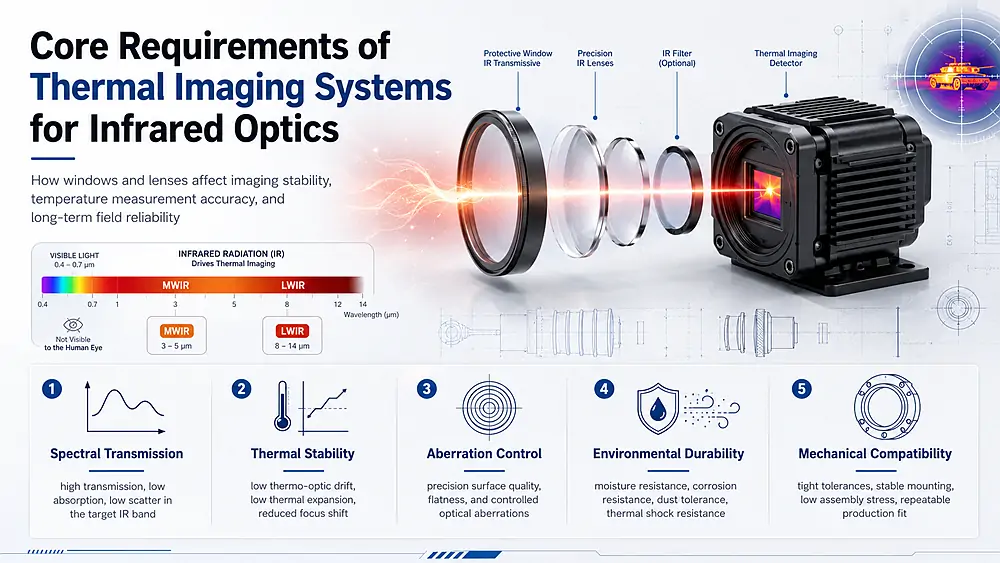
Thermal imaging optics should be specified from the actual operating band. Writing only thermal imaging window or IR lens is not enough for material and coating review. MWIR and LWIR systems place different demands on transmission, material behavior, detector architecture and environmental design.
| Band | Common range | Typical imaging role | Common system notes |
|---|---|---|---|
| MWIR | About 3-5 µm | High-temperature targets, gas-related bands and long-range thermal observation | Often used with cooled detectors and tighter optical loss budgets |
| LWIR | About 8-12 µm or 8-14 µm | Passive thermal imaging of room-temperature objects and general thermal cameras | Common in uncooled systems where size, cost, stability and production repeatability matter |
| CO2 laser reference | Often 10.6 µm | Laser beam delivery, protective optics and process monitoring | Requires separate review of absorption, coating, power density and contamination control |
Exact band definitions can vary by detector and application. For production optics, provide the real detector band or wavelength range, such as 3-5 µm, 8-12 µm, 8-14 µm or 10.6 µm.
Core Requirements for Thermal Imaging Windows and Lenses
A thermal imaging optic must transmit the useful infrared band while limiting losses that reduce image contrast or measurement repeatability. The practical requirements are broader than transmission alone.
| Requirement | Why it matters | Engineering review point |
|---|---|---|
| Band-matched transmission | Wrong material or coating can block the detector band | Confirm MWIR/LWIR range, substrate and coating together |
| Low absorption and scatter | Losses reduce signal and can increase haze or image noise | Review material grade, surface quality, thickness and coating |
| Thermal stability | Temperature change can shift focus or distort the optical path | Check thermal expansion, refractive-index shift and mount stress |
| Stray-light control | Ghost reflections can reduce contrast or create false features | Review wedge, parallelism, coating reflection and mechanical blackening |
| Environmental durability | Outdoor and industrial systems face dust, humidity, cleaning and shock | Define protective coating, sealing method, edge quality and handling process |
| Production repeatability | Batch variation can cause inconsistent image or calibration behavior | Lock drawing, tolerance, coating and inspection criteria before volume release |
Infrared Window Selection for Thermal Imaging
An infrared window protects the detector, sealed enclosure or front optical path while transmitting the target band. Compared with lenses, windows usually place more emphasis on environmental exposure, coating durability, sealing load, clear aperture and mechanical strength.
Window material starting points
| Material | Typical window use | Strengths | Cautions |
|---|---|---|---|
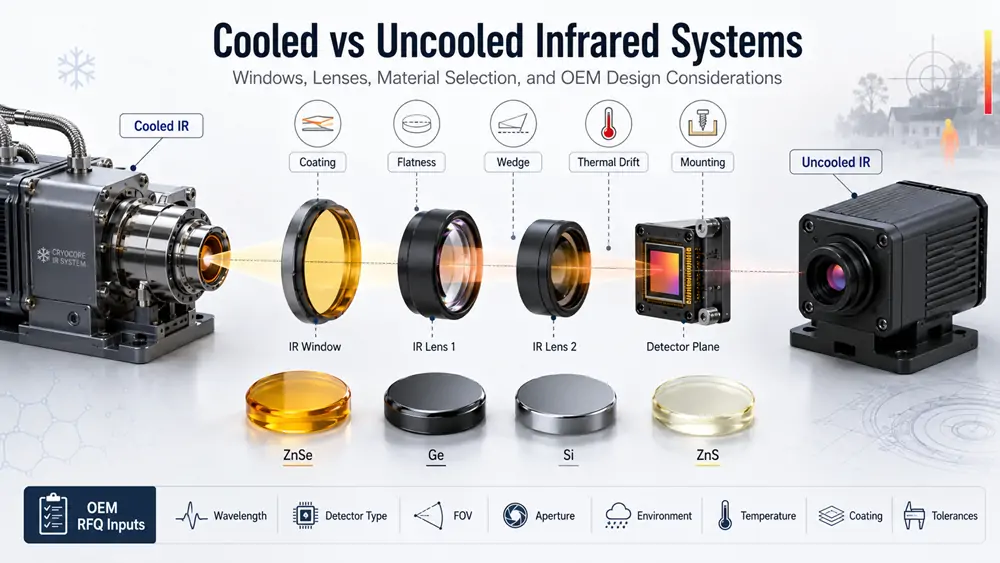
| CVD ZnSe | LWIR windows, CO2 laser-related windows and broadband IR paths | Broad IR transmission and common use around 10.6 µm | Relatively soft; needs careful cleaning, packaging and coating control |
| ZnS / Cleartran ZnS | Rugged MWIR/LWIR windows, domes and exposed protective covers | Good durability direction for harsh environments and multispectral requirements | Grade, scatter, transmission and cost must be specified clearly |
| Germanium | MWIR/LWIR thermal imaging windows in protected or controlled systems | High refractive index and established use in thermal imaging | Temperature behavior, density and coating durability need review |
| Silicon | NIR, SWIR and selected MWIR windows | Good mechanical strength and practical manufacturability | Not a normal 8-14 µm LWIR transmission material |
For exposed thermal camera windows, do not choose material by transmission curve alone. Review cleaning contact, dust, water, salt fog, oil, vibration, sealing load and whether a protective coating is required.
Infrared Lens Selection for Thermal Imaging
An infrared lens forms the image. It is more sensitive than a simple window to refractive index, dispersion, focal length, F-number, field of view, surface form, center thickness, coating and thermal drift. Lens material selection must be reviewed with the detector size, target distance, package size and image-quality requirement.
LWIR lens material review
Germanium is common in LWIR thermal imaging lenses because its high refractive index supports compact optical designs. It is widely used in security, industrial inspection and thermal camera assemblies. The main caution is temperature-dependent optical behavior, which may require athermal design, compensation or a controlled operating range.
ZnSe can also be reviewed for selected LWIR systems, especially when broadband IR transmission, laser-related compatibility or specific system constraints are important. Its relative softness and coating requirements should be accounted for in handling and assembly.
MWIR lens material review
MWIR systems often review silicon, germanium, ZnSe, ZnS, CaF2 or other IR materials depending on detector band, aperture, temperature and image quality. Silicon can be attractive in selected MWIR designs because of its mechanical properties and lower density compared with germanium, but the final band must be confirmed.
Rugged lens or front-element review
For outdoor, vehicle, marine or harsh industrial systems, mechanical durability and environmental stability may be as important as theoretical optical transmission. ZnS or Cleartran ZnS may be reviewed for exposed positions or rugged assemblies where cleaning, abrasion, shock or weathering creates higher risk.
Coating Strategy for Thermal Imaging Optics
AR coating should never be specified only as AR coating. A useful coating request should include substrate, wavelength range, angle of incidence, one-side or two-side coating, environmental exposure, cleaning method and any laser or high-temperature condition.
- MWIR AR coating: Usually designed around a defined 3-5 µm band or a narrower detector-specific range.
- LWIR AR coating: Commonly specified around 8-12 µm or 8-14 µm for thermal imaging cameras.
- Protective coating: May be needed when the optic is exposed to wiping, humidity, dust, oil, salt fog or abrasion.
- DLC coating: Often reviewed for selected germanium windows, but it should not be assumed suitable for every material or wavelength.
- Laser-related coating: Requires separate review of wavelength, power density, beam size, absorption and contamination risk.
For precision thermal imaging systems, coating loss is part of the optical budget. In multi-element lenses, small per-surface losses can accumulate and affect detector signal, contrast and calibration stability.
Mechanical and Environmental Design Factors
Material and coating can meet the specification and still fail if the mechanical design is not controlled. The window or lens must be integrated with the housing, mount, seal and inspection process.
| Factor | Risk if ignored | What to define |
|---|---|---|
| Clear aperture | Edge clipping, vignetting or reduced effective field | Minimum clear aperture, physical size and coating zone |
| Thickness | Weakness, excess absorption, added weight or stress sensitivity | Thickness, tolerance, pressure load and support method |
| Flatness or surface form | Wavefront error, blur or calibration variation | Flatness, surface quality and inspection method |
| Parallelism or wedge | Ghosting, beam deviation or stray reflections | Parallelism, wedge angle and acceptable beam shift |
| Mounting stress | Distortion, cracking, focus shift or seal failure | Retaining method, adhesive zone, gasket and torque limits |
| Edge quality | Chipping, crack initiation or sealing problems | Chamfer, bevel, edge polish and packaging requirement |
Common Specification Mistakes
| Mistake | Why it creates risk | Better approach |
|---|---|---|
| Specifying only thermal imaging optic | The material and coating cannot be selected reliably | State MWIR or LWIR band, detector type and application environment |
| Choosing by material name only | Grade, coating, thickness and surface quality may be unsuitable | Review material, geometry, coating and inspection as one package |
| Using silicon for LWIR transmission | Silicon is not a normal 8-14 µm transmissive material | Review germanium, ZnSe, ZnS or other LWIR-compatible materials |
| Ignoring temperature behavior | Focus drift can affect image quality and temperature measurement | Share operating temperature range and thermal cycling requirements |
| Requesting quotation without a drawing | Manufacturability and cost depend on size, tolerance, edge and coating zone | Provide a drawing or at least a complete dimensional checklist |
Inquiry Checklist for Thermal Imaging Windows and Lenses
Before requesting a quotation, prepare the following information where available. This reduces technical back-and-forth and prevents wrong material or coating assumptions.
- System type: Thermal camera, industrial temperature measurement, vehicle night vision, fire search, security, inspection or custom sensor.
- Detector and band: Cooled or uncooled detector, MWIR, LWIR, exact wavelength range or detector response band.
- Component type: Window, lens, front cover, protective optic, blank, prism or drawing-based custom part.
- Material preference: ZnSe, germanium, silicon, ZnS, Cleartran ZnS or open material review.
- Geometry: Diameter, length, width, thickness, clear aperture, wedge, step, chamfer, holes or custom shape.
- Optical specifications: Surface quality, flatness, wavefront requirement, parallelism, transmission target and reflection target.
- Coating: MWIR/LWIR band, one-side or two-side coating, protective coating, DLC requirement or durability condition.
- Environment: Temperature range, humidity, dust, oil, salt fog, vibration, shock, pressure, cleaning and sealing method.
- Commercial data: Prototype quantity, production quantity, required inspection documents, packaging and target schedule.
Related Materials and Product Paths
For material review, compare ZnSe material, germanium material, silicon material and ZnS material. For component directions, review ZnSe windows, ZnSe lenses, germanium windows, silicon windows and ZnS windows.
Practical Recommendation
The safe selection flow is straightforward: define the thermal imaging band, identify whether the optic is a window or lens, review environmental exposure, choose a material route, then finalize coating, tolerance and mounting details.
Windows usually prioritize protection, transmission stability and environmental durability. Lenses prioritize imaging performance, focus stability, aberration control and coating loss. Treating both parts as generic IR optics can create avoidable risk in image quality, measurement repeatability and production consistency.
OPTOStokes-IROptical supports infrared windows, lenses, protective optics and drawing-based custom components for thermal imaging and sensing systems. For material selection, drawing review, sample evaluation or quotation, use the contact form or email [email protected].