Single-Crystal Germanium for Infrared Optics
A practical guide to single-crystal germanium material properties, LWIR applications, coating risks and selection checks for infrared windows and lenses.
Why Single-Crystal Germanium Matters in Infrared Optics
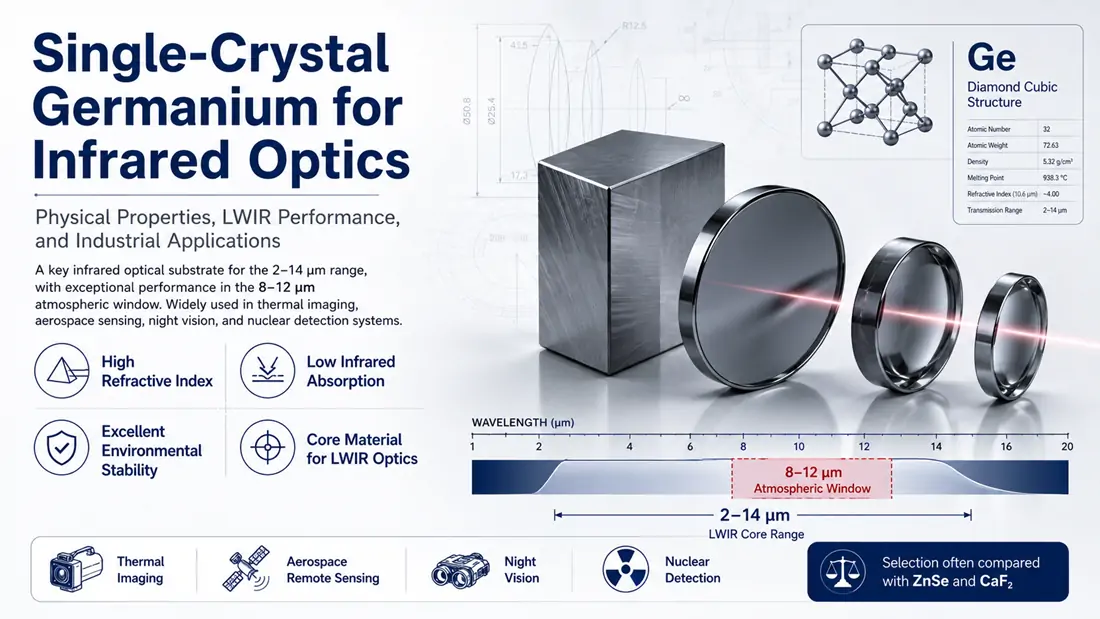
Single-crystal germanium is one of the most important high-index materials for long-wave infrared optical systems. It is commonly selected for LWIR thermal imaging windows, compact infrared lenses, protective covers and coated optical assemblies where the system operates mainly in the 8-14 µm region.
Germanium is not a universal infrared material. It offers strong advantages in compact LWIR designs, but it also brings practical engineering tradeoffs: high density, high surface reflection without coating, temperature-dependent optical behavior and procurement sensitivity to grade, coating and inspection requirements.
This guide explains how engineers and buyers should evaluate single-crystal germanium for infrared optics, when to compare it with ZnSe, CaF2, BaF2, silicon or ZnS, and what information should be included before requesting a quotation.
Material Overview
Germanium, chemical symbol Ge, is a crystalline semiconductor material with a diamond-cubic structure. Infrared-grade single-crystal germanium is used when optical uniformity, high refractive index and LWIR transmission are required in a precision component.
In optical procurement, the important question is not only whether the material is germanium. The project should also define crystal grade, usable wavelength band, component geometry, coating target, surface quality, thickness, mounting environment and operating temperature.
| Property | Typical engineering reference | Selection impact |
|---|---|---|
| Material | Single-crystal Germanium (Ge) | Used for high-index infrared windows and lenses |
| Typical useful IR range | Approximately 2-14 µm, depending on grade, thickness and coating | Best reviewed for MWIR/LWIR systems, especially thermal imaging optics |
| Core LWIR band | 8-14 µm | Common for thermal camera lenses and protective windows |
| Refractive index | About 4.0 near 10.6 µm | Supports compact optical layouts, but increases reflection without AR coating |
| Density | About 5.33 g/cm3 | Weight should be checked in handheld, airborne or moving systems |
| Knoop hardness | About 780 kg/mm2 | Suitable for precision optics, but coating and cleaning still matter |
| Thermal behavior | Temperature-sensitive optical performance | Athermal design or temperature review may be required |
Key Optical Advantages
High Refractive Index for Compact Designs
Germanium has a high refractive index compared with many infrared optical materials. This helps optical designers reduce element count or shorten the optical path in compact thermal imaging systems. It is one reason germanium remains common in LWIR camera lenses and objective assemblies.
Useful LWIR Transmission
Germanium is widely reviewed for systems operating around 8-12 µm or 8-14 µm. These bands are important for thermal imaging, industrial temperature monitoring, security optics, gas detection and many sensor-protection applications.
Stable Material Platform for Coated Components
Germanium can be manufactured into flat windows, plano-convex lenses, aspheric lenses and custom drawing-based parts. In most practical transmission designs, AR coating is required because uncoated germanium surfaces reflect strongly. For exposed windows, a protective coating may also be reviewed.
Engineering Limitations to Confirm Early
Germanium should not be selected only because it is common in thermal imaging. The following limitations should be reviewed before drawings and quotations are finalized.
- Temperature effect: optical behavior changes with temperature, so focus shift and transmission behavior must be reviewed in systems exposed to heat.
- Weight: germanium is relatively dense, which can matter in handheld devices, drones, airborne payloads and moving assemblies.
- Reflection: uncoated germanium has high surface reflection, so coating design is normally part of the real optical specification.
- Coating durability: outdoor windows may require AR plus protective coating review, depending on abrasion, cleaning and environmental exposure.
- Laser use: do not assume germanium is suitable for high-power CO2 laser transmission; absorption, thermal load and coating limits must be reviewed separately.
Typical Industrial Applications
| Application | Why germanium is considered | What to confirm |
|---|---|---|
| LWIR thermal imaging lenses | High-index material supports compact lens designs | Operating band, focal length, temperature range, coating and mounting stress |
| Infrared protective windows | Useful LWIR transmission and mechanical stability for sensor covers | Clear aperture, thickness, coating durability, cleaning method and sealing load |
| Industrial thermography | Compatible with many 8-14 µm thermal measurement systems | Transmission target, field environment, contamination and calibration needs |
| Gas detection and sensing optics | Can fit selected IR sensing paths where wavelength and coating align | Exact wavelength, angle of incidence, surface quality and reflection limit |
| Custom IR optical assemblies | Can be processed into windows, lenses and drawing-based components | Drawing tolerances, inspection grade, edge finish, coating and packaging |
Germanium Compared with Other IR Materials
No infrared material is best for every system. Germanium is often strong for compact LWIR imaging, while ZnSe, CaF2, BaF2, silicon and ZnS may be better in other wavelength, laser, cost, weight or environmental conditions.
| Material | Typical fit | Main advantage | Selection caution |
|---|---|---|---|
| Germanium (Ge) | LWIR thermal imaging windows and lenses | High refractive index and compact optical design potential | Temperature behavior, density and coating must be reviewed |
| CVD ZnSe | CO2 laser optics and broadband IR components | Useful transmission around 10.6 µm and broad IR application range | Relatively soft; handling, cleaning and coating control are important |
| Calcium Fluoride (CaF2) | UV, NIR and selected IR windows or lenses | Broad UV-to-IR coverage and low dispersion | Mechanical brittleness and long-wave IR limits must be checked |
| Barium Fluoride (BaF2) | Broadband IR optics in controlled environments | Wide transmission range | Moisture sensitivity and handling risk can limit field use |
| Silicon (Si) | NIR, SWIR and selected MWIR optics | Lower density than germanium and strong mechanical properties | Not a normal 8-14 µm transmissive LWIR material |
| ZnS / Cleartran ZnS | Rugged IR windows and multispectral covers | Useful durability for exposed optics depending on grade | Grade, scatter, transmission and cost must be specified clearly |
When Germanium Is a Strong Starting Choice
- The system operates mainly in the LWIR band and needs a compact optical layout.
- The component is a thermal camera lens, sensor window or protected IR optical element.
- Weight is acceptable for the mechanical package.
- The operating temperature range is defined and can be compensated or controlled.
- The coating target, surface quality and environmental exposure can be specified before production.
When Another Material May Be Better
- For transmissive CO2 laser optics near 10.6 µm, CVD ZnSe is often reviewed first.
- For UV-to-NIR or broadband spectroscopy work below the LWIR region, CaF2 or BaF2 may be part of the material review.
- For SWIR or selected MWIR designs where lower weight is important, silicon may be more practical.
- For exposed windows that require stronger environmental durability, ZnS or coated germanium should be compared based on the actual exposure.
RFQ Checklist for Germanium Optics
To reduce quotation rework, provide the following information when requesting single-crystal germanium windows, lenses or custom optics.
- Operating wavelength or wavelength band, such as 3-5 µm, 8-12 µm or 8-14 µm.
- Component type: window, plano-convex lens, aspheric lens, blank, protective cover or custom drawing.
- Clear aperture, outside diameter, thickness, wedge, chamfer and any mounting features.
- Surface quality, flatness, wavefront, centration or focal-length requirements where applicable.
- Coating target, coating side, angle of incidence and environmental durability requirements.
- Operating temperature range, cleaning exposure, humidity, vibration, shock or sealing load.
- Quantity, inspection requirements, packaging requirements and target delivery schedule.
Related Germanium Optics
For material reference, review Germanium (Ge) optical material. For component routes, compare germanium windows, germanium plano-convex lenses, germanium aspheric lenses and broader germanium optics.
Request Engineering Review
OPTOStokes-IROptical can review wavelength band, drawing, coating target, size, tolerance and application environment for germanium infrared optics. For material selection, sample review or quotation, use the contact form or email [email protected].