Lithium Fluoride (LiF) Optical Crystal Guide
A practical guide to Lithium Fluoride (LiF) optical crystal properties, DUV applications, material comparisons and RFQ checks for UV and IR optics.
Why Lithium Fluoride Matters for DUV Optics
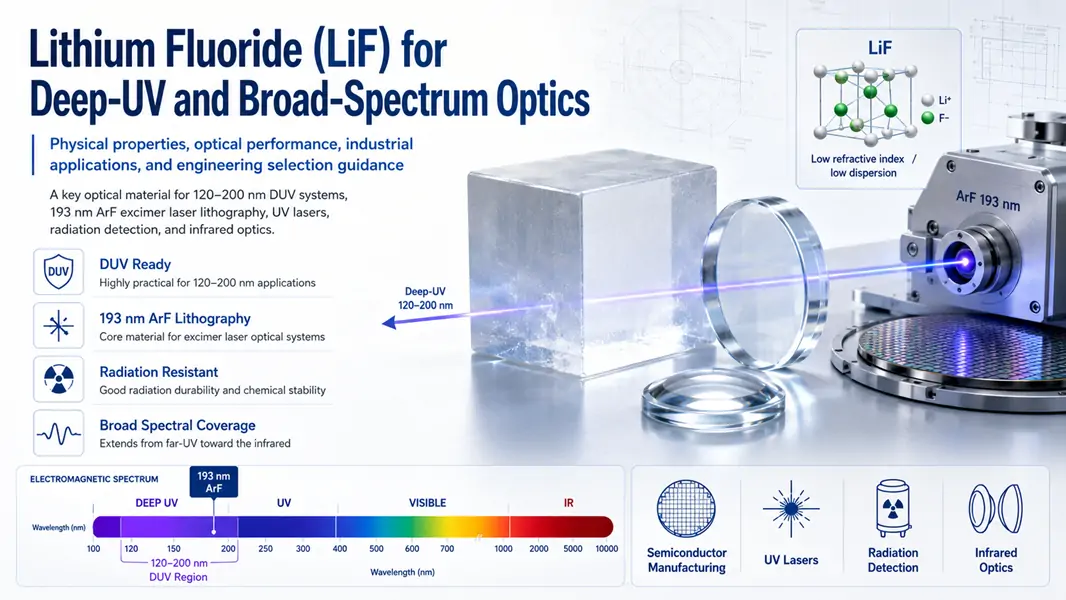
Lithium Fluoride (LiF) is a specialist optical crystal used when very short ultraviolet transmission, low refractive index and broad spectral coverage are important. It is often reviewed for deep ultraviolet optics, excimer laser components, spectroscopy windows, radiation-related optical systems and selected infrared optical paths.
LiF is not a general-purpose replacement for harder optical glasses or more robust fluoride crystals. Its value comes from deep ultraviolet transmission and low dispersion, but practical use depends on humidity control, surface protection, handling discipline, coating compatibility and mechanical design.
This guide explains how engineers and technical buyers should evaluate LiF, how it compares with CaF2, MgF2 and fused silica, and what information should be included before requesting a custom optical component review.
Material Overview
Lithium Fluoride is an alkali-halide ionic crystal with a cubic crystal structure. In optical procurement, it is normally discussed as a UV-to-IR crystal material rather than a standard visible optical glass.
For real component selection, the material name alone is not enough. The project should define wavelength, laser exposure if any, clear aperture, thickness, coating target, humidity condition, cleaning method, surface quality and packaging requirement.
| Property | Typical engineering reference | Selection impact |
|---|---|---|
| Material | Lithium Fluoride (LiF) | Specialty crystal for UV, DUV and selected IR optical paths |
| Typical transmission range | Approximately 0.11-7 µm, depending on grade, thickness and surface condition | Supports deep ultraviolet through selected infrared review |
| Deep UV use | Commonly reviewed around 193 nm ArF excimer laser wavelength | Useful where short-wavelength UV transmission is required |
| Refractive index | Low compared with many optical materials | Can reduce surface reflection and dispersion challenges, but coating still matters |
| Density | About 2.64 g/cm3 | Lower density than many IR crystals |
| Hardness | Relatively soft and brittle compared with many optical glasses | Handling, polishing, edge finish and packaging require care |
| Humidity behavior | More stable than NaCl or KBr, but still needs moisture review | High-humidity exposure should be controlled or protected |
Key Optical Advantages
Deep Ultraviolet Transmission
LiF is selected when the optical path extends into the deep ultraviolet. Its short-wavelength transmission makes it relevant for DUV spectroscopy, excimer laser windows and specialized UV optical assemblies where conventional optical glass is not suitable.
Low Refractive Index and Low Dispersion
The low refractive index of LiF can help reduce Fresnel reflection compared with higher-index materials. Low dispersion is useful when optical designers need to manage chromatic effects across a UV or broadband optical path.
Broad UV-to-IR Coverage
Depending on material grade, thickness and surface condition, LiF may be reviewed across a wide spectral range from DUV into infrared. This makes it useful in spectroscopy and research instruments where one material family must support a broad wavelength window.
Engineering Limitations to Review
LiF requires more careful engineering handling than many standard optical materials. The following points should be reviewed before release to production.
- Humidity exposure: LiF is not as moisture-sensitive as NaCl or KBr, but high humidity can still create risk over time.
- Mechanical fragility: the material is relatively soft and brittle, so edge design, polishing process and packaging need control.
- Thermal expansion: thermal stress should be reviewed when the optic is exposed to temperature cycling or tight mounting.
- Surface quality: DUV optics are sensitive to contamination, scratches and subsurface damage.
- Laser use: laser damage threshold must be confirmed for the exact wavelength, pulse width, repetition rate, beam size and coating.
Typical Applications
| Application | Why LiF is considered | What to confirm |
|---|---|---|
| ArF 193 nm optical paths | Deep ultraviolet transmission and low index are valuable | Material grade, coating, contamination control and laser exposure conditions |
| Excimer laser windows | Useful for selected UV laser wavelengths when the design supports LiF | Pulse conditions, coating absorption, thermal load and cleaning process |
| DUV spectroscopy | Short-wavelength transmission supports analytical and research instruments | Wavelength range, window thickness, surface quality and humidity control |
| Radiation detection and dosimetry materials | Special LiF compositions are used in thermoluminescent dosimetry | Confirm whether the request is for optical crystal, doped detector material or finished dosimeter |
| Broadband UV-to-IR windows | May support systems that need broad transmission in one substrate | Transmission target, coating compatibility and environmental exposure |
LiF Compared with Other DUV Materials
LiF should be compared against the actual wavelength and environment, not selected only by a broad transmission range. CaF2, MgF2 and fused silica often enter the same early review, but each material has a different risk profile.
| Material | Typical fit | Main advantage | Selection caution |
|---|---|---|---|
| Lithium Fluoride (LiF) | Deep UV, DUV spectroscopy and selected excimer laser optics | Very short UV transmission and low refractive index | Softness, humidity exposure and handling risk must be controlled |
| Calcium Fluoride (CaF2) | UV-to-IR windows, lenses and spectroscopy optics | Broad transmission and stronger practical use in many precision optics | DUV cutoff and application band must be checked carefully |
| Magnesium Fluoride (MgF2) | UV windows, broadband optics and birefringent components | Useful UV transmission and better durability than many alkali-halide crystals | Birefringence and coating design may affect system performance |
| Fused silica | UV and visible optics above its usable short-wavelength limit | Strong mechanical handling and mature optical supply chain | Not suitable for every DUV wavelength, especially below its transmission cutoff |
When LiF Is a Strong Starting Choice
- The system needs deep ultraviolet transmission near or below wavelengths where common UV glass is no longer suitable.
- The optical path involves ArF 193 nm review, DUV spectroscopy or specialized UV laser operation.
- The environment can control humidity, contamination and cleaning exposure.
- The mechanical package can protect a softer and more brittle crystal.
- The coating, surface quality and packaging requirements are defined early.
When Another Material May Be Better
- If the wavelength is above the DUV region and mechanical durability is more important, CaF2, MgF2 or fused silica may be more practical.
- If the optic will face high humidity, frequent cleaning or exposed outdoor operation, LiF requires careful protection and may not be the lowest-risk option.
- If the application is an IR-only system, compare LiF with the broader material index before committing to the substrate.
- If the request is for high-power laser use, do not rely on material name alone; coating absorption and laser damage data must be confirmed for the exact operating condition.
RFQ Checklist for LiF Optical Components
For faster engineering review, provide the following information when requesting LiF windows, crystals or custom optical parts.
- Operating wavelength or wavelength range, especially if 193 nm, 248 nm or another DUV laser line is involved.
- Component type: window, substrate, lens, prism, crystal blank or drawing-based custom part.
- Clear aperture, outside dimensions, thickness, wedge, chamfer and edge requirements.
- Surface quality, flatness, wavefront or transmission requirements.
- Coating target, coating side, angle of incidence and durability requirement.
- Humidity condition, cleaning method, storage requirement and packaging expectation.
- Laser pulse conditions, beam size, average power and contamination risk if used in a laser path.
- Quantity, inspection criteria and target schedule.
Related Material Pages
For baseline material information, review Lithium Fluoride (LiF). For adjacent substrate comparisons, also review Calcium Fluoride (CaF2), Magnesium Fluoride (MgF2) and the full optical material index.
Request Engineering Review
OPTOStokes-IROptical can review wavelength band, drawing, size, coating target, humidity exposure and application requirements for UV and IR optical components. For material selection, sample review or quotation, use the contact form or email [email protected].