ZnSe, Ge, Si and ZnS: IR Material Selection
Compare ZnSe, germanium, silicon and ZnS for infrared windows, lenses and protective optics by transmission band, application fit, coating and manufacturing risk.
Material Choice Drives Infrared Optical Performance
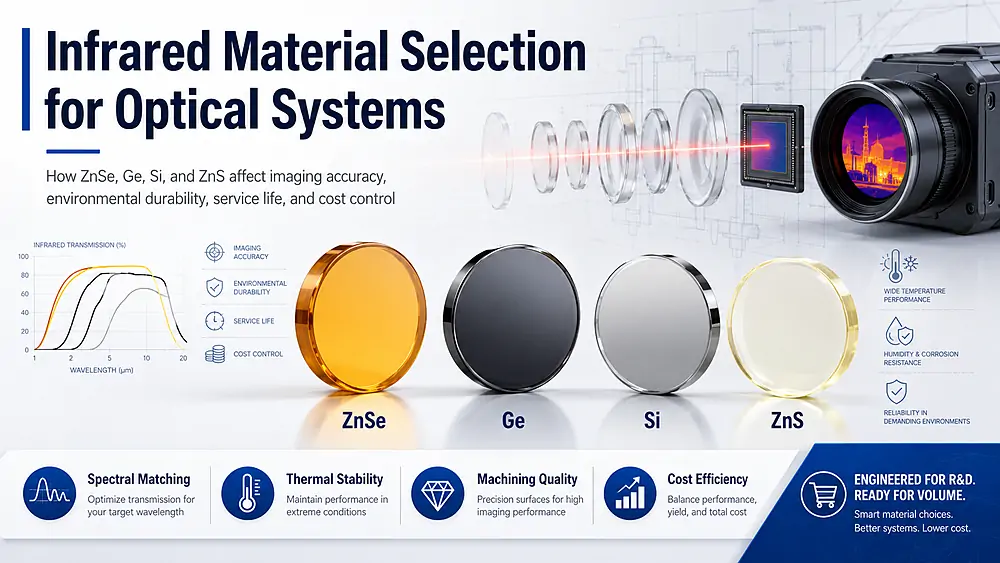
In infrared optical systems, material selection is one of the first decisions that affects transmission, image quality, thermal stability, coating design, manufacturability and total project cost. ZnSe, germanium, silicon and ZnS are all common infrared optical materials, but they are not interchangeable.
A material that works well for a CO2 laser window may be the wrong choice for an LWIR thermal imaging lens. A material that is attractive for cost and weight may fail the wavelength requirement. A material with strong transmission may still create risk if it is difficult to clean, too soft for the exposed location or unstable under temperature change.
This guide compares CVD ZnSe, germanium, silicon and ZnS from a practical engineering and procurement perspective. The goal is to help R&D engineers, purchasing managers and technical decision-makers define a safer material starting point before drawings, coatings and quotations are finalized.
Quick Comparison of ZnSe, Germanium, Silicon and ZnS
| Material | Typical infrared use | Main strengths | Selection cautions | Common components |
|---|---|---|---|---|
| CVD ZnSe | MWIR, LWIR and CO2 laser optics | Broad IR transmission and frequent use around 10.6 µm | Relatively soft; handling, coating, cleaning and packaging require control | Windows, lenses, beam delivery optics, prisms and laser protection optics |
| Germanium | MWIR and LWIR thermal imaging optics | High refractive index and strong use in compact thermal imaging lens designs | Dense, relatively costly and temperature-sensitive; high-temperature behavior must be reviewed | Thermal imaging lenses, IR windows and protective covers |
| Silicon | NIR, SWIR and selected MWIR optics | Good mechanical strength, low density compared with germanium and practical manufacturability | Not suitable for normal 8-14 µm LWIR transmission; wavelength range must be confirmed | SWIR/MWIR windows, substrates, mirrors and selected lens elements |
| ZnS / Cleartran ZnS | MWIR/LWIR windows, domes and multispectral protective optics | Useful balance of IR transmission and environmental durability in exposed applications | Grade, scattering, transmission, surface quality and cost must be specified clearly | Rugged windows, domes, protective covers and multispectral optics |
Exact usable transmission depends on grade, thickness, coating, temperature, surface quality and acceptance criteria. For production decisions, specify the actual operating wavelength or band instead of relying on a broad material name.
Start with Wavelength, Then Check Environment
The first filter is wavelength. The second filter is operating environment. Only after these two are understood should the team finalize geometry, coating and tolerance.
| System requirement | Why it matters | Material direction |
|---|---|---|
| SWIR imaging or sensing | The system may operate closer to visible or near-infrared design practice | Silicon, CaF2, fused silica or other materials may be reviewed depending on band |
| MWIR imaging or detection | 3-5 µm systems require IR-grade materials and matching AR coating | Silicon, germanium, ZnSe, ZnS, CaF2 or BaF2 may enter early review |
| LWIR thermal imaging | 8-12 µm or 8-14 µm systems need long-wave-compatible materials | Germanium, ZnSe, ZnS or selected chalcogenide materials are common starting points |
| CO2 laser optics | 10.6 µm laser transmission creates absorption and thermal-load concerns | CVD ZnSe is commonly reviewed first for transmissive laser optics |
| Exposed outdoor window | Impact, abrasion, cleaning and environmental durability may dominate risk | ZnS, coated germanium or protected ZnSe may be reviewed by environment |
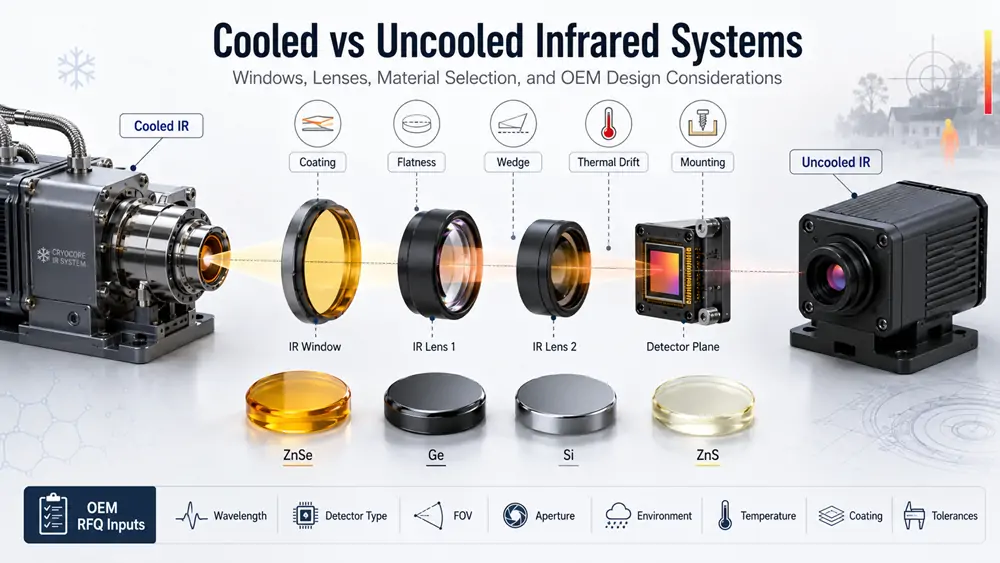
If a project request only says IR window or thermal imaging lens, it is not specific enough for reliable material selection. The inquiry should include wavelength band, detector type, environment, clear aperture, thickness, coating target and mounting method.
CVD ZnSe: Broad IR Transmission and CO2 Laser Use
CVD zinc selenide is widely used for infrared windows, lenses and CO2 laser optics. It is commonly reviewed when the optical path must transmit MWIR, LWIR or 10.6 µm laser energy. For many CO2 laser systems, ZnSe is a practical starting material because of its established use in transmissive laser lenses and protective windows.
ZnSe is also useful in thermal imaging, spectroscopy and custom infrared components where broad transmission is valuable. It can be processed into flat windows, wedged windows, lenses, prisms and other drawing-based optical parts.
Where ZnSe fits well
- CO2 laser focusing, beam delivery and protection optics
- LWIR windows and selected infrared lens elements
- Infrared spectroscopy components and broadband IR optical paths
- Custom IR windows, prisms and coated substrates
What to confirm before choosing ZnSe
- Operating wavelength, especially whether 10.6 µm is involved
- Laser power, beam size, power density and contamination risk if used in a laser path
- Surface protection, cleaning method and packaging because ZnSe is relatively soft
- Coating band, coating side, angle of incidence and inspection requirement
For related material and component pages, review ZnSe material, CVD ZnSe and CVD ZnSe flat windows.
Germanium: Compact LWIR Thermal Imaging Optics
Germanium is a common material for MWIR and LWIR thermal imaging windows and lenses. Its high refractive index supports compact lens designs, which is valuable in thermal cameras, night vision systems, security optics, industrial temperature measurement and other imaging assemblies.
The main engineering caution is temperature. Germanium optical behavior changes with temperature, and transmission can be affected in high-temperature conditions. It is also dense and can increase weight. These factors should be reviewed before using germanium in outdoor, high-temperature or weight-sensitive systems.
Where germanium fits well
- LWIR thermal imaging lenses and windows
- Compact IR lens assemblies that benefit from high refractive index
- Security, industrial inspection and night-vision thermal optics
- Protected windows where coating and mounting are controlled
What to confirm before choosing germanium
- Operating temperature range and whether thermal drift is acceptable
- Weight budget and mechanical package constraints
- AR coating, optional protective coating and cleaning exposure
- Whether athermal design or compensation is required
For related pages, review germanium material and germanium windows.
Silicon: Strong Option for SWIR and Selected MWIR Designs
Silicon is useful in near-infrared, SWIR and selected MWIR optical systems. It offers good mechanical properties, lower density than germanium and practical manufacturability. These characteristics can make silicon attractive for production projects where wavelength fit, cost control and mechanical stability are important.
Silicon should not be selected for normal LWIR thermal imaging around 8-14 µm. This is a common material-selection mistake. If the detector is LWIR, silicon is usually not the correct transmissive window or lens material.
Where silicon fits well
- SWIR sensing and inspection systems where the band is compatible
- Selected MWIR windows, substrates or lens elements
- Lightweight IR assemblies compared with germanium-based designs
- Projects where strength, availability and cost are important
What to confirm before choosing silicon
- Exact wavelength range and detector response
- Whether transmission is required or the part is reflective or structural
- Coating target, surface quality and thickness
- Mechanical load, thermal condition and production tolerance
For related pages, review silicon material and silicon windows.
ZnS and Cleartran ZnS: Rugged IR Windows and Multispectral Optics
Zinc sulfide is often reviewed for infrared windows, domes and protective optics where mechanical durability and environmental resistance are important. Depending on grade, ZnS can support MWIR/LWIR use and selected multispectral requirements. Cleartran ZnS is a processed grade used when improved transmission and lower scatter are required.
ZnS can be a better engineering choice than ZnSe when the optic is exposed to abrasion, dust, airflow, humidity, shock or cleaning. The tradeoff is that grade, transmission, scatter, cost and processing route must be specified carefully.
Where ZnS fits well
- Exposed IR windows and protective covers
- Rugged thermal imaging systems and outdoor optical assemblies
- Multispectral windows where visible-to-IR behavior may matter
- Applications where mechanical durability is more important than maximum theoretical transmission
What to confirm before choosing ZnS
- Whether standard ZnS or Cleartran ZnS is required
- Transmission range, haze, scatter and image-quality requirement
- Environmental exposure, cleaning method and coating durability
- Geometry, thickness, edge strength and mounting stress
For related pages, review ZnS material and Cleartran ZnS windows.
Processing and Coating Differences
The final performance of an infrared component is not determined by material alone. Polishing quality, subsurface damage, edge finishing, coating adhesion, coating absorption, cleaning process and packaging can all change field performance.
| Topic | ZnSe | Germanium | Silicon | ZnS |
|---|---|---|---|---|
| Handling risk | Higher surface-care requirement because the material is relatively soft | Surface and coating protection are important | Generally stronger mechanically than ZnSe and Ge | Often stronger for exposed-window use, depending on grade |
| Coating focus | IR AR coating, laser coating and low absorption where relevant | LWIR/MWIR AR coating and optional protective coating | Band-specific AR coating for SWIR/MWIR use | Durable coating and environmental resistance may be important |
| Thermal concern | Laser absorption and contamination control in high-power systems | Temperature-dependent optical behavior and focus drift | Band compatibility and thermal/mechanical package fit | Thermal shock, exposure and grade-dependent performance |
| Procurement risk | Confirm grade, coating, cleaning and packaging | Confirm temperature condition, weight and coating | Confirm wavelength compatibility before quotation | Confirm grade, scatter, durability and cost |
Common Material Selection Mistakes
| Mistake | Why it creates risk | Better approach |
|---|---|---|
| Choosing by transmission range only | It ignores coating, thickness, temperature, mounting stress and field exposure | Review wavelength, environment, geometry and coating together |
| Using silicon for LWIR thermal imaging | Silicon is not a normal 8-14 µm transmissive material | Review germanium, ZnSe, ZnS or other LWIR materials instead |
| Assuming ZnSe is always better than ZnS | ZnSe may transmit well, but it can be less durable in exposed positions | Use ZnS when ruggedness and environmental exposure dominate risk |
| Ignoring germanium temperature behavior | Thermal drift can affect focus and image quality | Confirm temperature range and athermal design requirements |
| Requesting a quotation without coating details | Material alone does not define final transmission or reflection | Provide wavelength band, angle, coating side and environment |
Recommended Review Flow
A reliable material decision should follow a clear sequence. This keeps the discussion focused and reduces quotation rework.
- Define the wavelength: Provide exact band or laser wavelength, such as 3-5 µm, 8-14 µm or 10.6 µm.
- Define the function: Window, lens, prism, dome, blank, mirror substrate or protective cover.
- Define the environment: Indoor, outdoor, sealed, exposed, high temperature, humidity, dust, vibration, cleaning or laser contamination.
- Define optical requirements: Clear aperture, transmission target, reflection limit, surface quality, flatness, wedge and coating.
- Define mechanical requirements: Outside size, thickness, tolerance, chamfer, step, mounting method and sealing load.
- Validate before production: Confirm sample performance, coating durability, inspection criteria and packaging before volume release.
Practical Recommendation
Use CVD ZnSe when broad IR transmission or CO2 laser compatibility is the main driver. Use germanium when compact MWIR/LWIR thermal imaging optics are needed and the temperature condition is controlled or properly compensated. Use silicon when the wavelength fits SWIR or selected MWIR requirements and weight, strength or cost matter. Use ZnS or Cleartran ZnS when exposed-window durability, ruggedness or multispectral requirements dominate the design.
No single infrared optical material is best for every system. The best choice is the material that satisfies wavelength, coating, mechanical, thermal and procurement constraints at the same time.
Requesting Material Review or a Quotation
For faster review, send the wavelength band, component type, drawing, quantity, coating target, surface requirement, operating environment and any inspection requirement. If the material is not fixed, state the application and let the engineering review compare ZnSe, germanium, silicon, ZnS or other suitable IR material routes.
OPTOStokes-IROptical supports infrared windows, lenses, prisms, blanks, protective optics and drawing-based custom components for R&D and production programs. For material selection, sample evaluation or quotation, use the contact form or email [email protected].