
ZnSe vs ZnS: Infrared Material Selection
Choose the right IR material by comparing ZnSe and ZnS for infrared optics, CO2 laser systems, windows, domes, and rugged optical assemblies.
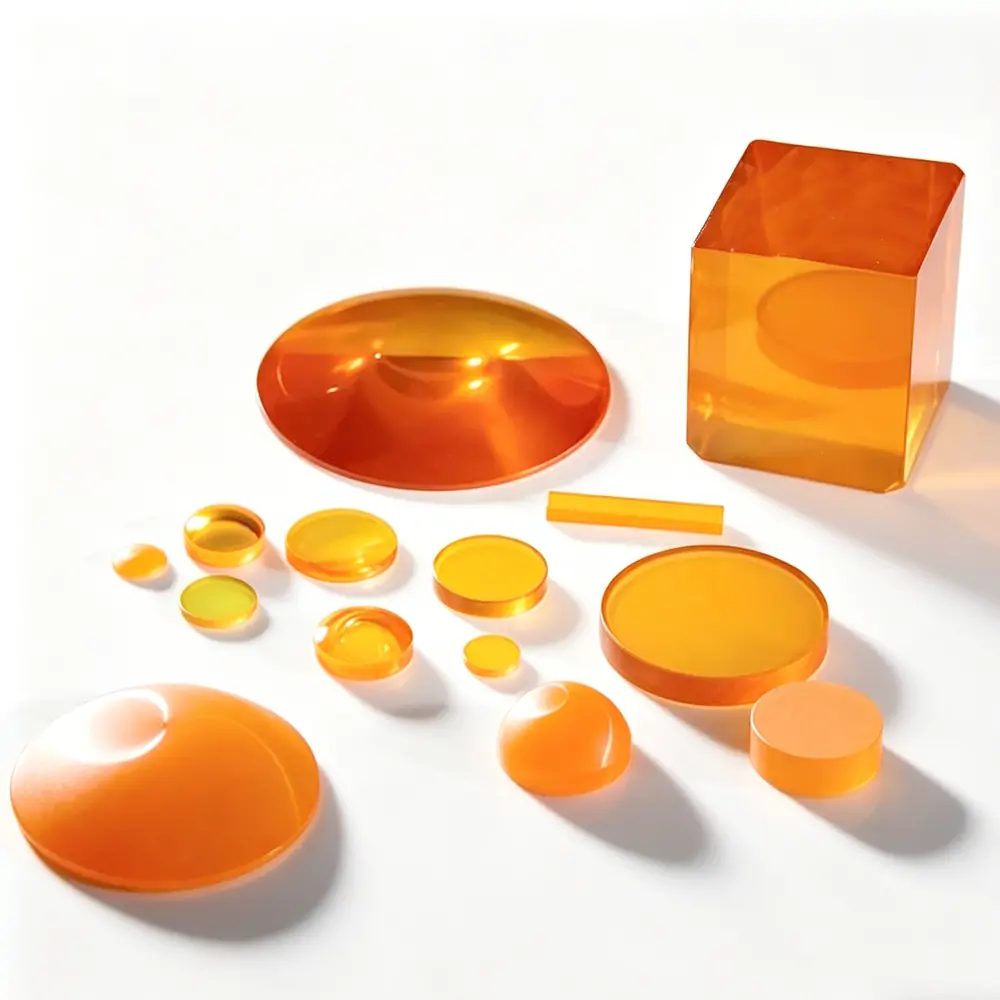
ZnSe vs ZnS for Infrared Optics
Zinc selenide (ZnSe) and zinc sulfide (ZnS) are two widely used materials in infrared optical systems. Both materials are used for lenses, windows, protective optics, laser components, and infrared imaging assemblies, but they are not interchangeable without engineering review.
The right choice depends on wavelength range, laser power, mechanical load, environmental exposure, coating requirements, and the final optical function. ZnSe is often selected for high infrared transmission and CO2 laser compatibility, while ZnS is preferred when mechanical strength and environmental durability are more important.
Basic Material Difference
ZnSe has the chemical formula ZnSe and is composed of zinc and selenium. ZnS has the chemical formula ZnS and is composed of zinc and sulfur. In infrared optics, both materials are commonly produced by chemical vapor deposition or controlled optical-grade manufacturing processes to achieve the required purity, homogeneity, and transmission performance.
From an optical design perspective, the most important difference is not only chemical composition. The practical difference lies in transmission range, absorption behavior, mechanical strength, thermal response, and how each material performs after polishing, coating, mounting, and long-term operation.
Optical Performance Comparison
| Property | ZnSe | ZnS | Engineering Meaning |
|---|---|---|---|
| Typical spectral use | Visible alignment, MWIR, LWIR, and CO2 laser wavelengths | Visible-to-infrared use depending on grade, especially IR windows and domes | ZnSe is often stronger for broad IR transmission, while ZnS is valuable for durable IR window applications |
| CO2 laser compatibility | Excellent for 10.6 µm applications | Less commonly selected for high-power CO2 laser transmission optics | ZnSe is usually the first material reviewed for CO2 laser lenses, windows, and beam delivery optics |
| Transmission behavior | High infrared transmission when properly polished and coated | Good infrared transmission in suitable grades, with stronger mechanical performance | Actual transmission depends on thickness, grade, surface quality, and coating design |
| Mechanical durability | Relatively soft and more vulnerable to scratching and edge damage | Harder and stronger than ZnSe | ZnS is often better for exposed windows, domes, and rugged assemblies |
| Typical selection priority | Optical transmission and laser performance | Mechanical robustness and environmental resistance | The material should be selected according to the system risk, not by transmission alone |
When to Choose ZnSe
ZnSe is commonly selected when the infrared system requires high transmission, low absorption at CO2 laser wavelengths, and stable optical performance in mid-wave or long-wave infrared bands. It is widely used in laser optics, thermal imaging systems, medical laser equipment, industrial sensing modules, and spectroscopy-related components.
Typical ZnSe Applications
| Application | Why ZnSe Is Used |
|---|---|
| CO2 laser lenses and windows | Strong compatibility with 10.6 µm laser systems and efficient infrared transmission |
| Infrared lenses and beam delivery optics | Suitable for focusing, collimating, and transmitting infrared beams |
| Thermal imaging optics | Useful for systems requiring stable infrared transmission and precise optical performance |
| IR beamsplitters and optical substrates | Can be processed and coated for customized beam control functions |
ZnSe should be handled carefully during manufacturing, coating, assembly, and cleaning. Its relative softness makes surface protection and proper packaging important, especially for high-value laser optics and precision infrared assemblies. For related components, review ZnSe material, CVD ZnSe, and ZnSe lens options.
When to Choose ZnS
ZnS is often selected when an infrared optical component must withstand harsher mechanical or environmental conditions. Compared with ZnSe, ZnS generally offers higher hardness and stronger resistance to impact, abrasion, and external exposure. This makes it suitable for protective infrared windows, domes, and rugged optical systems.
Typical ZnS Applications
| Application | Why ZnS Is Used |
|---|---|
| Infrared windows | Provides a practical balance between infrared transmission and mechanical durability |
| IR domes and protective covers | Better suited for exposed optical surfaces and harsh operating environments |
| Rugged thermal imaging systems | Useful where shock, abrasion, or environmental exposure is a major design concern |
| Defense, aerospace, and industrial sensing optics | Supports applications where strength and durability may outweigh maximum transmission |
ZnS should not be treated as a lower-value substitute for ZnSe. It serves a different engineering purpose. In exposed optical systems, ZnS can be the more reliable choice because mechanical failure, surface erosion, or environmental damage may be more critical than maximum theoretical transmission. For related material and product pages, review ZnS material and ZnS window options.
Key Selection Factors
Material selection should begin with the optical and mechanical requirements of the system. A correct ZnSe or ZnS decision usually requires review of wavelength, power level, aperture size, coating type, surface quality, operating temperature, mounting method, and exposure conditions.
| Selection Factor | ZnSe Is Usually Better When | ZnS Is Usually Better When |
|---|---|---|
| Primary goal | High infrared transmission and CO2 laser compatibility | Mechanical strength and environmental resistance |
| Laser use | The system operates around 10.6 µm CO2 laser wavelength | The part mainly acts as a protective or structural optical window |
| Surface exposure | The optic is protected inside the optical path | The optic is exposed to dust, airflow, impact, or harsh environments |
| Mechanical load | Mechanical stress is moderate and controlled | Higher hardness and fracture resistance are required |
| Coating strategy | High-performance AR or laser coatings are required | Durable coatings and protective surfaces are required |
Coating and Manufacturing Considerations
Both ZnSe and ZnS require controlled manufacturing to achieve reliable optical performance. Surface quality, subsurface damage, coating adhesion, edge integrity, and cleaning process all affect the final component. For high-performance infrared systems, material selection and coating design should be reviewed together rather than treated as separate decisions.
ZnSe optics often require carefully optimized polishing and coating processes to reduce absorption, scattering, and surface damage. ZnS optics may require durable surface finishing and coating strategies to support exposed or mechanically demanding applications. In both cases, the final specification should match the real operating environment, not only the nominal wavelength range.
Practical Recommendation
For CO2 laser optics, beam delivery components, and systems where infrared transmission efficiency is the main priority, ZnSe is commonly the stronger candidate. For infrared windows, domes, protective covers, and rugged systems exposed to harsher environments, ZnS may offer a better engineering balance.
The best material choice is not always the material with the highest transmission. In many infrared systems, the correct choice is the material that can maintain optical performance after coating, mounting, cleaning, transportation, and long-term field operation.
ZnSe and ZnS Optical Components from OPTOstokes-IROptical
OPTOstokes-IROptical supports infrared optical component selection for ZnSe and ZnS applications, including standard options and custom components based on drawings or technical requirements. Available solutions may include infrared windows, lenses, prisms, beamsplitter substrates, protective optics, and coated optical components for laser, imaging, sensing, and industrial systems.
Engineering teams often need to confirm more than material type. Key questions include wavelength range, power density, clear aperture, dimensional tolerance, coating requirement, environmental exposure, and whether the component must be optimized for transmission, durability, or both.
For material selection support, sample evaluation, or a quotation request, submit an inquiry through the contact page. OPTOstokes-IROptical can review drawings, wavelength requirements, coating needs, and application conditions to help identify a suitable ZnSe or ZnS optical solution.