
ZnSe Thin Films for Nonlinear Optical Response
A technical review of ZnSe thin film nonlinear optical response, third-order susceptibility, film thickness effects, and practical selection notes for photonics and IR optical projects.
Third-Order Nonlinear Optics
Zinc selenide (ZnSe) thin film is an II-VI direct-bandgap semiconductor material with a wide bandgap, high exciton binding energy, and high transparency in the visible region. These characteristics make ZnSe relevant to optoelectronic devices, light-emitting devices, photoluminescence studies, and infrared optical component development.
From a nonlinear optics perspective, ZnSe thin films are of interest because their electronic structure can support measurable nonlinear optical effects. For engineers evaluating harmonic generation, thin-film mirror concepts, or ZnSe-based photonic components, the key question is not simply whether ZnSe is transparent. The more important question is how film thickness, wavelength, and film quality influence the nonlinear response.
Why ZnSe Thin Film Nonlinearity Matters
Nonlinear optical behavior becomes important when an optical material is exposed to a strong electromagnetic field and its polarization response is no longer proportional to the incident field. In ZnSe thin films, the third-order nonlinear susceptibility, written as χ(3), is especially relevant for third-harmonic generation (THG), wavelength conversion, optical switching research, and thin-film optical design.
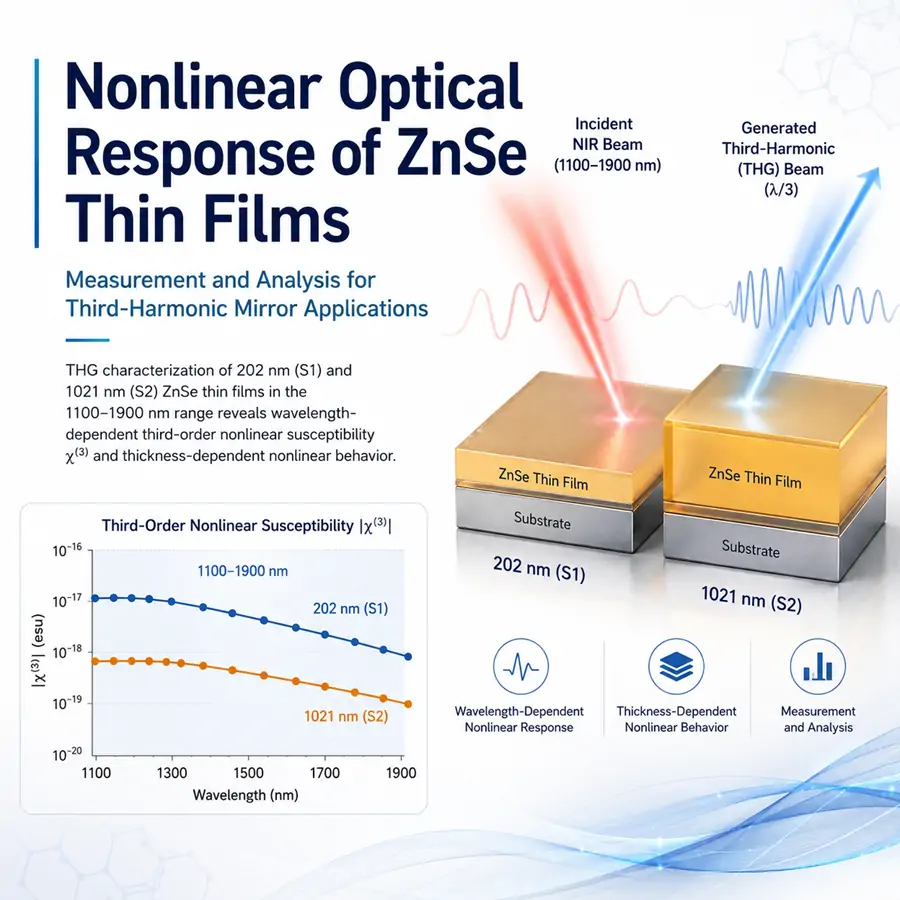
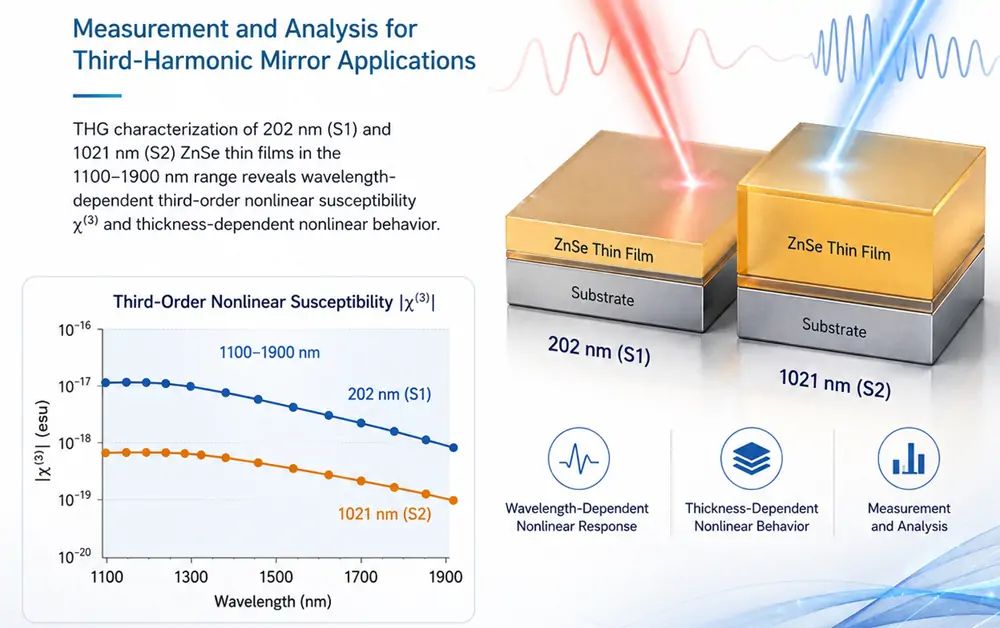
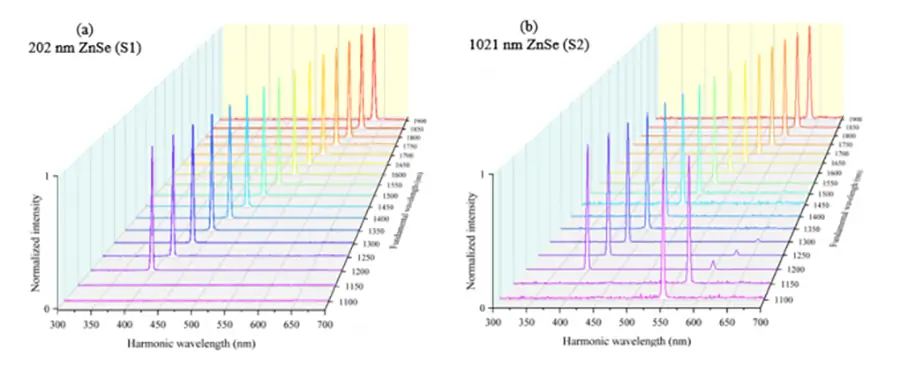
The Chinese source material focused on measured nonlinear optical response in ZnSe films with two different thicknesses. The study used third-harmonic techniques over the 1100-1900 nm wavelength range and compared a 202 nm film sample (S1) with a 1021 nm film sample (S2). The reported behavior shows that ZnSe thin film nonlinearity is wavelength-dependent and thickness-dependent.
Measured Sample Conditions
| Sample | Film Thickness | Measured Wavelength Range | Observed Nonlinear Behavior |
|---|---|---|---|
| S1 | 202 nm | 1100-1900 nm | Third-harmonic signal observed; χ(3) decreased as wavelength shifted to the red. |
| S2 | 1021 nm | 1100-1900 nm | Higher χ(3) values at many matched wavelengths; weak second-harmonic signal observed at 1100-1300 nm. |
Key Findings from the ZnSe Thin Film Data
The third-order nonlinear susceptibility of ZnSe thin films is a function of incident wavelength. This means optical design work should not rely on a single isolated value unless the operating wavelength, film thickness, deposition route, and measurement condition are clearly defined.
For the thinner S1 sample, the observed nonlinear response was limited to third-harmonic generation. Its χ(3) value decreased as the wavelength moved toward longer wavelengths. For the thicker S2 sample, local χ(3) peaks were reported near 1350 nm, 1500 nm, and 1750 nm, while a weak second-harmonic component appeared in the 1100-1300 nm region.
At the same wavelength, the thicker ZnSe thin film sample generally showed a higher χ(3) value. This does not mean that a thicker film is always the correct engineering choice. It means thickness must be treated as an active design variable together with optical bandgap behavior, film uniformity, stress, substrate compatibility, and coating or stack design.
Possible Physical Reasons for the Thickness Effect
The difference between the two ZnSe thin film samples may be associated with increased geometric defect density during film formation, optical bandgap compression, and local anisotropy inside the film. These mechanisms can affect how the film interacts with the incident field and how efficiently harmonic components are generated.
Because these effects are process-sensitive, nonlinear performance should be confirmed under the actual manufacturing and measurement conditions. Deposition method, film crystallinity, surface quality, substrate material, thickness tolerance, and environmental exposure can all influence the final optical response.
Engineering Notes for ZnSe Optics and Coating Projects
- Confirm the working wavelength: Nonlinear response changes across the 1100-1900 nm band, so wavelength must be defined early.
- Separate bulk material behavior from film behavior: ZnSe bulk optics and ZnSe thin films can show different optical and process sensitivities.
- Define thickness and tolerance: Film thickness can influence χ(3), harmonic generation behavior, stress, and repeatability.
- Review substrate and coating stack: The final optical response depends on the complete structure, not only the ZnSe layer.
- Request measurement context: Temperature, incident power, wavelength range, and test method should be documented before comparing values.
Application Relevance
ZnSe thin film nonlinear behavior is relevant to photonics research, harmonic generation components, nonlinear optical mirrors, optical switching studies, and specialty infrared optical systems. It can also support early-stage evaluation of ZnSe-based coatings or thin-film structures where wavelength conversion or field-dependent response is part of the design target.
For standard IR optical components, engineers should also compare the thin-film requirement with available ZnSe material properties, IR optical components, and drawing-based manufacturing options. This helps separate research-grade nonlinear thin-film requirements from conventional windows, lenses, prisms, and beam-control optics.
Request Technical Review
If your project involves ZnSe optics, thin-film coating review, wavelength conversion, or custom IR optical components, send the wavelength band, substrate, film thickness target, drawing, coating target, quantity, and test requirement through the contact form or email [email protected]. OPTOstokes-IROptical can review the practical manufacturing route and help clarify whether the requirement should be handled as a coating project, a custom ZnSe component, or a broader optical assembly review.