
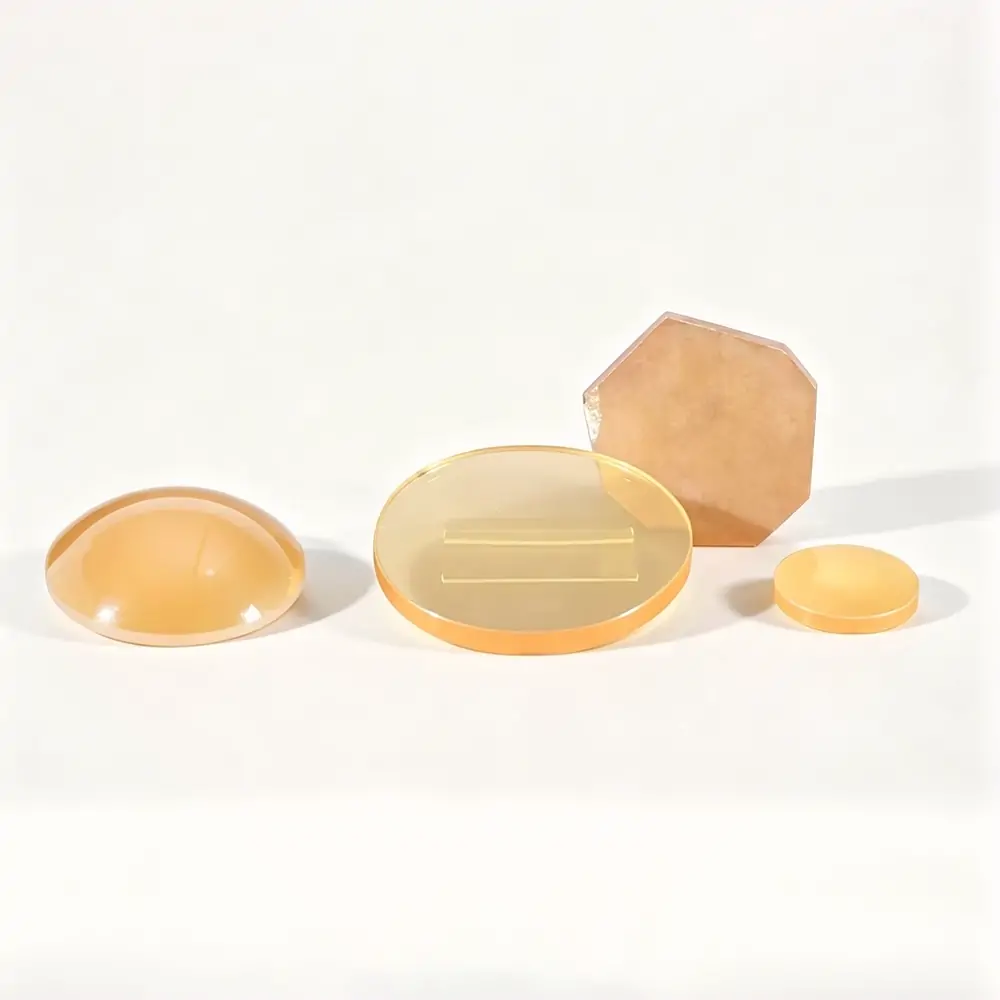
ZnS Plano-Convex Lenses
ZnS plano-convex lenses for MWIR and LWIR systems, offering durable zinc sulfide optics with custom sizes, AR coatings, and IR applications.
Quick Specifications
Product Description
Overview
ZnS plano-convex lenses are positive focal length spherical lenses made from zinc sulfide optical material. One surface is flat and the other surface is convex, allowing the lens to focus collimated infrared radiation or collimate radiation from a point source.
Zinc sulfide, especially CVD ZnS optical material, is valued for its combination of infrared transmission, mechanical strength, thermal stability, and environmental durability. It is widely used in infrared lenses, windows, protective optics, thermal imaging systems, sensing modules, and rugged optical assemblies.
Why Choose ZnS for Infrared Lenses
ZnS is often selected when an infrared optical system requires better mechanical durability than softer infrared materials while maintaining useful transmission in MWIR and LWIR regions. For exposed or rugged systems, ZnS may provide a better balance between transmission and durability than a material chosen by transmission alone.
Quick Specifications
| Parameter | Guidance |
|---|---|
| Material | Zinc Sulfide (ZnS), CVD polycrystalline grade available |
| Lens Type | Plano-convex spherical lens |
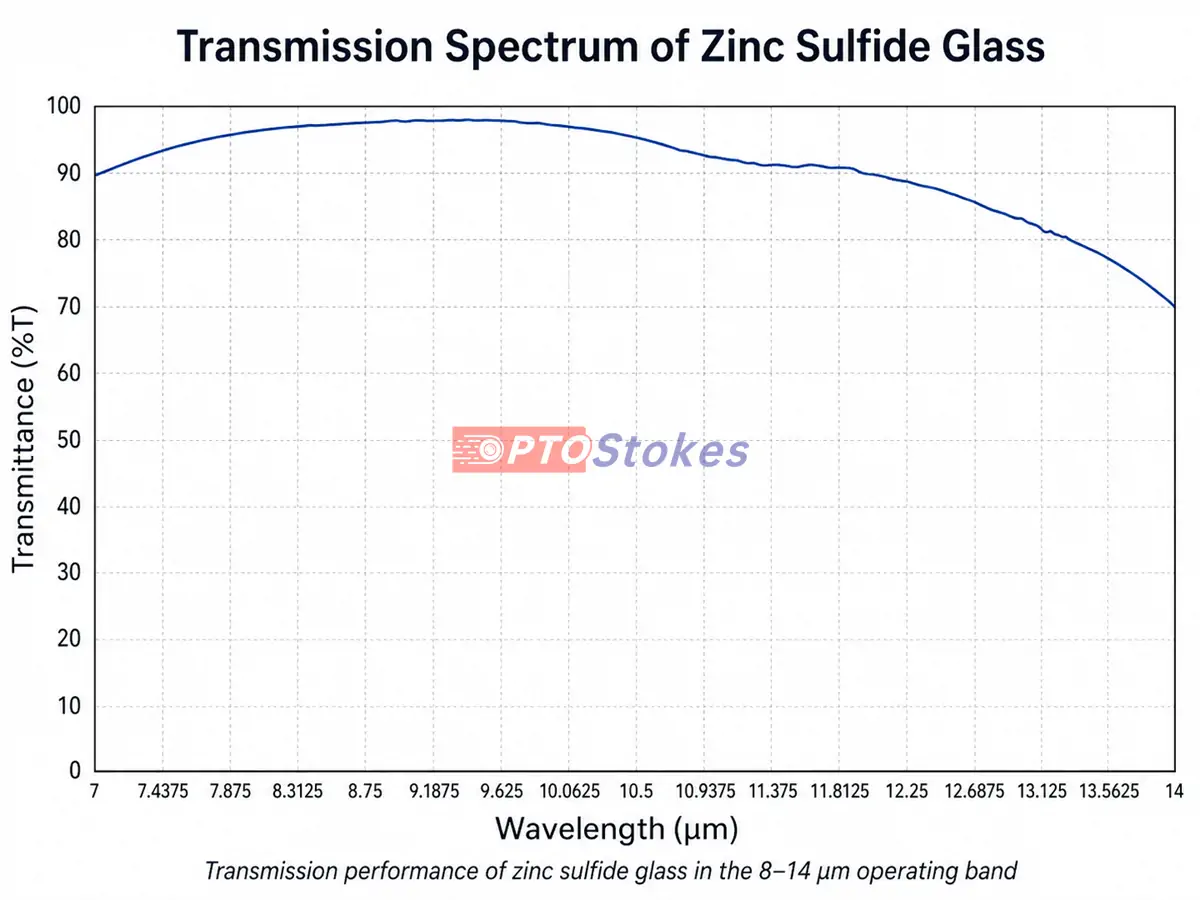
| Typical Working Bands | MWIR, LWIR, and selected broadband infrared applications depending on material grade and coating |
| Typical Transmission Range | Approximately 0.4-12 µm for suitable grades; practical working band depends on grade and coating |
| Refractive Index | Approximately 2.192 at 10.6 µm |
| Typical Size Range | 5-400 mm; custom sizes available on request |
| Coating | Double-side AR coating for specified infrared bands |
Material Reference Values
| Property | Typical Value |
|---|---|
| Density | 4.09 g/cm3 |
| Knoop Hardness | Approximately 230 HK |
| Thermal Expansion Coefficient | Approximately 6.5 × 10⁻⁶/K |
| Thermal Conductivity | Approximately 19.2 W/(m·K) |
| Temperature Coefficient of Refractive Index | Approximately 4.3 × 10⁻⁵/K |
| Surface Figure | Up to λ/10 at 10.6 µm available depending on size and specification |
Typical Applications
- Thermal imaging systems and MWIR/LWIR optical paths
- Infrared sensing modules and signal collection optics
- Rugged IR optical assemblies exposed to vibration, shock, or harsh environments
- Airborne and ground-based IR systems
- Protective infrared optics, windows, domes, and covers
- Custom sensing, monitoring, inspection, and analytical instruments
Engineering Notes
ZnS and ZnSe are different infrared materials. ZnSe is often reviewed first for CO2 laser transmission optics and high IR transmission in protected optical paths, while ZnS is often selected when hardness, mechanical durability, and environmental resistance are more important.
To specify a ZnS PCX lens, provide diameter, focal length, center thickness, wavelength band, coating band, surface quality, surface figure, clear aperture, operating temperature, environmental exposure, and quantity. For related material comparison, review ZnSe vs ZnS material selection or send drawings through the contact form.
Key Features
Applications
Related Products

Cleartran ZnS Windows
Cleartran ZnS Windows for multispectral infrared windows and durable sensing apertures, with Cleartran ZnS material, custom size review, and coating options.
ZnS Optics
ZnS Optics for multispectral infrared imaging and protective optical assemblies, with Cleartran ZnS material, custom size review, and coating options.
Helpful Resources