

Cleartran ZnS Spherical Lenses
Cleartran ZnS spherical lenses for visible-to-LWIR multispectral focusing, collimation, and rugged optical assemblies with drawing-based engineering review.
Quick Specifications
Product Description
Overview
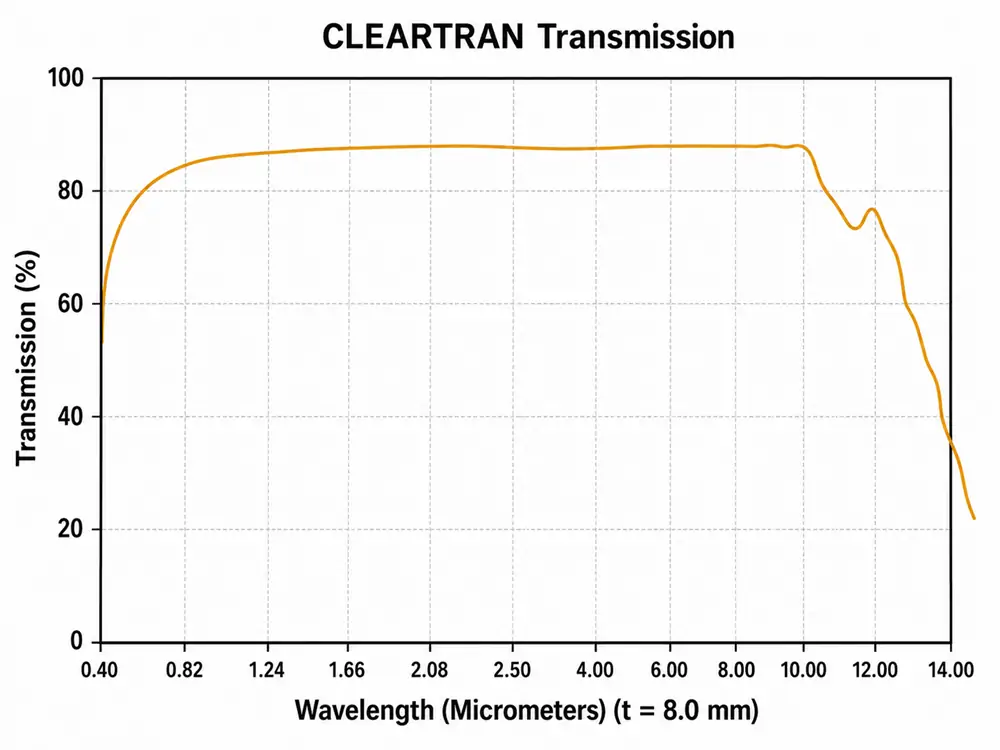
Cleartran ZnS spherical lenses are reviewed when one powered optic must support visible alignment, MWIR sensing, and LWIR imaging in a mechanically demanding assembly. The source material describes multispectral CVD ZnS produced by post-deposition hot isostatic pressing, which is used to improve internal optical quality and extend practical transmission toward the visible band.
For engineering teams, the main decision is not only focal power. The real review points are spectral band, coating target, environmental exposure, surface-finish requirement, and whether the optical path benefits from a multispectral ZnS lens instead of a standard ZnS or ZnSe part.
Why Cleartran ZnS Matters
Compared with standard CVD ZnS, the multispectral Cleartran route is intended to reduce internal scatter and make the material practical over a wider common-aperture band. This matters when a single spherical lens must serve visible setup light and infrared working bands without splitting the optical train into separate materials.
Source-Based Material Comparison
| Property | Standard CVD ZnS | Multispectral Cleartran ZnS |
|---|---|---|
| Density | 4.09 g/cm3 @ 298 K | 4.09 g/cm3 @ 298 K |
| Electrical resistivity | ~10^12 ohm.cm | ~10^13 ohm.cm |
| Melting point | 1827 °C | 1830 °C |
| Chemical purity | 99.9996% | 99.9996% |
| Thermal expansion | 6.6 × 10^-6/K @ 273 K; 7.3 × 10^-6/K @ 373 K | 6.3 × 10^-6/K @ 273 K; 7.0 × 10^-6/K @ 373 K |
| Thermal conductivity | 16.7 W/(m.K) @ 298 K | 27.2 W/(m.K) @ 298 K |
| Specific heat | 0.469 J/(g.K) @ 298 K | 0.515 J/(g.K) @ 298 K |
| Knoop hardness | 200-235 kg/mm2 | 160 kg/mm2 |
| Flexural strength | 103 MPa | 103 MPa |
| Young's modulus | 74.5 GPa | 74.5 GPa |
| Poisson ratio | 0.29 | 0.28 |
Optical Reference for Lens Selection
| Parameter | Standard CVD ZnS | Multispectral Cleartran ZnS |
|---|---|---|
| Transmission guidance | 1.0-14.0 µm | 0.37-14.0 µm |
| Index inhomogeneity | <7.3 × 10^-4 @ 10.6 µm | <0.2 × 10^-4 @ 632.8 nm |
| Absorption coefficient | 0.2 /cm @ 10.6 µm | 0.2 /cm @ 10.6 µm |
| dn/dT reference | 4.6 × 10^-5/K @ 1.15 µm; 4.3 × 10^-5/K @ 3.39 µm; 4.1 × 10^-5/K @ 10.6 µm | 5.43 × 10^-5/K @ 632.8 nm; 4.21 × 10^-5/K @ 1.15 µm; 3.87 × 10^-5/K @ 3.39 µm |
What Engineers Should Confirm
Spherical-lens performance depends on more than substrate name. Engineers should define the lens form, focal length, clear aperture, edge thickness, coating band, and environmental exposure together. If the assembly uses both visible alignment and infrared working bands through one optic, Cleartran ZnS is often reviewed before switching to separate visible and IR elements.
- Multispectral common-aperture systems using visible setup light with MWIR or LWIR working bands
- Rugged IR focusing and collimation paths that need better environmental durability than softer infrared substrates
- Sensor, seeker, and thermal-imaging optics that must balance transmission with mechanical robustness
- Drawing-based custom spherical lenses, blanks, and preforms for downstream coating or integration
What Purchasing Should Include in the RFQ
For quotation, specify whether the lens is plano-convex, bi-convex, meniscus, or another spherical geometry. Also provide wavelength band, focal length, diameter, center thickness, coating target, surface quality, quantity, and any environmental or cleaning requirement. If you are still comparing materials, review Cleartran ZnS windows, the broader ZnS optics page, and the existing ZnS plano-convex lens path before freezing the drawing.
Request Engineering Review
Send wavelength band, focal length, diameter, coating target, quantity, and drawing notes through the contact page or email sales@iroptical.com for a practical Cleartran ZnS lens review.
Key Features
Applications
Related Products
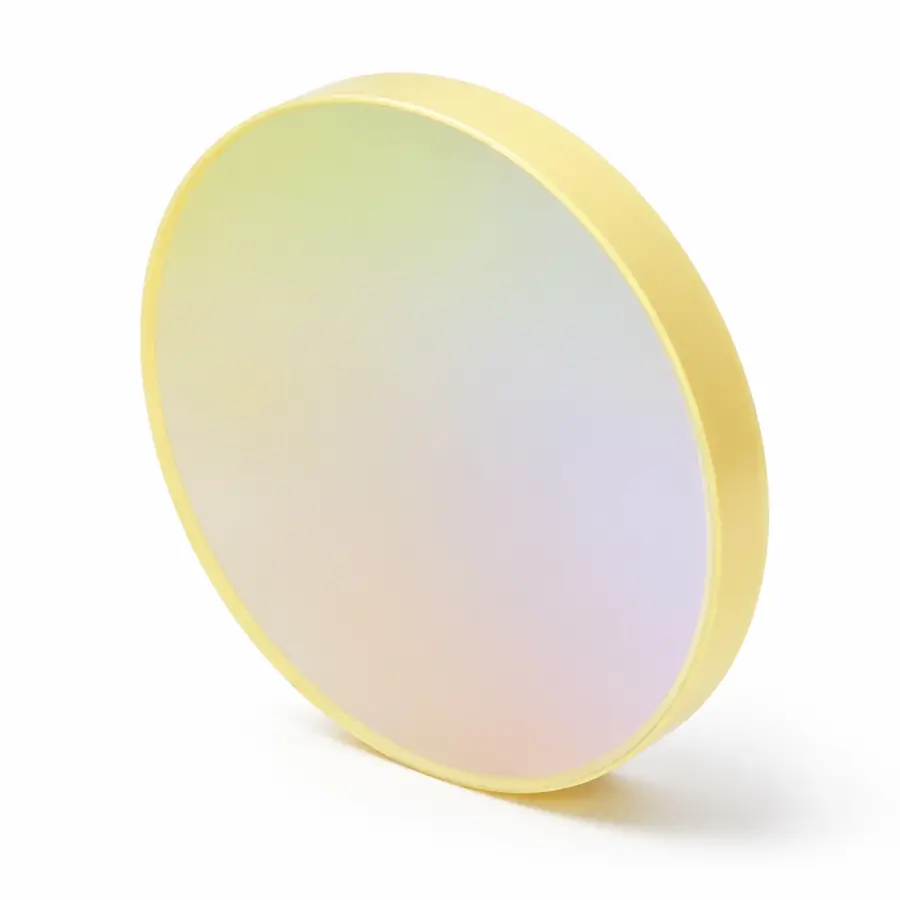
Cleartran ZnS Windows
Cleartran ZnS windows for visible-to-infrared multispectral apertures, thermal imaging, FLIR, astronomy, and rugged protective optical systems.

ZnS Optics
ZnS Optics for multispectral infrared imaging and protective optical assemblies, with Cleartran ZnS material, custom size review, and coating options.

ZnS Plano-Convex Lenses
ZnS plano-convex lenses for MWIR and LWIR systems, offering durable zinc sulfide optics with custom sizes, AR coatings, and IR applications.
Helpful Resources