
ZnSe Prisms for Infrared Optical Systems
Scenario-based case article explaining how ZnSe prisms are selected and manufactured for infrared optical systems that require beam steering, spectral routing, compact packaging, and reliable coating performance.
The Challenge
Our Solution
Results
ZnSe Prisms in Infrared Optics
Zinc selenide (ZnSe) prisms are precision optical components used in infrared systems that require broad transmission, low bulk absorption, and stable optical performance. They are widely specified for beam steering, image rotation, light-path folding, and wavelength-dispersive functions in laser, sensing, spectroscopy, and thermal imaging platforms.
For engineers working in the mid-wave and long-wave infrared bands, ZnSe remains one of the most practical prism materials because it combines broad spectral coverage with good optical homogeneity and strong compatibility with CO2 laser applications. For purchasing teams and technical decision-makers, it is also a material that supports both standard configurations and custom prism geometries when optical performance and manufacturability must be balanced together.
Why ZnSe Is Used for Infrared Prisms
ZnSe is typically produced by chemical vapor deposition and is valued for its broad infrared transmission range, relatively low absorption at 10.6 µm, and stable performance in demanding optical assemblies. These properties make it a preferred material for many infrared prism designs, especially when the system must handle CO2 laser wavelengths, thermal signatures, or spectroscopic signals.
At the same time, material performance should never be evaluated in isolation. The actual transmission of a finished prism depends on the optical path length, prism geometry, surface quality, coating design, and operating wavelength. In practical engineering, material selection and prism design must always be reviewed together.
Key Optical Properties
| Property | Typical Value / Range | Engineering Relevance |
|---|---|---|
| Transmission range | Approximately 0.6 µm to 21 µm | Suitable for many visible-alignment, MWIR, and LWIR applications |
| Refractive index | About 2.4028 at 10.6 µm | Supports compact prism designs and efficient beam control |
| CO2 laser compatibility | Excellent at 10.6 µm | Widely used in laser delivery, beam shaping, and scanning systems |
| Bulk absorption | Low in the infrared working range | Helps maintain optical efficiency in well-designed systems |
Common ZnSe Prism Types
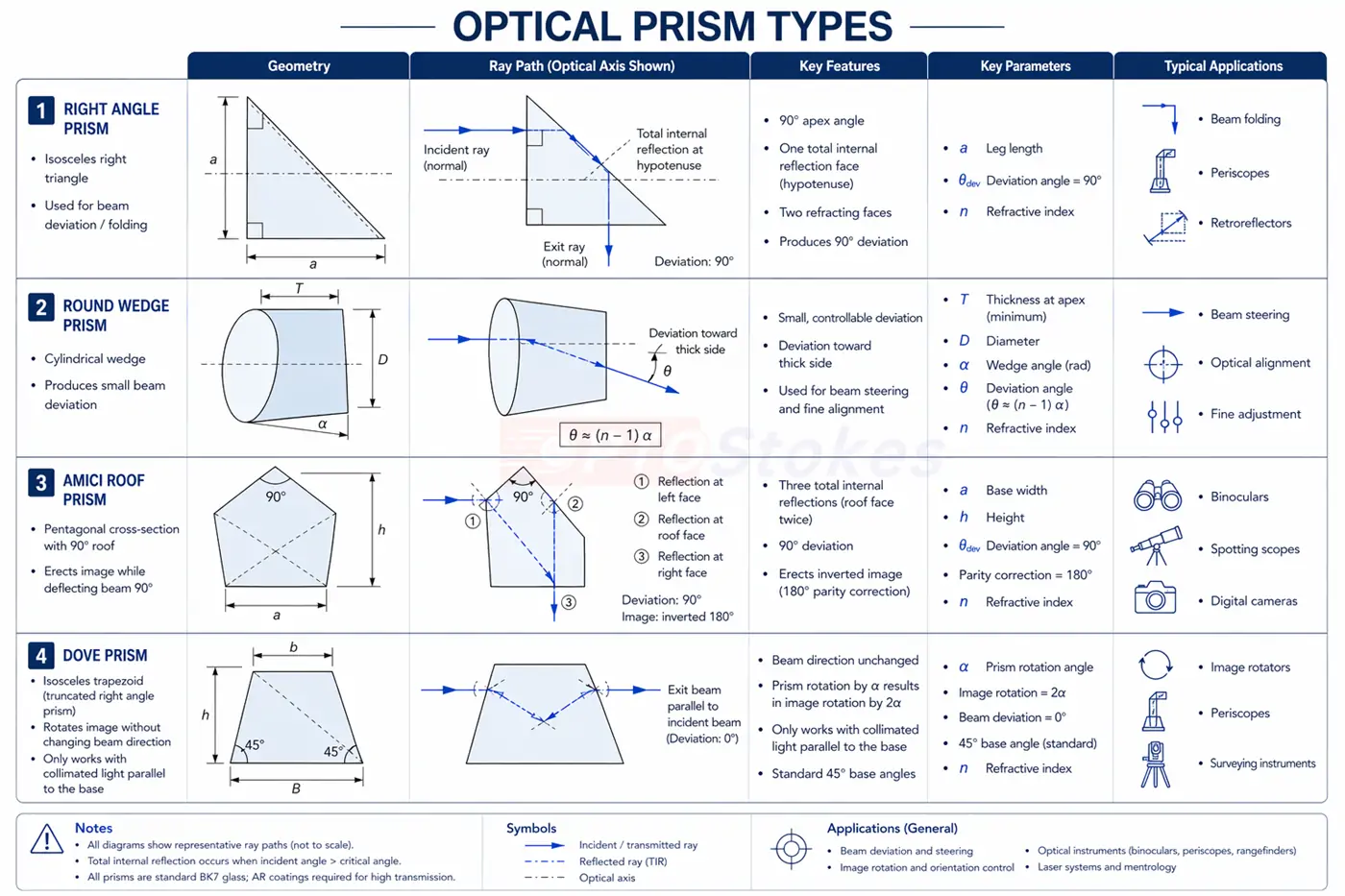
ZnSe can be manufactured into several prism forms depending on the optical function required. The final geometry is usually driven by beam deviation angle, system packaging limits, image orientation requirements, wavelength band, and coating strategy.
| Prism Type | Primary Function | Typical Infrared Use |
|---|---|---|
| Right-angle prism | 90 degree beam deflection or image/path redirection | IR alignment tools, folded laser paths, compact optical modules |
| Wedge prism | Small-angle beam steering or controlled deviation | Beam adjustment, alignment correction, beam combining assemblies |
| Pellin-Broca or dispersive prism | Wavelength separation and spectral routing | Mid-IR spectroscopy, FTIR-related optical subsystems |
| Roof prism | Image inversion or path folding | Compact infrared imaging systems with strict packaging limits |
| Dove prism | Image rotation | Specialized infrared imaging and optical manipulation systems |
Not every prism type is equally common in ZnSe. Right-angle and wedge prisms are more widely used because they are easier to integrate and typically more practical to manufacture. Roof and Dove prisms are possible, but they place higher demands on angle control, surface integrity, and coating consistency.
Manufacturing Challenges of ZnSe Prisms
ZnSe offers strong optical advantages, but it is not an easy material to process. High-quality infrared prism manufacturing depends on controlling edge damage, subsurface defects, geometry, and coating performance from the first grinding step to final packaging.
Material Softness and Brittleness
ZnSe is relatively soft and brittle compared with many visible-range optical materials. During machining, the material can chip at edges, scratch under improper handling, or develop microcracks if grinding parameters are too aggressive. This directly affects yield, coating quality, and long-term component reliability.
Surface Figure and Surface Quality Control
Prism surfaces must meet tight requirements for flatness, roughness, and scatter. ZnSe is vulnerable to subsurface damage during grinding and polishing, especially on steep angles, narrow faces, or miniature geometries. If this damage is not removed correctly, the result may be wavefront distortion, scattering loss, or premature coating failure.
Coating Durability and Adhesion
ZnSe prism performance often depends on infrared AR coatings, partial reflective coatings, or protected metallic coatings, depending on the design. Coating on ZnSe requires controlled surface preparation and a process route that matches both the wavelength band and the operating environment. Weak process control can lead to poor adhesion, optical drift, or reduced durability under thermal load.
Thermal Expansion and Process Stability
ZnSe has a relatively high coefficient of thermal expansion, so fabrication, coating, mounting, and system use all require good thermal discipline. In high-power laser systems or applications with large temperature swings, thermal effects can influence alignment stability, coating stress, and overall optical performance.
Angular Accuracy and Geometric Tolerances
Many infrared prism applications require angular tolerances better than <1 arcmin, and some assemblies demand even tighter control. This becomes more difficult as the prism gets smaller, the geometry becomes more complex, or multiple functional surfaces must be aligned within one component.
How High-Quality ZnSe Prisms Are Manufactured
Reliable ZnSe prism production is not the result of one single process improvement. It comes from disciplined control across machining, polishing, metrology, coating, cleaning, handling, and packaging.
Low-Stress Precision Grinding
Advanced manufacturers use fine diamond tooling, stable fixturing, and carefully tuned feed and speed parameters to reduce edge chipping and internal stress. The goal is not only to shape the prism, but to preserve enough material quality for the polishing stage to succeed.
Controlled Polishing for Infrared Surfaces
Polishing strategies are selected to minimize subsurface damage while maintaining figure accuracy. For tight radii, steep surfaces, or compact prism designs, sub-aperture tools and carefully selected slurry systems help achieve repeatable surface quality without sacrificing geometry.
Coating in Controlled Environments
For infrared prisms, coating is a performance step, not a cosmetic step. Humidity control, particulate control, substrate preparation, and process repeatability all matter. Depending on the wavelength range and durability target, manufacturers may use e-beam evaporation, ion-assisted processes, or other proven thin-film methods to achieve the required optical result.
Full Optical Inspection and Metrology
High-end prism production relies on interferometry, angle measurement systems, autocollimators, dimensional inspection, and scatter checks. These controls confirm that the finished prism meets the required figure, angle, surface quality, and coating specifications before shipment.
Protective Handling and Packaging
Because ZnSe surfaces can be damaged by poor handling even after final inspection, packaging is part of quality assurance. Non-abrasive materials, clean handling protocols, and protective packing configurations help preserve the prism surface during storage and transport.
Applications Across Industries
ZnSe prisms are used in a wide range of infrared systems where optical efficiency, compact beam control, and stable material performance are required.
CO2 Laser Systems
ZnSe prisms are widely used in CO2 laser platforms for beam folding, beam steering, and optical path management. Their compatibility with 10.6 µm makes them a practical choice for industrial laser equipment, medical laser systems, and precision optical assemblies.
Thermal Imaging and Infrared Cameras
In compact infrared imaging systems, ZnSe prisms can support light-path folding and image-handling functions while helping designers reduce package size. This is useful in thermal modules where available space is limited but optical alignment remains critical.
Spectroscopy and FTIR Systems
Dispersive ZnSe prism designs can be used in spectroscopy-related systems where wavelength separation or infrared signal handling is required. These components are relevant in applications involving chemical analysis, gas detection, polymer testing, and laboratory instrumentation.
Industrial Sensing and Automation
Infrared prisms are also integrated into sensing systems for non-contact temperature measurement, process monitoring, and automated inspection. In these environments, repeatability, coating durability, and dimensional consistency are often just as important as nominal transmission.
Key Selection Considerations Before Ordering
For engineering teams, specifying a ZnSe prism usually requires more than naming the material and geometry. A practical RFQ should define the wavelength range, coating requirement, prism type, clear aperture, dimensional tolerances, angular tolerances, surface quality, and application environment. If the prism will be used in a laser system, power density and thermal load should also be reviewed early.
For purchasing teams, the real risks are usually not hidden in the drawing alone. The main issues are coating consistency, manufacturable tolerances, delivery predictability, and whether the supplier can support both prototype and production quantities with the same quality standard.
ZnSe Prism Solutions from OPTOStokes
OPTOStokes supplies ZnSe prism solutions for infrared optical systems that require reliable quality, controlled production, and practical engineering support. Standard configurations can help shorten evaluation time, while custom manufacturing supports application-specific requirements in geometry, coating, aperture, and tolerance.
If your team is comparing suppliers, the critical questions are usually straightforward: Can the prism meet the target wavelength range9 Can the coating survive the real operating environment9 Can tolerances be held consistently from sample to batch9 Can lead time stay predictable when the project moves forward9 These are the issues that determine whether a prism works in the lab only, or works in the field as well.
For technical consultation, sample evaluation, or a quotation request, contact [email protected] or submit an inquiry through the website form. OPTOStokes supports both in-stock selection and custom ZnSe prism development for infrared laser, imaging, sensing, and spectroscopy applications.
Related Engineering Resources
For prism-based infrared systems, compare ZnSe prism options, review CVD ZnSe material, or request drawing-based review through the contact form.
Products Used
ZnSe ATR Prisms, ZnSe Equilateral Prisms, Custom ZnSe Infrared Prisms
Applications
Need a Similar Solution?
Our engineering team can help you design and manufacture custom IR optical components.
Request a ConsultationRelated Case Studies
High-Power CO2 Laser System for Industrial Cutting
Supplied high-quality ZnSe lenses and windows for a 10kW CO2 laser cutting system, achieving 99.7% transmission and minimal thermal lensing for industrial manufacturing applications.
Industrial Process Control Pyrometry System
Supplied high-temperature sapphire windows and ZnS optics for industrial pyrometry systems, enabling accurate temperature measurement in metal processing and glass manufacturing.