
Zinc Sulfide (ZnS) Optics: Physical Properties, Material Grades, and Application Selection
Zinc Sulfide (CVD ZnS) is a key polycrystalline material for infrared (IR) optical components requiring a combination of optical transparency, mechanical strength, and environmental resistance. Grown via Chemical Vapor Deposition (CVD), ZnS serves as a resilient substrate for high-velocity aerodynamic windows, multispectral electro-optical systems, and marine thermal imaging platforms.
While other infrared materials such as Germanium (Ge) or Zinc Selenide (ZnSe) offer specific optical advantages, ZnS provides superior mechanical hardness, high thermal shock resistance, and rain erosion resistance. This guide examines the physical performance factors of ZnS, compares Standard FLIR Grade and Multispectral Grade materials, and outlines optical selection criteria for demanding engineering environments.
Key Material Properties and Optical Characteristics
The engineering utility of CVD Zinc Sulfide stems from its balanced mechanical, thermal, and optical profile across the thermal band pass:
Spectral Transmission: Standard FLIR grade ZnS transmits efficiently in the Long-Wave Infrared (LWIR) band (8–12 um). Post-treated Multispectral ZnS extends clear transmission from the visible spectrum (0.4 um) through the Near-Infrared (NIR), Short-Wave Infrared (SWIR), Mid-Wave Infrared (MWIR), and LWIR up to 12 um.
Refractive Index and Dispersion: ZnS exhibits a refractive index of approximately 2.2 at 10 um. Its low chromatic dispersion aids optical designers in controlling chromatic aberrations in broadband infrared assemblies.
Mechanical Resilience: With a Knoop hardness significantly higher than ZnSe, ZnS demonstrates elevated fracture toughness and resistance to airborne dust and micro-particle impacts.
Thermal Shock Resistance: Unlike Germanium, which experiences thermal runaway and increased absorption at elevated temperatures above 100deg;C, ZnS maintains optical performance in high-temperature environments.
FLIR Grade vs. Multispectral Grade ZnS
The manufacturing process determines the optical clarity and spectral coverage of Zinc Sulfide. Synthesis begins with the chemical vapor deposition of zinc vapor and hydrogen sulfide gas, yielding polycrystalline ZnS blanks. Subsequent thermodynamic processing divides the material into two primary engineering grades.
| Parameter / Feature | Standard FLIR Grade ZnS | Multispectral Grade ZnS (Cleartran) |
|---|---|---|
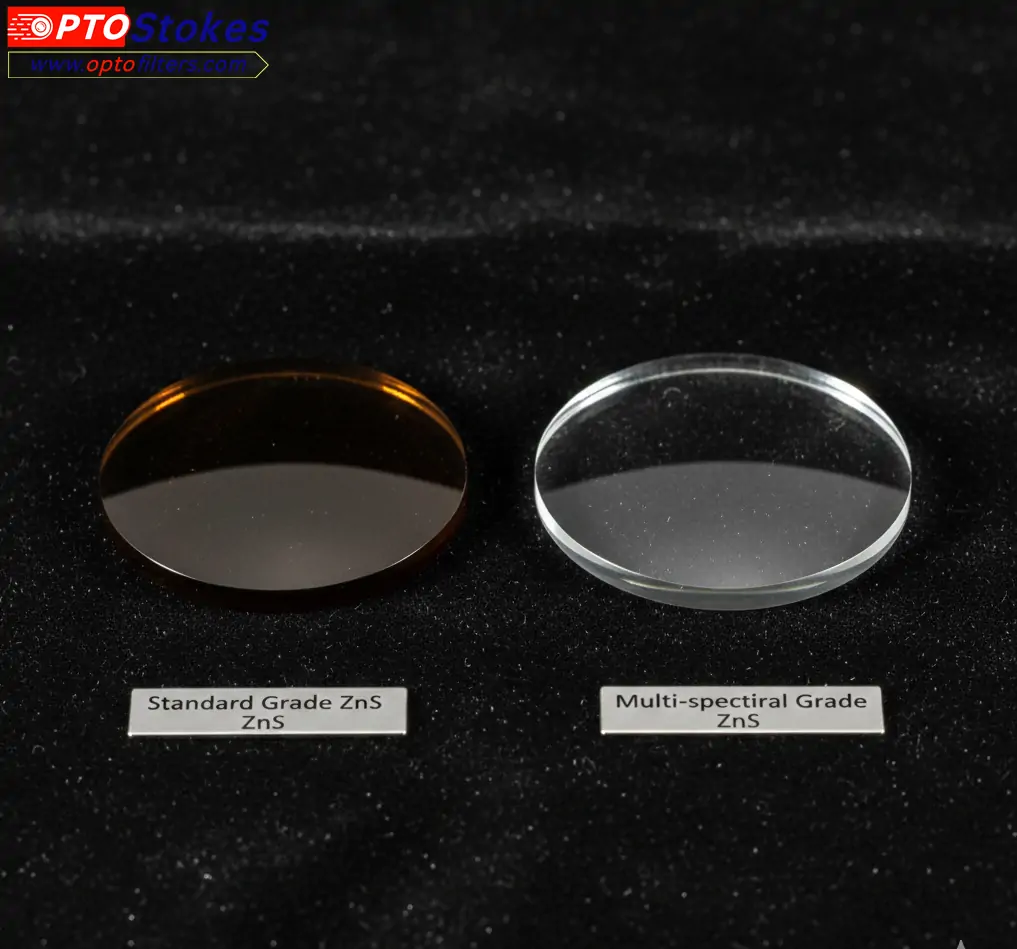
| Visual Appearance | Translucent yellow to dark amber | Water-clear / Transparent |
| Spectral Range | 8.0 μm – 12.0 &um (LWIR) | 0.4 μm – 12.0 um (Vis to LWIR) |
| Processing Method | As-grown CVD deposition | CVD followed by Hot Isostatic Pressing (HIP) |
| Scatter & Microstructure | Higher microscopic grain-boundary scatter in visible/SWIR | Defect clusters eliminated; minimal internal scatter |
| Primary Applications | LWIR thermal imaging windows, industrial monitoring | Multispectral EO/IR targeting systems, tri-band sensors |
1. Standard FLIR Grade ZnS
As-grown CVD ZnS exhibits a yellowish or amber appearance caused by internal lattice imperfections and grain boundary scatter. Although opaque in the visible spectrum, FLIR grade ZnS delivers consistent optical performance across the 8–12 um LWIR band. Its high fracture toughness renders it an economical choice for external thermal imaging windows, protective enclosures, and uncooled thermal sensor optics.
2. Multispectral Grade ZnS
Multispectral ZnS undergoes a secondary post-deposition process known as Hot Isostatic Pressing (HIP). Subjecting the material to intense uniform pressure and elevated temperatures reconfigures its microcrystalline lattice, eliminating scatter centers and microscopic voids. The resulting material is optically clear from 0.4 μm to 12 μm. This enables a single optical window or lens element to support aligned visible cameras, laser rangefinders, SWIR designators, and MWIR/LWIR thermal imagers simultaneously.
Engineering Applications and System Integration
Due to its environmental durability, Zinc Sulfide is specified across maritime, defense, aerospace, and industrial platforms:
Aerospace Electro-Optical Systems: Forward-facing airborne sensor pods, targeting gimbals, and EOTS systems utilize multispectral ZnS windows to maintain structural integrity under aerodynamic heating while facilitating multi-band optical transmission.
Maritime and Offshore Enclosures: Marine surveillance systems rely on ZnS protective windows to withstand high-salinity spray, moisture, and chemical corrosion without surface degradation.
Gas Analysis and Spectroscopy: The chemical inertness and wide transmission window of ZnS allow it to serve as durable sample windows in harsh industrial process spectroscopy.
Manufacturing, Diamond Turning, and IR Coating Options
Fabricating high-precision ZnS optics requires optimized machining and optical coating strategies:
Single Point Diamond Turning (SPDT): While ZnS is machinable using diamond turning techniques, its polycrystalline structure demands controlled feed rates and tooling geometry to avoid subsurface micro-fracturing along grain boundaries.
Antireflection (AR) Coatings: Due to an index of refraction around 2.2, uncoated ZnS exhibits reflection losses of approximately 28% per un-coated window (two surfaces). Custom multi-layer Broadband Antireflection (BBAR) coatings increase total transmission above 95% across target wavelengths.
Diamond-Like Carbon (DLC) Coatings: For external front-surface windows subjected to extreme rain erosion, blowing sand, or harsh maritime environments, hard carbon (DLC) coatings are applied to ensure environmental survival while maintaining functional IR throughput.
Engineering Consultation and RFQ Guidelines
At OPTOStokes, we supply precision-machined Chalcogenide Glass Optics, Germanium Optics, and custom CVD Zinc Sulfide (ZnS) lenses, windows, and prisms engineered to military and industrial optics specifications.
When requesting a quote or engineering review for ZnS optical components, please provide the following requirements:
Target spectral band (e.g., 8–12 um or broadband 0.4–12 um for grade selection)
Dimensional specs, tolerances, and clear aperture requirements
Surface quality standards (e.g., Scratch-Dig) and wavefront error specs
Environmental exposure conditions (temperature range, salt fog, rain erosion exposure)
Coating specification (Standard BBAR, High-Durability BBAR, or DLC)
Estimated production or prototype quantities
Contact the OPTOStokes engineering support team to discuss material selection, custom optical designs, or to submit your drawings for evaluation.