
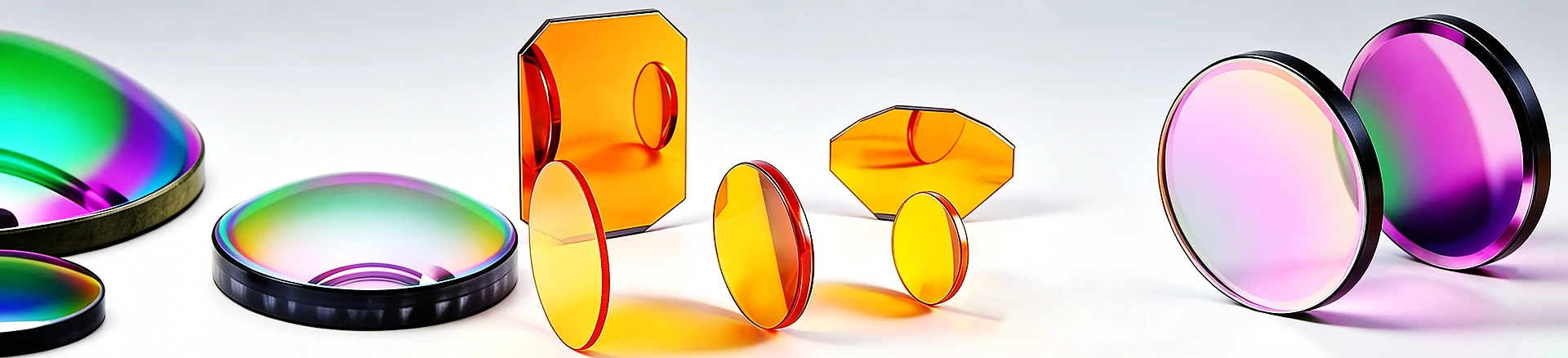
Introduction
Common oxide-based glasses are optimized for visible light transmission and form the foundation of everyday optical products. For mid-wave infrared (MWIR) and long-wave infrared (LWIR) systems, however, conventional silicate glasses are nearly opaque. Chalcogenide glass has emerged as a versatile infrared optical material, delivering wide IR transmission and flexible manufacturing capabilities for a growing range of thermal imaging and sensing applications.
What Is Chalcogenide Glass?
Chalcogenide glass is a class of amorphous inorganic optical materials. Unlike oxide glasses that use oxygen as the network-forming element, chalcogenide glasses are built on chalcogen elements — sulfur, selenium, and tellurium — combined with metalloids such as germanium, arsenic, antimony, and gallium. These elements form a stable, disordered three-dimensional covalent network that gives the material its glassy structure without crystalline order.
Based on their primary chalcogen component, chalcogenide glasses are grouped into sulfide, selenide, and telluride families, each with a distinct transmission window and refractive index profile to match different infrared wavelength bands.
The non-crystalline structure avoids the cleavage and growth limitations of single-crystal IR materials, while the chalcogenide chemical framework enables transmission far into the infrared spectrum.
Key Material Properties
Broad Infrared Transmission Window
The defining advantage of chalcogenide glass is its ability to transmit infrared light across a wide spectral range. As a material family, chalcogenide glasses cover wavelengths from approximately 0.5 µm up to 25 µm, spanning all three major atmospheric infrared windows: 1–2 µm, 3–5 µm, and 8–12 µm.
In the 8–12 µm LWIR band, uncoated chalcogenide glass typically achieves over 64% transmission; with appropriate anti-reflection coatings, surface transmission can exceed 95%. This makes the material well suited for capturing thermal radiation emitted by objects at ambient and industrial temperatures.
High Refractive Index and Optical Design Flexibility
Chalcogenide glasses offer refractive indices ranging from roughly 1.7 to 3.5, depending on composition — significantly higher than standard visible optical glasses. A higher refractive index allows optical designers to achieve equivalent focusing power with thinner, more compact elements, reducing overall system size and weight.
Many chalcogenide compositions also support achromatic design strategies in the infrared, helping to reduce chromatic aberration and improve imaging resolution in multispectral systems.
Favorable Thermal Stability
Temperature fluctuations can shift focal position and degrade image quality in infrared systems. Many chalcogenide glasses exhibit a much lower thermo-optic coefficient (dn/dT) than crystalline germanium, meaning changes in temperature have a smaller effect on refractive index and optical performance.
Combined with controllable thermal expansion and good environmental durability, this stability makes chalcogenide optics suitable for outdoor, industrial, and extreme-temperature operating conditions.
Precision Moldability for High-Volume Production
Unlike crystalline infrared materials that require labor-intensive grinding and polishing, chalcogenide glass is thermoplastic and compatible with precision glass molding. This process can form aspheric and freeform surfaces in a single production step, reducing manufacturing lead time and improving part-to-part consistency.
Chalcogenide glass also offers good chemical resistance and long-term stability, supporting extended service life in field-deployed equipment.
Chalcogenide Glass vs. Crystalline Germanium
Crystalline germanium has long been the dominant material for MWIR and LWIR optics. Chalcogenide glass serves as an alternative to conventional germanium optics for selected thermal imaging and sensing designs. The table below summarizes key differences between the two material classes.
| Characteristic | Chalcogenide Glass | Crystalline Germanium |
|---|---|---|
| Transmission range | MWIR to LWIR coverage; exact band depends on sulfide/selenide/telluride composition | Excellent MWIR and LWIR transmission; strong absorption in visible and near-IR |
| Refractive index | ~1.7–3.5, composition-dependent | ~4.0 at 10.6 µm |
| Thermo-optic behavior | Low dn/dT for most compositions; reduced thermal lensing | High dn/dT; prone to thermal focus shift |
| Manufacturing | Precision molding compatible with complex surface shapes | Conventional grinding and polishing; limited geometry options |
| Best suited for | High-volume compact systems, wide-temperature environments | High-performance MWIR/LWIR lenses, mature optical designs |
Typical Applications
Thermal Imaging and Night Vision Systems
Chalcogenide glass is widely used in security surveillance cameras and outdoor night vision devices, where it enables passive, all-weather imaging without active illumination. In automotive systems, infrared lenses made from chalcogenide glass support night vision functions that detect pedestrians and obstacles beyond headlight range, improving driving safety after dark.
Industrial Thermometry and Non-Contact Inspection
In industrial settings, chalcogenide optics are used in infrared pyrometers and thermal imaging cameras for condition monitoring. Typical use cases include electrical equipment inspection, printed circuit board thermal analysis, metallurgical process temperature measurement, and pipeline leak detection. The material enables non-contact, non-destructive temperature mapping to support predictive maintenance and process control.
Mid-Infrared Photonics and Research
Chalcogenide glasses exhibit high nonlinear refractive index and good rare-earth ion solubility, making them a candidate material for infrared fibers, mid-IR lasers, optical switches, and integrated photonic devices. They play an important role in mid-infrared optical communication, ultrafast optics, laser detection, and astronomical infrared observation research.
Aerospace and Defense Optics
The combination of thermal stability and lightweight design potential makes chalcogenide glass suitable for various aerospace and defense infrared systems, including portable night vision devices, infrared targeting optics, missile guidance lenses, and unmanned aerial system reconnaissance payloads. IR windows made from chalcogenide compositions can also serve as protective apertures for sensors operating in harsh environments.
Design and Selection Considerations
When evaluating chalcogenide glass for an infrared optical design, engineers should consider the following factors:
Operating wavelength band: Select sulfide, selenide, or telluride compositions matched to the target MWIR or LWIR spectral range.
Temperature range: Verify dn/dT and CTE values against expected operating temperatures to maintain focus stability.
Surface geometry: Leverage precision molding for aspheric and freeform surfaces to reduce element count and system size.
Coating compatibility: Pair the substrate with AR, DLC, or other functional coatings to maximize transmission and environmental durability.
Production volume: Chalcogenide molding is particularly cost-effective at medium to high production volumes.
For guidance on matching material composition to your application, explore our infrared optical materials overview or submit your design requirements for engineering review.
Summary
Chalcogenide glass offers a valuable combination of wide infrared transmission, high refractive index, good thermal stability, and scalable precision manufacturing. It complements traditional crystalline IR materials and enables compact, cost-effective optical solutions for MWIR and LWIR thermal imaging, industrial sensing, and photonic applications.
Optimal material selection depends on wavelength requirements, environmental conditions, optical design targets, and production volume. Early engineering review can help identify the most suitable substrate and coating configuration for each project.
If you are evaluating chalcogenide glass optics for your next program, share your drawing, wavelength range, dimensions, coating requirements, operating conditions, and estimated quantity. Our engineering team will review your specifications and provide a tailored quotation and material recommendation. Contact us at sales@iroptical.com to start your assessment.