
How to Overcome Critical Defects in CVD ZnSe Prism Polishing and Cutting?
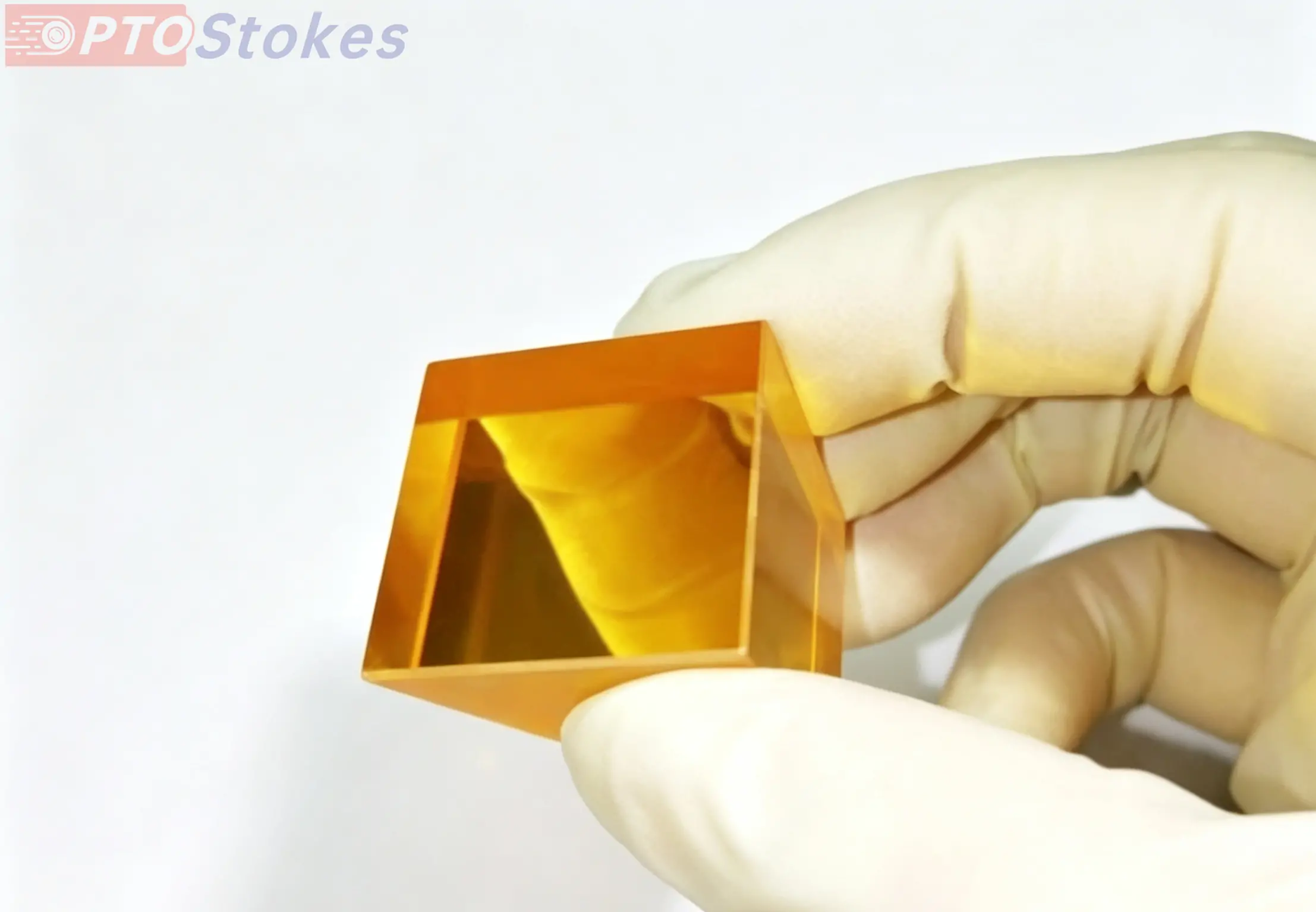
Zinc Selenide (ZnSe) produced via Chemical Vapor Deposition is a premier optical substrate for thermal imaging, FTIR spectroscopy, and high-power CO2 laser systems. Because CVD ZnSe exhibits exceptional bulk purity and broad infrared transmission, it is the primary choice for precision IR prisms. However, its low Knoop hardness (approx. 100-120 kg/mm²) and high brittleness present severe manufacturing challenges. Inadequate process control during cutting, grinding, and polishing leads to subsurface lattice degradation, surface micro-chipping, and angular deviations. At iroptical, rigorous production protocols prevent four main defects during ZnSe prism fabrication.
Key Machining Defects and Engineering Mitigations
| Defect Type | Primary Root Cause | Engineering Mitigation Strategy |
|---|---|---|
| Surface Scratches & Edge Chipping | Excessive mechanical force, coarse abrasive grains, or particulate contamination acting on soft substrate. | Graded micro-abrasive sequences, controlled lap pressures, elastic tooling, and stringent cleanroom protocols. |
| Sub-target IR Transmission | Thick subsurface damage (SSD) layer, non-uniform AR coating, or internal bulk material flaws. | Multi-stage chemical-mechanical polishing (CMP), pre-blank ultrasonic damage inspection, optimized thin-film deposition. |
| Angular & Beam Steering Errors | Cumulative machining stress relief post-processing, inaccurate goniometer tooling calibration. | Interstage stress-relief thermal annealing, high-precision laser autocollimator verification. |
| Hygroscopic Degradation & Oxidation | High relative humidity exposure during polishing/storage leading to surface fogging and scattering loss. | Humidity-controlled cleanroom processing, immediate protective dielectric coating, vacuum sealing. |
1. Surface Scratches and Edge Micro-Chipping
Due to its low mechanical hardness, CVD Zinc Selenide is susceptible to localized mechanical damage. High down-force during lapping, residual abrasive agglomerates, or non-uniform edge stress during chamfering directly cause deep surface grooves and perimeter fracture. To mitigate these risks, iroptical implements a multi-step grinding schedule using progressively finer diamond slurries. Workstations maintain ISO Class 5 air cleanliness, with solvent wipes applied after each phase. Elastic polishing pads and customized flexible fixtures distribute mechanical forces evenly across prism apexes and facets.
2. Sub-target Infrared Transmission Performance
Infrared transmittance directly impacts system signal-to-noise ratios and beam throughput. Below-specification transmission usually stems from three factors: unremoved subsurface damage (SSD) causing forward scatter, poor optical thin-film adhesion, or raw substrate inclusions. Our facility addresses this by applying a specialized chemical-mechanical polishing (CMP) cycle that eliminates SSD without introducing mechanical stress. Before optical coating, raw blanks undergo full-spectrum laser inspection to reject internal striations or inclusions. Thin-film deposition occurs in high-vacuum chambers, applying durable mil-spec coating runs to guarantee environmental stability and peak throughput.
3. Angular Tolerance and Spatial Deviation
Precision prisms depend on exact internal reflection and refractance angles. Deviation in wedge, roof, or right angles distorts system optical paths. These errors typically stem from cumulative thermal and grinding stresses that relax post-machining, altering geometry. To prevent dimensional drift, our process integrates controlled thermal annealing cycles between coarse grinding and fine polishing steps. Angle accuracy is continuously monitored using high-accuracy laser autocollimators, ensuring final angular tolerances remain within tight arcsecond specifications.
4. Environmental Fogging and Surface Oxidation
Although stable under ambient dry conditions, bare ZnSe optics exposed to high humidity and elevated temperatures during processing suffer surface hydration and mild oxidation. This yields a cloudy surface haze that degrades IR throughput. We isolate all precision polishing and handling within climate-controlled cleanrooms held below strictly monitored relative humidity thresholds. Immediately following surface figure verification, prisms receive environmental barrier coatings and are sealed in desiccant-backed vacuum packaging to block moisture exposure prior to integration.
Technical Consultations and Custom Optics Sourcing
High-yield fabrication of CVD ZnSe prisms requires strict process control at every production stage. Whether you need off-the-shelf inventory or custom optics with tight angular tolerances and high laser damage thresholds, iroptical provides predictable lead times and reliable quality control. Contact our engineering team at sales@iroptical.com to review your custom drawings, request technical datasheets, or evaluate prototype samples for your application.