
CVD Zinc Sulfide Optics: Standard FLIR vs. Multispectral Grade Selection Guide
In thermal imaging, airborne defense, and multispectral sensing systems, optical designers frequently require materials that balance broadband infrared transparency with severe environmental survivability. Chemical Vapor Deposition Zinc Sulfide (CVD ZnS) is a core optical material engineered to protect sensitive detectors against rain erosion, sand abrasion, thermal shock, and high mechanical loads.
This technical guide evaluates the physical characteristics, optical performance differences, coating selection, and design considerations for standard FLIR-grade CVD ZnS and multispectral CVD ZnS components.
Material Synthesis & Synthesis-Driven Properties
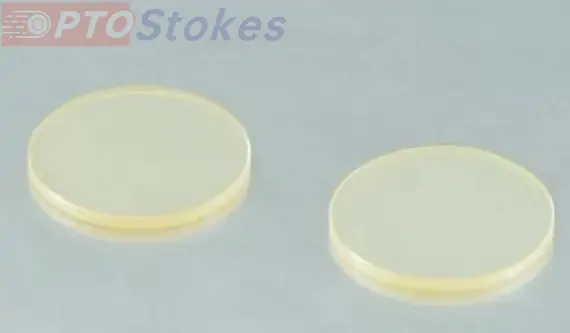
CVD ZnS is synthesized through a gas-phase reaction of zinc vapor and hydrogen sulfide gas, producing a dense, polycrystalline bulk material. The as-deposited material inherently contains microscopic lattice defects and grain boundary scattering centers, which yield a yellowish, visually opaque appearance while offering strong transmission in the long-wave infrared (LWIR) spectrum.
To eliminate short-wavelength scattering, raw CVD ZnS blanks undergo a post-deposition Hot Isostatic Pressing (HIP) process under elevated temperature and pressure. This treatment rearranges the polycrystalline structure, yielding multispectral ZnS (commonly known as Cleartran or water-clear ZnS), which exhibits broad optical transparency from the visible spectrum through the LWIR band.
Standard CVD ZnS vs. Multispectral ZnS
Selecting between standard FLIR-grade ZnS and multispectral ZnS depends on optical bandwidth requirements, mechanical stress exposure, and target system architecture. The table below outlines key technical parameters:
| Parameter | Standard CVD ZnS (FLIR Grade) | Multispectral CVD ZnS (Cleartran) |
|---|---|---|
| Transmission Wavelength Range | 8.0 µm – 12.0 µm (LWIR Focus) | 0.4 µm – 12.0 µm (VIS to LWIR) |
| Visual Appearance | Opaque / Yellow-Orange (High VIS/NIR scattering) | Water-clear / Water-transparent |
| Refractive Index (at 10 µm) | ~2.20 | ~2.20 |
| Knoop Hardness | ~230 kg/mm² | ~160 kg/mm² |
| Flexural Strength | ~103 MPa | ~69 MPa |
| Primary Application Scope | Single-band LWIR imaging, uncooled thermal sensors, rugged external protective windows | Multi-sensor pods, boresight-aligned systems (VIS/SWIR/MWIR/LWIR), airborne electro-optical turrets |
Key Performance Factors for Optical Systems
1. Spectral Transmission Capabilities
Standard FLIR-grade ZnS provides an economical solution for dedicated 8–12 µm thermal cameras, forward-looking infrared (FLIR) pods, and thermography instruments. Multispectral ZnS extends system capabilities across VIS (0.4–0.7 µm), SWIR (1–3 µm), MWIR (3–5 µm), and LWIR (8–12 µm) wavebands. This broad spectrum allows a single protective aperture or multispectral lens assembly to serve co-aligned visible daylight cameras, laser rangefinders, and thermal sensors simultaneously.
2. Mechanical Durability & Surface Hardness
Compared to softer infrared substrates like CVD ZnSe, ZnS exhibits significantly higher mechanical hardness and flexural strength. Standard CVD ZnS features a Knoop hardness of approximately 230 kg/mm², rendering it resilient against high-velocity raindrop impact, sand particulate erosion, and structural pressure differentials encountered in defense and aerospace applications.
3. Coating Requirements & Fresnel Loss Mitigation
Because CVD ZnS possesses a high refractive index ($n \approx 2.2$ in the LWIR band), an uncoated surface incurs a Fresnel reflection loss of approximately 14% per interface, resulting in a total transmission loss exceeding 25% for an Uncoated ZnS Window. Anti-reflective (AR) coatings are required to maximize system throughput:
High-Efficiency BBAR Coatings: Applied to internal optics to achieve overall broadband transmittance >95% across target operational wavebands.
Diamond-Like Carbon (DLC) / Hard Carbon Coatings: Applied to exposed outer window faces to deliver extreme scratch resistance, moisture repelling, salt fog endurance, and severe abrasion resistance.
4. Thermal Limits & Operating Considerations
Although the sublimation point of ZnS exceeds 1700 °C, prolonged exposure to ambient oxygen at elevated temperatures causes surface oxidation, increasing scattering and reducing infrared throughput. For optical systems operating in air, the maximum recommended continuous operating temperature is 250 °C.
Design Guidelines & Trade-Off Analysis
Engineers evaluating ZnS / Cleartran ZnS windows or lenses should consider the following optical trade-offs:
ZnS vs. Germanium (Ge): Germanium offers a higher refractive index ($n \approx 4.0$) and lower chromatic dispersion in LWIR, making it ideal for compact thermal imaging lenses. However, Ge exhibits thermal runaway (transmission drop above 100 °C) and lower impact resistance. ZnS is preferred for external windows exposed to high temperatures and mechanical shock.
ZnS vs. CVD ZnSe: CVD ZnSe has lower bulk absorption at 10.6 µm, making it the industry standard for high-power CO₂ laser optics. ZnS is selected when structural strength, scratch resistance, and multispectral aperture integration take precedence over raw optical absorption floor limits.
Engineering Consultation & Request for Quote (RFQ)
OPTOStokes provides custom optical components including precision-polished ZnS optical windows, spherical lenses, prisms, and customized thin-film coated apertures tailored to customer engineering specifications. To request a technical feasibility assessment or commercial quote, please submit your engineering drawings, required spectral transmission band (MWIR/LWIR or multispectral VIS-LWIR), clear aperture specifications, environmental coating requirements (DLC or BBAR), and target quantities to our engineering team.