
ZnS Infrared Prisms: Material Selection and Optical Design Guide
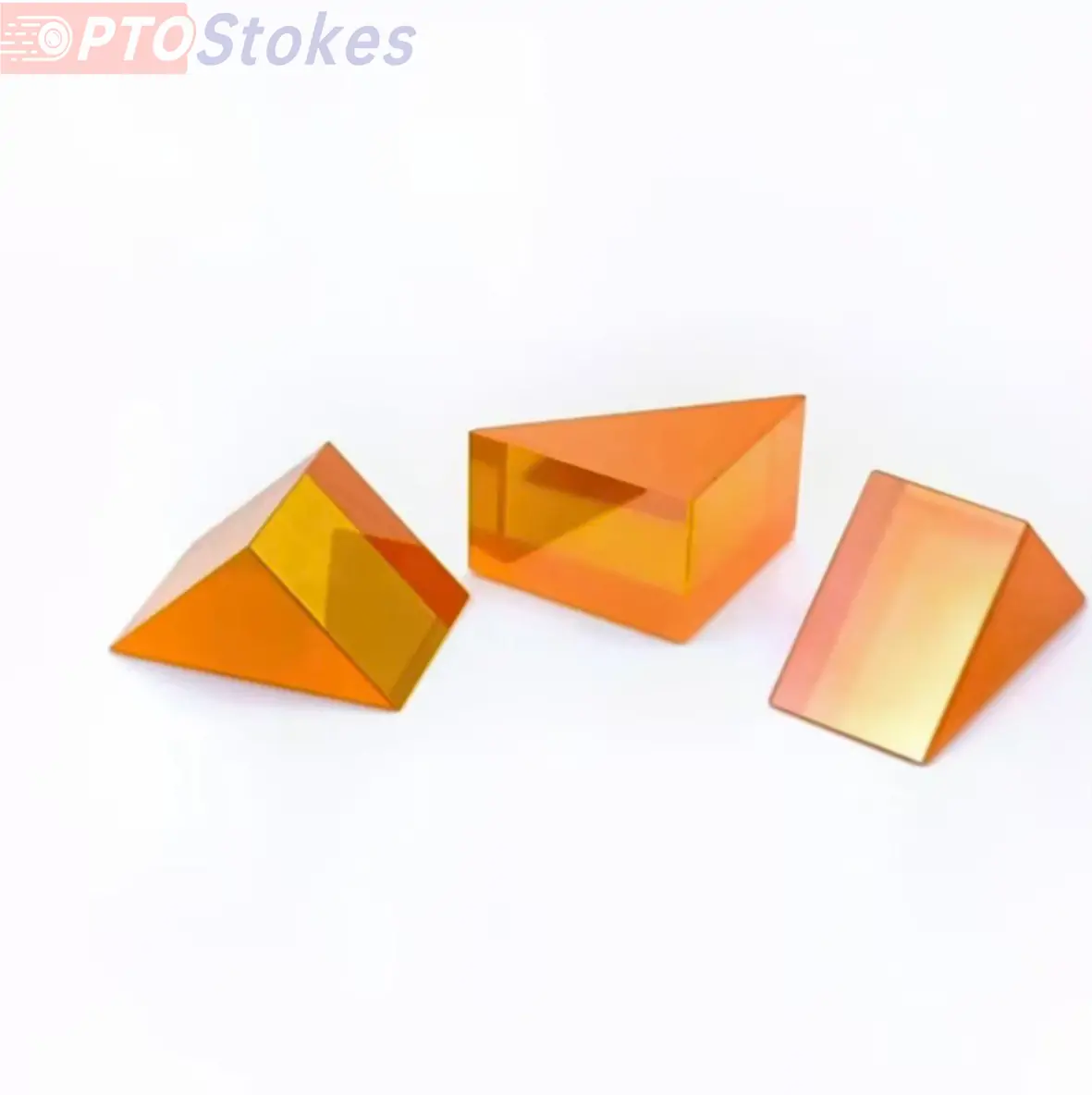
Optical prisms manufactured from Chemical Vapor Deposition Zinc Sulfide (CVD ZnS) are essential components in advanced infrared optical systems, Fourier-transform infrared (FTIR) spectrometers, multispectral imaging payloads, and gas detection instruments. By utilizing controlled refraction, dispersion, and internal reflection, IR Prisms redirect beam paths, separate spectral wavelengths, and condition optical wavefronts.
This technical guide evaluates the material grades, optical characteristics, fabrication tolerances, and engineering selection criteria for custom ZnS optical components deployed in demanding research and industrial environments.
Material Grades and Microstructure
CVD Zinc Sulfide is produced via a vapor-phase chemical reaction, yielding a dense polycrystalline structure. Depending on system requirements, ZnS prisms are fabricated from two primary material grades:
Standard CVD ZnS (FLIR Grade): Characterized by strong transmission across the 8.0 µm to 12.0 µm long-wave infrared (LWIR) band. It exhibits high mechanical strength and hardness, making it ideal for rugged thermal imaging and radiometric instruments where visible transparency is not required.
Multispectral CVD ZnS (Cleartran): Processed via Hot Isostatic Pressing (HIP) to eliminate microscopic scattering centers. This grade provides continuous broadband transmission from 0.4 µm in the visible spectrum through 12 µm in the LWIR, enabling co-aligned visible alignment lasers and infrared sensors.
Key Optical and Mechanical Performance Factors
Evaluating ZnS prisms requires analyzing fundamental bulk properties alongside tight manufacturing tolerances to ensure wavefront integrity and minimal stray light scattering:
| Parameter | Standard CVD ZnS (FLIR Grade) | Multispectral CVD ZnS (Cleartran) |
|---|---|---|
| Transmission Range | 8.0 µm – 12.0 µm (LWIR) | 0.4 µm – 12.0 µm (VIS to LWIR) |
| Refractive Index ($n$ at 10 µm) | ~2.20 | ~2.20 |
| Knoop Hardness | ~230 kg/mm² | ~160 kg/mm² |
| Surface Figure Accuracy | lambda/10 to lambda/4at 632.8 nm | lambda/10to lambda/4at 632.8 nm |
| Surface Quality (Scratch-Dig) | Typically 40-20 or 60-40 | Typically 40-20 or 20-10 |
Design Considerations and Fabrication Tolerances
1. Apex Angle and Angular Deviation
The geometric apex angle and angular tolerance of a ZnS prism dictate its dispersion and beam-steering precision. High-precision spectrometers require tight apex angle tolerances (within arcseconds) to prevent beam wander and calibration drift during spectral scanning.
2. Wavefront Distortion and Surface Quality
Prism entrance and exit faces must maintain high surface flatness (typically $\lambda/4$ or better) to preserve input beam collimation and minimize transmitted wavefront error. Surface roughness and scratch-dig specifications must be strictly controlled to suppress unwanted scatter, particularly in sensitive laser-based detection systems.
3. Thin-Film Coating Integration
Because ZnS has a relatively high refractive index ($n \approx 2.2$), uncoated prism faces experience high Fresnel reflection losses (>12% per surface). Broadband Anti-Reflection (BBAR) coatings optimized for the target operational waveband (e.g., 3–5 µm MWIR or 8–12 µm LWIR) are necessary to maximize throughput and suppress ghost reflections.
Material Comparison: ZnS vs. Alternative IR Substrates
When engineering dispersing prisms or refractive beam-steering elements, optical designers often compare ZnS with other crystalline substrates:
ZnS vs. Germanium (Ge): Germanium offers a much higher refractive index ($n \approx 4.0$), yielding higher dispersion in compact designs, but suffers from thermal runaway at elevated temperatures. ZnS provides superior environmental durability and mechanical strength.
ZnS vs. CVD ZnSe: While ZnSe is widely utilized for high-power CO₂ laser transmission due to its extremely low bulk absorption coefficient, ZnS is selected when superior hardness, erosion resistance, and multispectral capabilities are prioritized.
Engineering Guidelines for RFQ and Procurement
To ensure optimal system integration, engineering teams specifying custom ZnS prisms should define the following parameters:
Operating Wavelength Band: Specify whether single-band LWIR or multispectral VIS-LWIR performance is required.
Prism Geometry & Dimensions: Provide complete mechanical drawings detailing apex angles, clear aperture, and dimensional tolerances.
Surface Specifications: Define required wavefront error, surface flatness, and scratch-dig quality.
Coating Requirements: Specify BBAR coating wavelength ranges and angle of incidence (AOI).
Operating Environment: Note exposure to moisture, thermal cycling, or mechanical shock.
Engineering Consultation & Request for Quote
OPTOStokes manufactures custom CVD Zinc Sulfide prisms, lenses, and infrared windows tailored to rigorous optical engineering specifications. To initiate an engineering review or request a quotation, please submit your optical drawings, required wavelength range, clear aperture dimensions, surface precision, coating requirements, and order quantity through our website or contact email.