
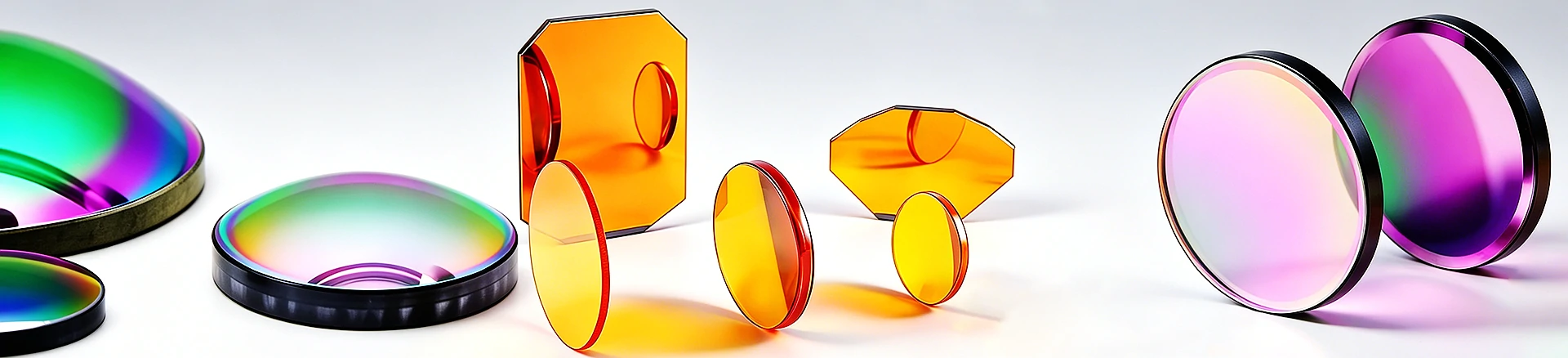
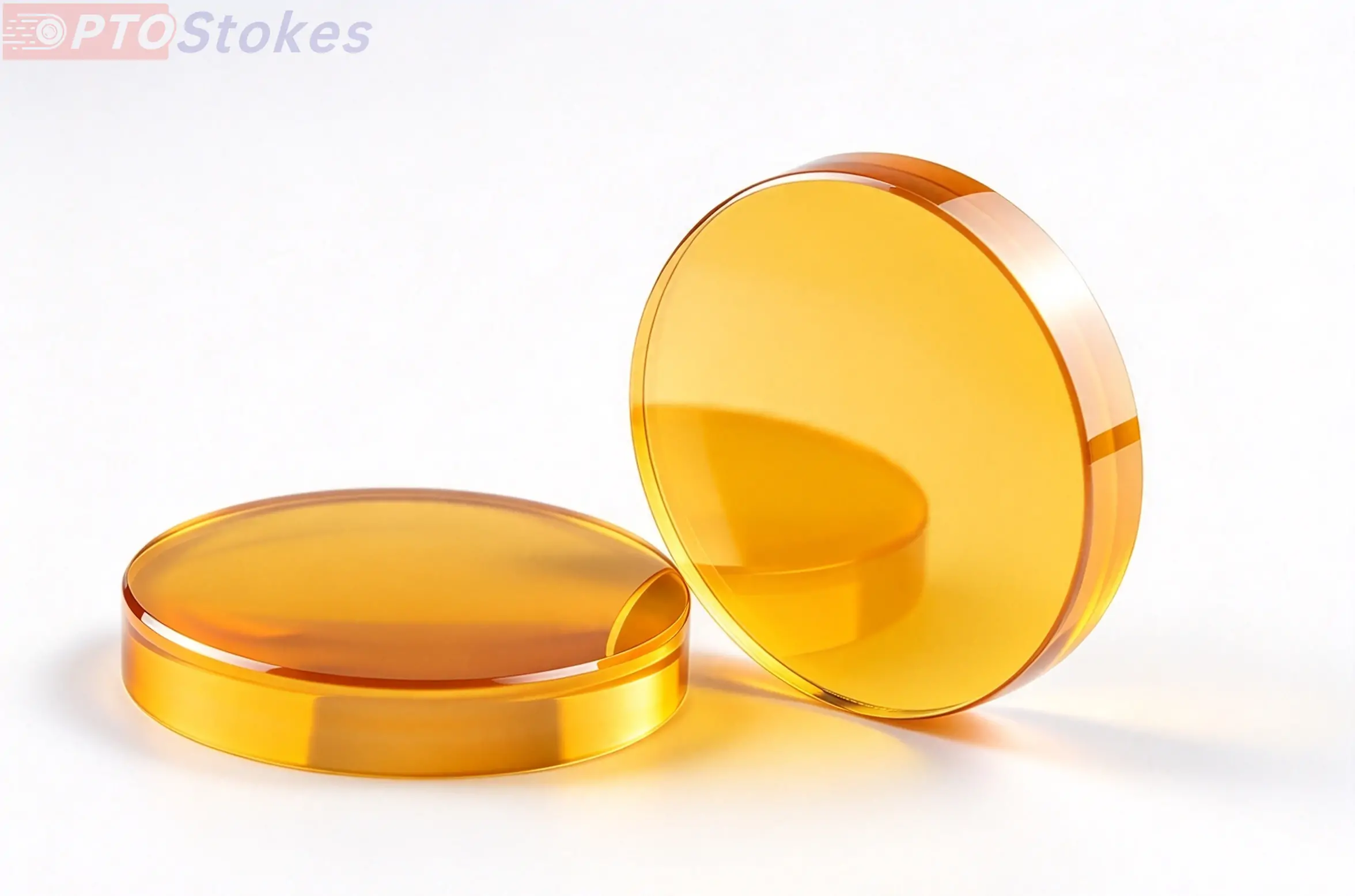
CO2 laser focus lenses are critical consumables for all industrial cutting and marking systems. They take the expanded beam from the laser resonator and focus it into a tight, high-energy spot that melts or vaporizes workpiece material. The condition of this single component directly determines cut speed, edge quality, and overall operating cost.
Focus lenses mount near the bottom of the cutting head, just above the nozzle, typically 1–2 cm from the workpiece. They are the last optical component the beam passes through before reaching the material, so even minor surface damage disrupts the focal point and degrades performance.
Common CO2 Focus Lens Materials & Types
Most 10.6μm CO2 laser focus lenses are made from one of two materials, each with distinct performance properties:
| Material | Key Characteristics | Knoop Hardness | Softening Temperature |
|---|---|---|---|
| Zinc Selenide (ZnSe) | High transmission, warm reddish tint, relatively soft; sensitive to scratches and impact | ~120 | ~250°C |
| Gallium Arsenide (GaAs) | Dark opaque appearance, much harder and more scratch-resistant; higher cost | ~731 | ~1238°C |
For most general-purpose cutting and marking applications, CVD ZnSe lenses are the industry standard due to their excellent transmission-to-cost ratio.
Focus lenses are available in plano-convex (the most common) and meniscus profiles. Both sides are coated with anti-reflective (AR) coating optimized for 10.6μm optics to maximize energy throughput and produce a tight focal spot. Coating durability is a key factor in overall lens lifespan, and cannot be reliably judged by visual inspection alone.
A brand-new lens will have a perfectly clear, uniform clear aperture when held up to light. Over time, normal use will gradually degrade the surface and coating. This guide explains how to assess lens condition, predict end of life, and maximize service life through proper care.
Key Signs Your CO2 Focus Lens Needs Replacement
Visual Inspection Under Light
The fastest way to assess lens condition is to hold the lens by its outer edges (never touch the clear aperture) and inspect it under a bright light or flashlight.
Clear: Normal condition. Light passes through as a clean, uniform beam, identical to a new lens.
Hazy: The clear aperture looks frosted, like breath on glass. This indicates coating erosion or surface contamination that scatters the laser beam.
Darkened: Uneven yellow or gray discoloration across the surface. This is typically caused by oil, fume buildup, or advanced coating aging.
Burn spots: Isolated black dots or pinpoint craters in the clear aperture. This is permanent damage where the laser has broken through the coating.
A common workshop mistake is wiping a hazy lens with alcohol, seeing temporary clarity, and returning it to service — only for the haze to return within days. This happens because the coating itself has become textured, and wiping only removes surface dust, not the underlying damage.
Deteriorating Cut Quality
A degraded lens disperses laser energy instead of focusing it into a tight spot, leading to wider, uneven kerfs, heavy dross that is difficult to remove, and incomplete cuts on material that previously processed cleanly.
If cuts are straight on one side and jagged on the other, or circles cut as ovals, first check for lens misalignment or beam drift before replacing the lens.
Increased Power Requirement
If you need to raise laser power output to cut the same material at the same speed, the lens is likely absorbing more energy due to coating wear or surface contamination. This creates a destructive cycle: higher absorption raises lens temperature, which further increases absorption and accelerates coating failure.
Continuing to run an underperforming lens at elevated power wastes energy and dramatically shortens remaining service life. The combined cost of extra power consumption and premature lens replacement almost always exceeds the cost of timely replacement.
Abnormal Spark Pattern
During cutting, a properly focused lens produces a tight, uniform, downward-directed spark stream from the nozzle. A worn or damaged lens creates scattered, uneven, or skewed sparks. Note that misaligned nozzles or assist gas issues can also cause abnormal spark patterns, so cross-reference with other signs for an accurate diagnosis.
| Warning Sign | Appearance | Root Cause | Risk of Delayed Replacement |
|---|---|---|---|
| Hazy clear aperture | Foggy, frosted look across the optical surface | Coating erosion or surface contamination causing light scatter | Incomplete cuts, dross buildup, accelerated thermal damage |
| Darkened/yellowed surface | Uneven dark or yellow discoloration across the lens | Oil, fume buildup, or advanced coating aging | Steady drop in transmission, worsening cut quality |
| Burn spots/pits | Pinpoint black spots or tiny craters in the clear aperture | Laser-induced coating breakdown, often with substrate damage | Progressive damage spread, risk of catastrophic lens failure |
| Wide kerf & heavy dross | Wider uneven cut seam, hard-to-remove molten debris | Defocused beam from scattered laser energy | Higher scrap rate, reduced cutting efficiency |
| Higher power demand | Need for increased power settings for same material | Increased energy absorption by damaged lens | Thermal runaway, rapid burn spot formation |
| Scattered spark pattern | Uneven, skewed or dispersed spark stream from nozzle | Distorted beam shape and shifted focal point | Poor edge quality, inconsistent dimensional accuracy |
Why Lens Lifespan Varies Widely Between Setups
Two identical focus lenses can have service lives ranging from two weeks to three months, depending entirely on operating conditions. The following factors have the greatest impact:
| Operating Factor | Impact on Lifespan | Typical Shop Floor Variation |
|---|---|---|
| Laser power level | Higher power increases thermal load and accelerates contamination burn-in | A 3000W system generates 10x more thermal stress on the lens than a 300W system over the same runtime |
| Assist gas quality | Oil, moisture, and particulates in gas directly contaminate the lens surface | Clean dry nitrogen maximizes lifespan; compressed air with oil/water causes rapid spotting; oxygen cutting produces more splatter |
| Cleaning practice | Improper wiping scratches coatings and accelerates degradation | Dry wiping with paper or clothing acts like sandpaper; proper single-direction wiping with lint-free material preserves coating integrity |
| Workshop environment | Dust, fumes, and poor nozzle airflow increase surface contamination | Weak cutting head airflow allows upward splatter to strike the lens; high-dust environments speed up soiling |
| Coating durability | Hard, dense AR coatings resist wiping and contamination far better than soft coatings | Premium coatings remain clear after dozens of cleanings; low-quality coatings haze after a few wipes |
For example, 1.5mm stainless steel cutting with clean, dry nitrogen and proper airflow can keep a lens in good condition for two months or more. The same application using unfiltered compressed air with moisture buildup can cause visible hazing in as little as two weeks.
Thick material piercing is especially hard on lenses: poorly timed gas delay allows molten material splatter to shoot upward and pit the lens surface in a single incident, regardless of lens quality.
Burn Spots vs. Surface Hazing: Critical Differences
Both conditions reduce lens clarity, but they require completely different responses. Confusing the two can lead to unnecessary damage or wasted downtime.
| Characteristic | Burn Spots | Surface Hazing |
|---|---|---|
| Appearance | Isolated black dots or pinpoint craters in the clear aperture | Uniform frosted or foggy look across the surface, no distinct pits |
| Root cause | Laser energy has broken through the coating and may have damaged the substrate | Surface contamination (oil, fumes, dust) or early-stage coating degradation |
| Can be cleaned? | No — wiping will not remove pits and may worsen surrounding damage | Mild cases can be restored with proper cleaning technique |
| Recommended action | Replace immediately; do not return to service | Clean and retest; replace if hazing returns quickly |
| Consequence of delay | Damage spreads rapidly; risk of full lens fracture and damage to downstream optics | Gradual performance decline; usually lasts days to weeks before replacement is needed |
Safety note: Never handle cracked or broken ZnSe lens fragments with bare hands, and do not inhale fumes from laser-damaged ZnSe. Use gloves and tools to handle broken pieces, and dispose of them properly.
Proper Lens Cleaning Technique to Avoid Damage
More lenses are damaged by improper cleaning than by normal operation. Follow these steps to safely clean contaminated lenses:
Step 1: Blow Off Loose Debris First
Before wiping, use a rubber bulb blower or filtered dry nitrogen to blow loose dust and particulates off the surface. Never start with a dry wipe — embedded grit will scratch the coating like sandpaper.
Step 2: Use the Right Materials
Use lint-free optical tissue and reagent-grade anhydrous ethanol. Do not use medical-grade alcohol, which contains water and will leave streaks. Wipe gently in a single direction from the center of the lens outward, using light, even pressure. Do not rub back and forth. Use each tissue only once.
Step 3: Clean Only at Room Temperature
Never clean a warm lens immediately after operation. Thermal shock from cool cleaning fluid can crack the substrate. Allow the lens to cool fully before handling.
Step 4: Inspect After Cleaning
Hold the lens up to a light source after cleaning to check for streaks, lint, or new scratches. If hazing remains after proper cleaning, the coating has degraded and the lens should be replaced.
Troubleshooting Poor Cut Performance: Step-by-Step
If you experience incomplete cuts or heavy dross, follow this sequence before replacing the lens or adjusting machine parameters:
Verify cutting head airflow and nozzle condition. Clogged nozzles or poor gas flow cause upward splatter that contaminates the lens, and are the most common root cause of sudden quality drops.
Remove the lens and inspect it under bright light. Identify whether the issue is hazing, discoloration, or burn spots.
If only mild hazing or surface dirt is present, clean the lens following proper procedure, reinstall it, and run a test cut.
If performance returns to normal, log the cleaning and schedule more frequent visual inspections.
If cleaning does not resolve the issue, or if burn spots are present, replace the lens immediately.
If a new lens does not restore cut quality, the issue lies elsewhere: beam misalignment, focal position shift, or declining laser output power. Contact a service technician for alignment and calibration.
The lens is always the fastest and easiest component to check, but it is not the only possible cause of poor cutting performance.
Spare Lens Storage Best Practices
Proper storage extends the shelf life of spare lenses and prevents damage before installation. These guidelines apply to all precision IR optical components used in laser and thermal imaging systems.
Keep dry: Store lenses in a sealed container with desiccant. While ZnSe substrate is not hygroscopic, AR coatings degrade under prolonged high humidity and can develop mold spots from skin oil contact.
Do not stack: Never stack lenses directly on top of each other. Store them individually with the coated side facing up, and do not place heavy objects on top.
Handle by edges only: Always hold lenses by their outer edges, and wear powder-free gloves or finger cots. A single fingerprint in the clear aperture becomes an energy absorption point when the laser is active.
Store vertically: Vertical storage is more stable than flat stacking and reduces risk of impact damage from falling objects.
Always inspect new lenses under light before installation. Shipping vibration or pressure can cause scratches or coating damage in transit.
Need Reliable CO2 Laser Optics for Your Operation?
IROptical manufactures high-performance CVD ZnSe focus lenses and CO2 laser optics for industrial cutting, marking, and engraving systems. We maintain an extensive in-stock catalog for fast delivery, and offer full custom manufacturing with engineering review for application-specific requirements. All products are produced under ISO 9001:2015 aligned processes with predictable lead times and consistent quality.
For technical consultation, sample requests, or custom quotation, contact our engineering and sourcing team at sales@iroptical.com or submit your drawing and requirements through our website RFQ form.