
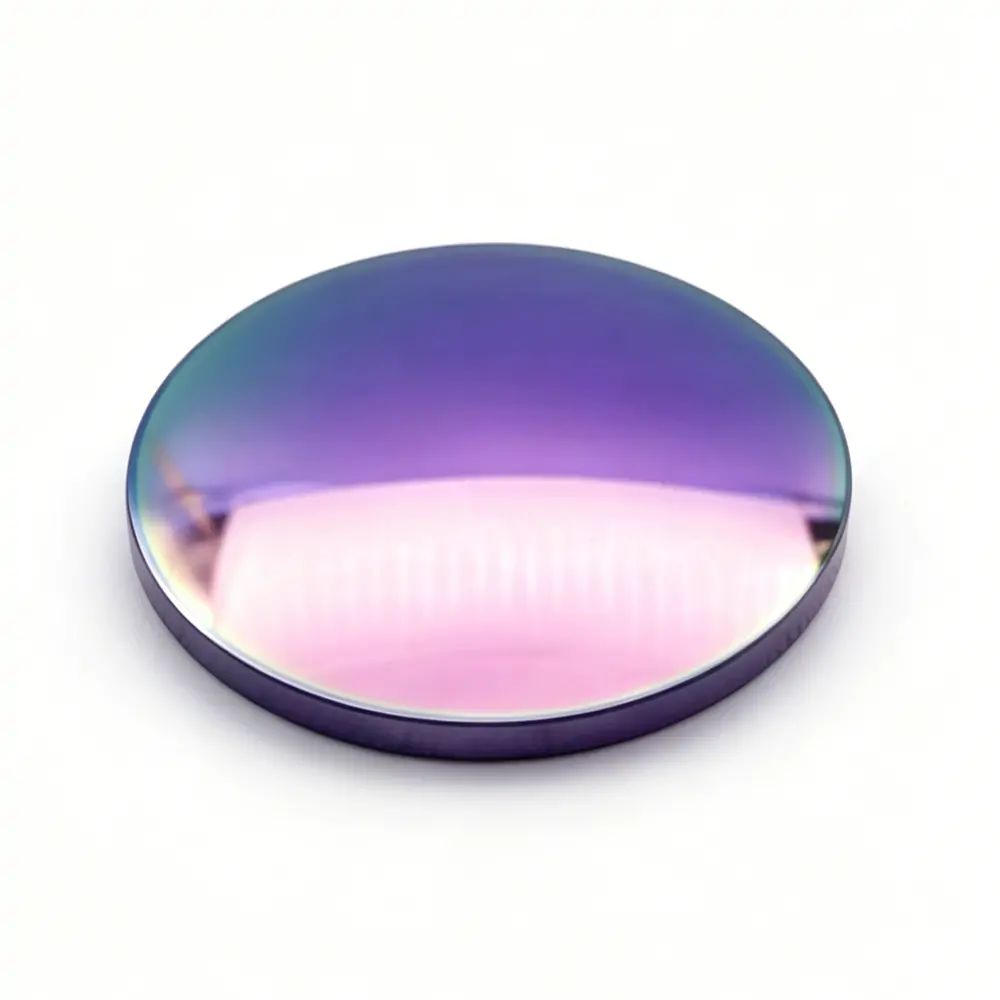
Silicon Plano-Convex Lenses
Silicon plano-convex lenses for 1.2-8 um infrared systems, including uncoated and 3-5 um AR-coated options for MWIR applications.
Quick Specifications
Product Description
Overview
Silicon plano-convex lenses are positive focal length spherical lenses for infrared optical systems. One surface is flat and the other surface is convex, allowing the lens to focus collimated infrared radiation or collimate radiation from a point source.
Single-crystal silicon is used in NIR and MWIR optical systems because it combines useful infrared transmission, high thermal conductivity, low density, high hardness, and strong mechanical stability. It is commonly reviewed for infrared lenses, windows, substrates, and optical components in sensing, imaging, medical, defense, and industrial systems.
Why Silicon Matters for MWIR Lenses
Silicon is lighter and harder than Germanium, making it useful for compact infrared instruments and mechanically demanding assemblies. It is suitable for many 1.2-8 µm applications, but it should not be selected for 10.6 µm CO2 laser transmission optics because of absorption behavior near that wavelength.
Quick Specifications
| Parameter | Guidance |
|---|---|
| Material | Single-crystal Silicon (Si) |
| Lens Type | Plano-convex spherical lens |
| Typical Transmission Range | Approximately 1.2-8.0 µm for common infrared transmission applications |
| Refractive Index | Approximately 3.42 in the infrared region |
| Diameter Range | 1-500 mm depending on geometry and specification |
| Processing Status | Blank, rough ground, polished, uncoated, or custom coated |
| Coating Options | Uncoated or custom infrared AR coating, including 3-5 µm broadband AR coating |
Typical Material Properties
| Property | Typical Value |
|---|---|
| Density | Approximately 2.33 g/cm3 |
| Melting Point | Approximately 1420°C |
| Thermal Expansion Coefficient | Approximately 4.15 × 10⁻⁶ /°C |
| Thermal Conductivity | Approximately 163.3 W/(m·K) at 273 K |
| Knoop Hardness | Approximately 1150 kg/mm2 |
| Young's Modulus | Approximately 131 GPa |
Standard Lens Options
The following silicon plano-convex lens options are useful for engineering selection. Final availability, coating, and inspection requirements should be confirmed before ordering.
| Diameter | Focal Length | EFL | Coating |
|---|---|---|---|
| 12.7 mm | 15.0 mm, 20.0 mm, or 40.0 mm | 14.3-39.4 mm | Uncoated or Ravg <1.5% @ 3-5 µm |
| 25.4 mm | 25.4 mm, 50.0 mm, 75.0 mm, 100.0 mm, 150.0 mm, or 200.0 mm | 24.4-198.7 mm | Uncoated or Ravg <1.5% @ 3-5 µm |
| 25.4 mm | 500.0 mm, 750.0 mm, or 1000.0 mm | 499.4-999.4 mm | Uncoated or Ravg <1.5% @ 3-5 µm |
Typical Applications
- MWIR imaging systems and infrared sensors
- Signal collection and beam control in compact optical paths
- Thermal and industrial imaging systems requiring low weight and high hardness
- Medical and defense infrared assemblies after coating and environmental review
- Selected terahertz components depending on grade and design
- Laser mirror substrates when coating design and thermal load are specified
Engineering Notes
Silicon has a high refractive index, so AR coating is normally recommended for practical infrared transmission systems. For MWIR systems, coating design and angle of incidence should be reviewed early to avoid transmission loss or unwanted reflection.
For CO2 laser transmission optics, review ZnSe material guidance instead. To request a silicon PCX lens quote, send diameter, focal length, wavelength range, coating requirement, tolerance level, quantity, and drawings through the contact form.
Key Features
Applications
Related Products

Silicon Aspheric Lenses
Silicon Aspheric Lenses for compact NIR/SWIR imaging, with Silicon material, custom size review, and coating options.

Silicon Optics
Silicon Optics for NIR/SWIR imaging, with Silicon material, custom size review, and coating options.
Silicon Windows
Silicon Windows for NIR/SWIR sensor protection and compact infrared assemblies, with Silicon material, custom size review, and coating options.
Helpful Resources