
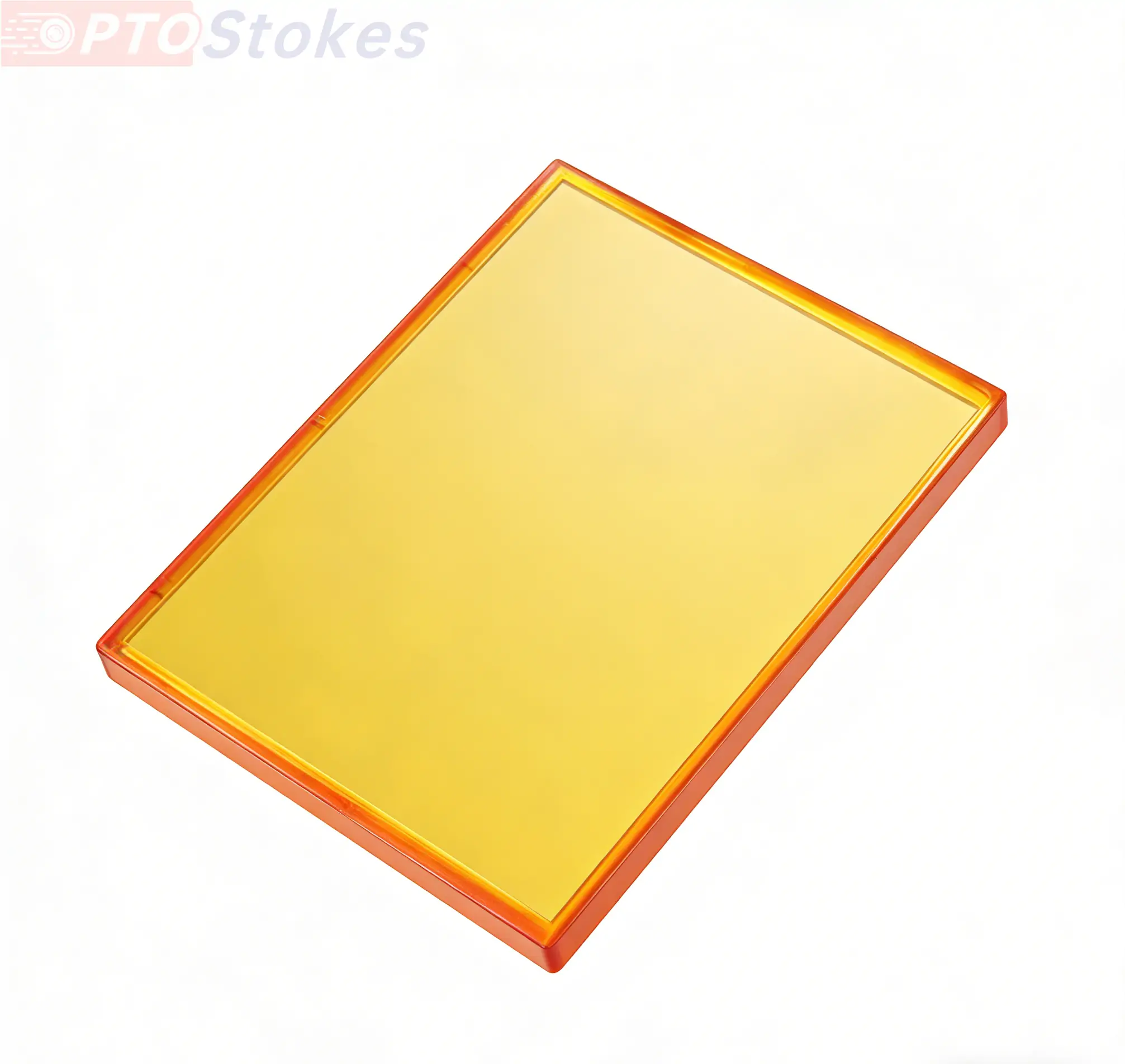
CVD ZnSe Zinc Selenide Strip Window 34 × 33 × 6.1 mm
34 33 6.1 mm CVD zinc selenide (ZnSe) long window, 0.6-21 μ m transmission, non hygroscopic, suitable for FTIR spectrometer sample chamber
Product Overview
This is a rectangular zinc selenide window that can be installed on the sample chamber of a Fourier transform infrared spectrometer, with a size of 34mm × 33mm and a thickness of 6.1mm. The reason for choosing CVD ZnSe is very practical: it transmits at 0.6-21 μ m, is insoluble in water and does not absorb moisture, and can replace halide windows such as KBr and NaCl that deliquescent and turn white when exposed to moisture, allowing the instrument to be used for a long time in laboratories with uncontrollable humidity without frequent replacement. If you need to compare infrared materials horizontally, you can refer to<a href=“ https://www.iroptical.com/materials/ Comparison of infrared materials
Technical specifications
| Project | Parameters | Description |
|---|---|---|
| Materials/Processes | Zinc Selenide (ZnSe), CVD Growth | Optical Grade, Polycrystalline |
| Dimensions | Rectangular 34 × 33 mm | |
| Thickness | 6.1 mm | Determine the interference ripple period |
| Transmission range | 0.6-21 μ m | Material typical value, lower limit about 476 cm ⁻¹ |
| Refractive index | ≈ 2.4 (10 μ m) | Typical values of materials |
| Uncoated transmittance | About 70% | Reflection loss on both sides is about 17%, theoretical calculation |
| Knoop hardness | ≈ 105 kg/mm ² | Soft material, easily scratched by dry rubbing |
| Parallelism/surface shape/surface quality/coating | Confirm according to order | This specification is not given, and drawing review is required before quotation |
Why is ZnSe often chosen for FTIR?
In a certain FTIR instrument, gas cell transmission measurement needs to be performed at 4000-500 cm ⁻¹. The sample chamber is kept open for a long time, and the humidity inside the chamber reaches 85% RH during the rainy season. The operator is accustomed to wiping the window with acetone. This operating condition directly excludes KBr - its deliquescence is not gradual, but a cliff like drop in transmittance after a single water absorption. The lower transmission limit of ZnSe is about 476 cm ⁻¹, which just covers the range of 500 cm ⁻¹; The cost is that the refractive index is too high at 2.4, and when not coated, only 70% of the overall transmission is left. Quantitative analysis will be disadvantageous, so this type of component usually needs to be equipped with an infrared anti reflection film. The applicable boundary is also clear: if the spectrum needs to extend to the far-infrared region below 400 cm ⁻¹, the phonon absorption of ZnSe will block it, and it still needs to return to CsI or diamond. Suggestions for verification conditions should be included in the procurement agreement -1000-400 cm ⁻¹ baseline scan, empty light path buckle background, and finished product measured transmission curve should be accompanied by the goods.
The same material is also commonly used in the windows and lenses of CO ₂ laser systems, where the evaluation focus is on absorption coefficient and thermal load, which is not the same as FTIR windows.
Two places that are prone to misjudgment
After a parallel plane window with a thickness of 6.1 mm enters the optical path, the front and rear surfaces form a Fabry Perot cavity, so a layer of regular ripples with a period inversely proportional to the thickness is stacked on the baseline. In engineering, it is often misinterpreted as a sample absorption peak or repeatedly adjusted as instrument drift. The discrimination method is not complicated: if the background is rescanned with an empty optical path, and the ripple shifts with the change of window tilt angle, it is window interference. The countermeasure is to choose a window with a small wedge angle, or to install the window at a tilt of 2-3 degrees in the optical path; By the way, tilting can cause slight polarization related losses, which need to be considered in quantitative analysis.
The second misjudgment is to use ZnSe as a durable component. Its Knoop hardness is only about 105 kg/mm ², much softer than common optical glass. When wiped dry with lens paper, scratches will be left, and the scratches will become scattering sources near 10 μ m, directly raising the baseline. The correct approach is to blow, wash, and suck, and try not to wipe as much as possible; For occasions that require frequent contact or wiping, choosing the hard carbon (DLC) film version is more cost-effective.
Processing, coating and clamping
The size, thickness, wedge angle, aperture, chamfer, and installation hole position are all processed according to the drawings; The coating can be selected as infrared anti reflective or DLC wear-resistant film, and the film system and indicators will be determined after the evaluation of the working band. The rigidity of the 30mm condition is limited, and it is recommended to use surface pressure or elastic compression during assembly, rather than directly pressing with screws - local pre tightening will leave stress deformation in the illuminated area, which cannot be seen under visible light, but cannot escape in the interference diagram. Similar standard components can be found in<a ref=“ https://www.iroptical.com/IRWindows/ Infrared Window Series
Information required for inquiry
Working band, size and thickness, parallelism or wedge angle requirements, coating requirements and quantity, it will be much faster to attach drawings directly. Sent to sales@iroptical.com , Or through<a ref=“ https://www.iroptical.com/contact/ Inquiry pageSubmit. The specific values for parallelism, surface shape, surface quality, and coating are not listed on this page and need to be confirmed after reviewing the drawings - this is also the part that should be discussed during the quotation stage for long-term conditions.