
High-Precision CVD Zinc Selenide (ZnSe) Plano-Convex Lenses
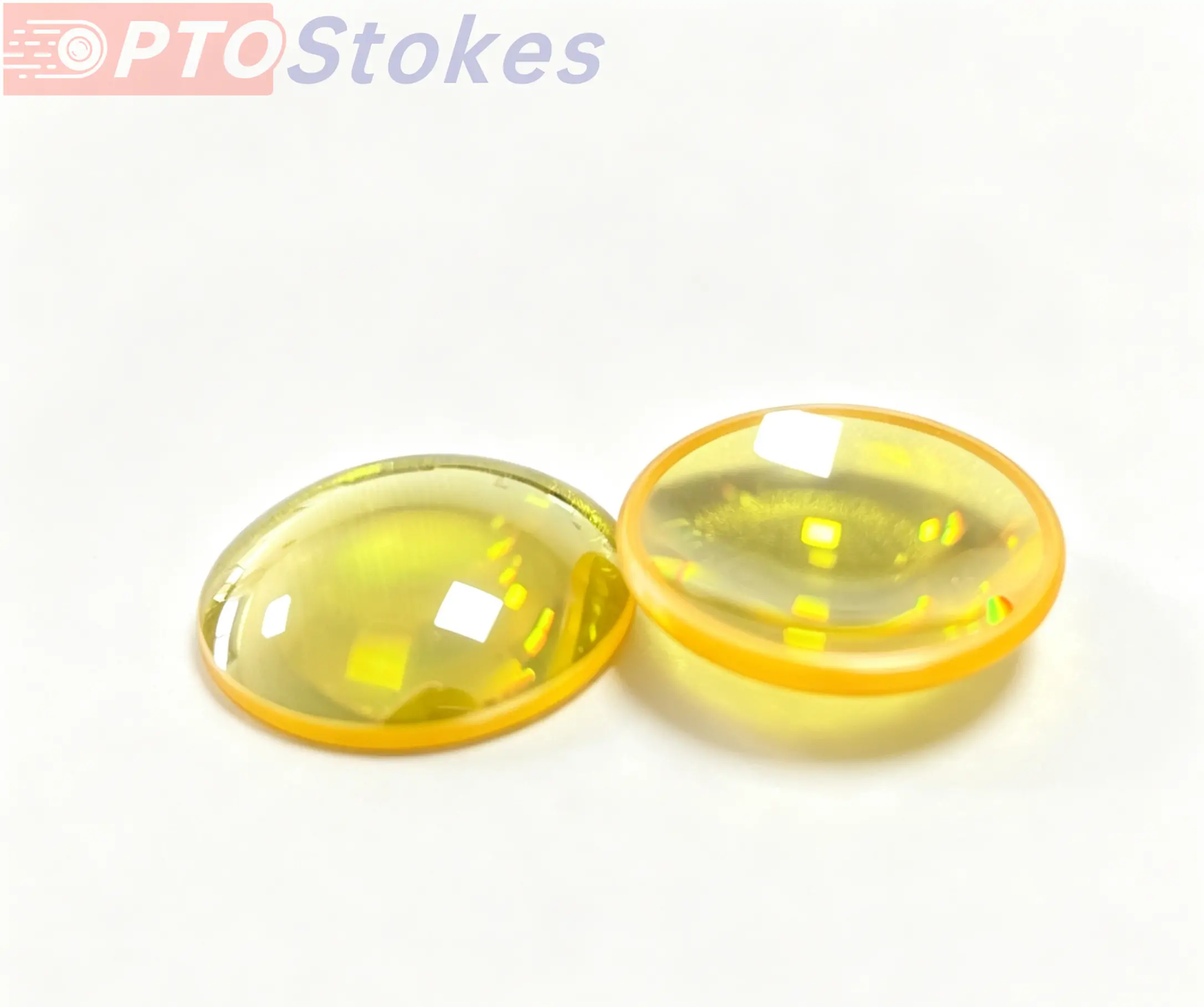
Plano-convex lenses manufactured from Chemical Vapor Deposition Zinc Selenide (CVD ZnSe) are essential optical components for focusing and beam collimation in thermal imaging and mid-to-far infrared laser systems. Featuring one flat surface and one spherical convex surface, these optics are optimized to minimize spherical aberration when focusing parallel light beams down to a diffraction-limited focal spot.
At iroptical, we engineer premium-grade CVD ZnSe lenses designed for demanding thermal applications, infrared instrumentation, and high-power laser beam delivery. Thanks to a broad transmission spectrum ranging from 0.6 µm to 16 µm, these lenses provide superior transmission at the benchmark 10.6 µm wavelength while allowing partial transmission in the visible red spectrum (e.g., 632.8 nm) for effortless red-guide laser beam alignment.
Technical Specifications & Optical Parameters
To support rigorous system integration, the critical engineering and material specifications for our ZnSe plano-convex optical elements are summarized below:
| Parameter | Standard Specification |
|---|---|
| Substrate Material | Chemical Vapor Deposition Zinc Selenide (CVD ZnSe) |
| Transmission Range | 0.6 µm to 16 µm |
| Design Wavelength | 10.6 µm (CO2 Laser Standard) |
| Refractive Index (n) | 2.403 @ 10.6 µm |
| Surface Quality (Scratch-Dig) | 40-20 (Standard) / 20-10 (Precision Grade) |
| Clear Aperture | >90% of central diameter |
| Surface Accuracy (PV) | < λ/4 @ 632.8 nm |
| Coating Options | Uncoated / Anti-Reflective (AR @ 10.6 µm) / Broadband AR (BBAR 8-12 µm) |
| Transmittance (AR Coated) | >98.5% @ 10.6 µm (per surface reflection <0.25%) |
Key Advantages for High-Power and Infrared Systems
Integrating CVD ZnSe plano-convex lenses into your optical layout offers distinct performance benefits:
Ultra-Low Bulk Absorption: Produced via chemical vapor deposition, our ZnSe material exhibits an extremely low bulk absorption coefficient (<0.0005 cm⁻¹ at 10.6 µm). This minimizes thermal absorption, reduces thermal lensing, and maintains optical beam stability during operation.
Broadband IR Performance: ZnSe delivers high transmission across the mid-wave infrared (MWIR) and long-wave infrared (LWIR) bands, making it ideal for multi-spectral sensor applications.
Visible Alignment Compatibility: Although optimized for infrared wavelengths, the slight visible transparency enables technicians to align infrared optical paths using low-power red laser diodes.
High Laser Damage Threshold (LDT): Combined with state-of-the-art AR coatings, our optics withstand high power densities typical of multi-kilowatt industrial CO2 laser optics setups.
Primary Industrial & Scientific Applications
Engineers and researchers utilize CVD ZnSe plano-convex optics across diverse high-tech sectors:
1. Industrial Laser Materials Processing
Equipped in multi-kW CO2 laser cutting, welding, and engraving systems, these optics focus laser energy to precise spots for high-speed industrial processing with clean kerfs and reduced heat-affected zones.
2. Thermal Imaging & Infrared Sensing
In high-resolution thermal cameras, thermographic equipment, and FLIR systems, ZnSe lenses accurately collect and focus thermal radiation onto IR detector arrays.
3. Medical & Surgical Laser Equipment
Used in CO2 laser surgical systems and aesthetic medical devices where precise 10.6 µm energy delivery is crucial for controlled tissue ablation and cauterization.
4. FTIR Spectroscopy & Research Optronics
Essential components in Fourier-transform infrared (FTIR) spectrometers, gas sensing instrumentation, and military-grade defense optoelectronics.
Handling, Maintenance & Handling Considerations
While CVD ZnSe offers excellent chemical stability and resistance to environmental degradation, it is a relatively soft material (Knoop Hardness ~105) and exhibits mechanical brittleness. To maximize optics lifespan:
Always wear lint-free powder-free gloves or finger cots when handling lenses.
Avoid metal tools; use plastic tweezers or soft lens holders to prevent edge chipping.
Clean exclusively with optical-grade acetone or isopropyl alcohol using delicate drop-and-drag tissue techniques.
Streamlined Sourcing & Custom Manufacturing
At iroptical, we bridge the gap between prototyping and high-volume commercial production. We maintain an extensive in-stock selection of standard focal lengths and diameters for immediate dispatch, ensuring minimal downtime for your project timelines.
Require non-standard dimensions, specific focal lengths, or specialized custom coatings? Our engineering team delivers tailored custom optical components with strict quality control, predictable lead times, and world-class optical performance guaranteed.
Discuss Your Optical Requirements with Our Engineers
Whether you need rapid delivery on off-the-shelf stock or custom ZnSe optical design support for a new prototype, iroptical is ready to assist your team. Contact our technical sales experts today to request a quotation, technical drawing, or custom coating recommendation.
Email Us Direct: sales@iroptical.com
Website: https://www.iroptical.com/