
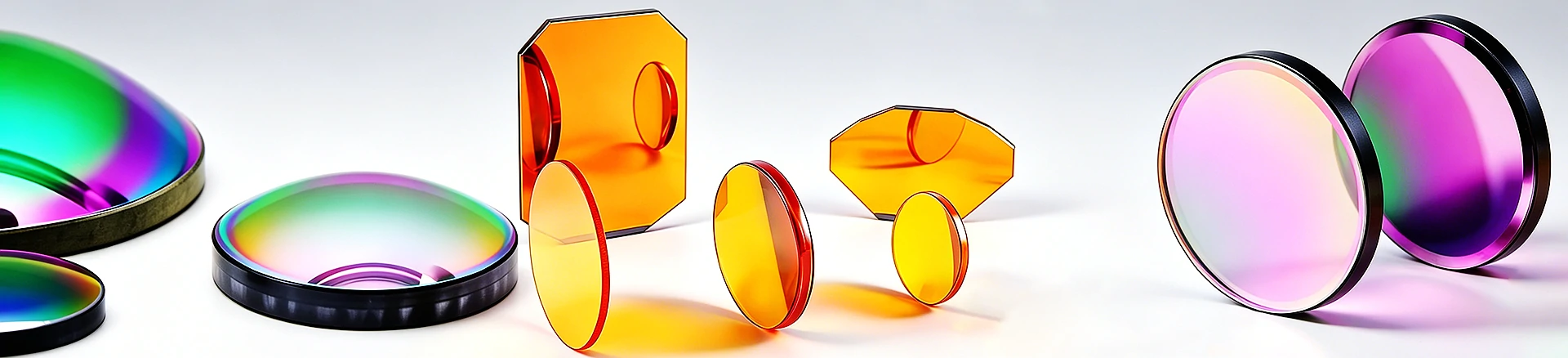
CO ₂ laser output mirror R5.98m: selection of curvature radius and cavity stability
The output coupler is the output end of the CO ₂ laser resonant cavity, and its performance is determined by two parameters: transmittance T determines how much power is output, and curvature radius R determines the stability of the cavity. This article focuses on the R-R5.98m concave output mirror, which is a common CO ₂ laser tube configuration with a radius shared by the Φ 15-25.4 mm aperture family. The value of T (10% -45%) was discussed in the previous article, and here we will talk about R and cavity type. Product specifications can be found in<a ref=“ https://www.iroptical.com/output-coupler-lenses/ Output coupling mirror series
Output mirror in cavity: clarify two parameters first
A resonant cavity consists of two mirrors: one for total reflection and one for output, with a gain medium in the middle. The cavity length ranges from tens of centimeters to over a meter - the longer the cavity, the longer the round-trip time of light, and the more susceptible the mode is to disturbance. The output mirror faces inward and outward, with the coating facing inward and the back coated with anti reflective coating to reduce glare. CO ₂ laser commonly uses stable cavities, with g1g2 falling between 0 and 1; The R of the output mirror and the R of the total reflection mirror are combined to determine the cavity type (flat concave, double concave, concave convex). The key point is that T and R are not independent: if the same cavity is replaced with R, the stable region changes and the output mode changes accordingly. Summary in one sentence - T is set for output, R is set for stability, and both parameters must be checked together when selecting the output for the mirror.
What is R5.98m
R5.98m refers to the curvature radius of the working surface of the output mirror being 5.98 meters, which is the distance from the vertex to the center of the sphere. Concave surface facing the cavity, bending edge rays towards the center, is a way to achieve cavity stability; Concave focusing makes the mold volume smaller than that of a biplane, while the larger the curvature radius, the weaker the focusing and the larger the mold volume. 5.98 m is a relatively long radius with a large mode volume, suitable for CO ₂ lasers ranging from medium to high power.
R5.98m Output Mirror Specification Family: Confirmed Items
| Project | Parameters | Description |
|---|---|---|
| Type | Output coupling mirror (OC), concave surface facing the cavity | Stable cavity output end |
| Curvature radius | R5.98 m | Concave surface facing the cavity; Symbol conventions shall be based on the drawings |
| Caliber | Φ 15/18/20/23/25.4 mm | R5.98m Concave |
| Thickness | 3-3.5 mm | Slightly increase with larger aperture |
| Transmittance T | 10% -45% | Output coupling values, see # 8 |
| Surface type | λ/10 or better | If the surface type is poor, the equivalent R is biased, and the g parameter is biased accordingly |
| Coating orientation | Coating orientation is towards the cavity, with increased transparency on the back | Reducing back light |
| Base material | Confirm according to order | Not provided in this article, need to be verified |
There is another type of dual plane output mirror with a diameter of 12.7 × 3 mm: it has no curvature and is used in a balanced flat cavity. It is not interchangeable with the R5.98m concave part - the cavity type is different and the mirror cannot be mixed. The selection order is always to first determine the cavity and then determine the mirror.
What will happen in the cavity if we switch to another R
Replacing R5.98m with a longer or shorter radius will cause the size and position of the cavity mode spot to move - the size of the gain medium is fixed, and the mode spot deviates from the gain region, resulting in a decrease in extraction efficiency and output power. This is the actual meaning of "T and R are not independent". Therefore, replacing the output mirror on site is not enough: after replacing, the mode needs to be re examined, and the power and mode shape should be restored to the design state before the cavity can be re matched. The exchange of lenses with the same R value but different T has a small impact (only changing the output ratio); Cross R value exchange is a re evaluation of the cavity, not a simple replacement.
Two places that are prone to misjudgment
The first one is the symbol convention for R. The aperture used in this article is positive for concave surfaces facing the cavity and negative for convex surfaces, but the definitions in different literature and manufacturers are not consistent. If the symbol is incorrect and the g-parameter is calculated as fully inverted, a stable cavity will be classified as an unstable cavity. Confirming the symbol convention before calculating g is more reliable than remembering a certain "standard convention" when receiving the drawing.
The second one is to underestimate the linkage between radius measurement and surface shape. R5.98m is a long curvature radius with few spherical interference fringes, and needs to be fitted using a telephoto interferometer. The surface tolerance is generally λ/10 or better - for surface differences, the equivalent R is biased, and the g parameter is biased accordingly. When the radius deviation is 1%, the variation of the g parameter is on the order of one thousandth (slightly different with cavity length), which is not fatal for most marking and cutting purposes, but for applications with high mode requirements, the tolerance and measurement method of R should be specified during acceptance, rather than just "surface shape qualified".
Information required for inquiry
Caliber and thickness, R value and symbol agreement, transmittance T, surface tolerance, base material, quantity, attached drawings are the fastest. Sent to sales@iroptical.com , Or through<a ref=“ https://www.iroptical.com/contact/ Inquiry pageSubmit. The T-position corresponding to the base material and each caliber shall be based on the results of the drawing review.