
Precision Chalcogenide IR Windows
Chalcogenide Glass Optical Window | 30mm Dia x 2mm
Precision 30mm x 2mm Chalcogenide glass IR window with λ/6 flatness and 40-20 surface quality for MWIR/LWIR thermal imaging and optical systems.
Product Overview
Chalcogenide Glass Optical Window | 30mm Dia x 2mm
Introduction
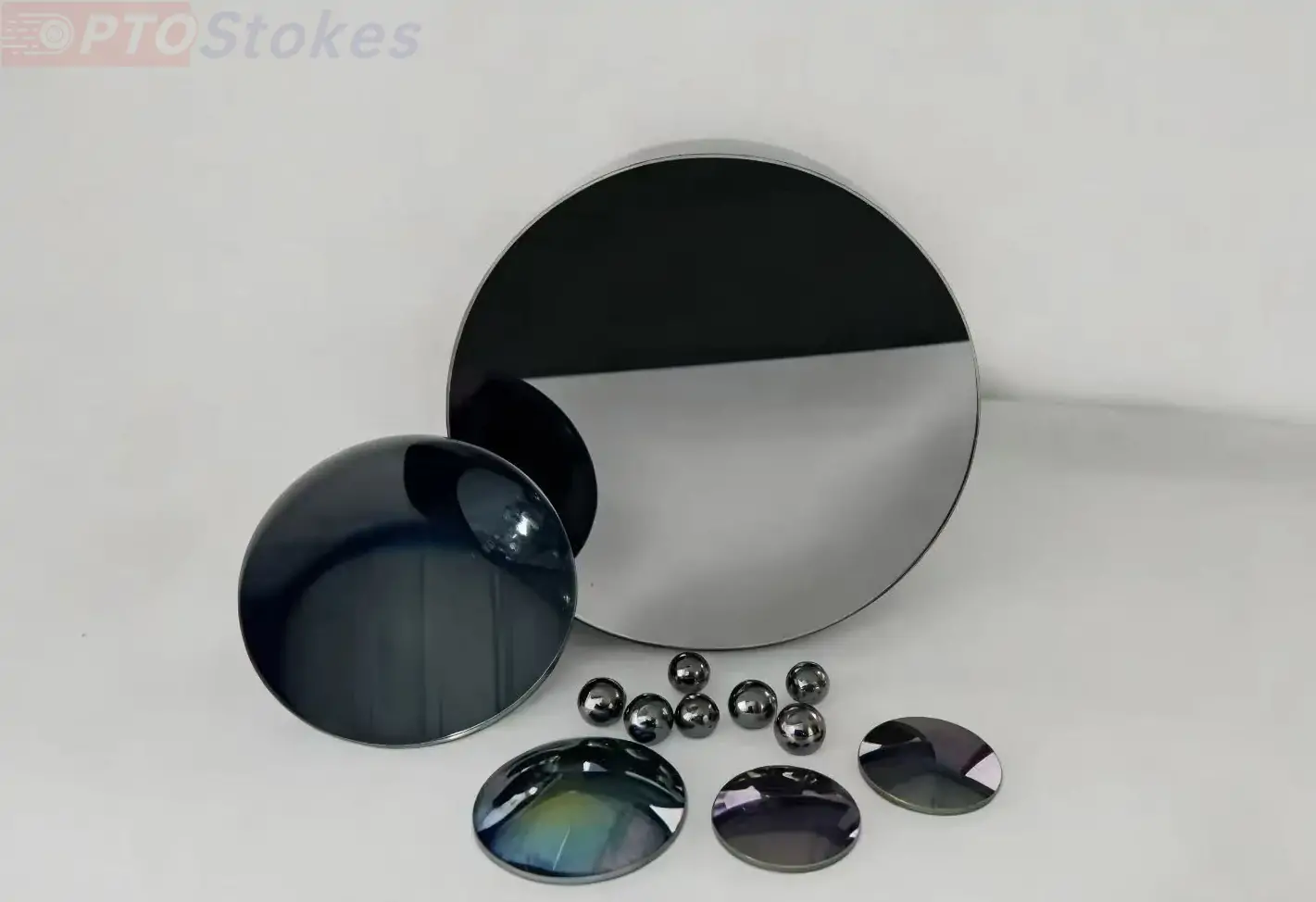
The OPTOStokes Chalcogenide Glass Optical Window (Ø30.0 mm × 2.0 mm) is a precision-polished infrared substrate designed for integration into advanced MWIR (3–5 µm) and LWIR (8–12 µm) optical systems. Chalcogenide glass serves as a viable optical alternative to conventional Germanium optics, offering favorable thermo-optic properties (dn/dT) that simplify athermalized lens design in thermal imaging and infrared sensing applications.
Manufactured under high-precision optical processing standards, this IR window provides low wave-front distortion, excellent surface quality, and reliable mechanical stability for OEM optical instruments, gas sensing modules, and thermal imaging assemblies.
Technical Specifications
| Parameter | Specification Details |
|---|---|
| Material | Chalcogenide Glass |
| Diameter | 30.0 mm (+0.0 / -0.2 mm) |
| Thickness | 2.0 mm |
| Clear Aperture | >90% of outer diameter |
| Surface Flatness (Figure) | λ/6 @ 632.8 nm |
| Surface Quality (Scratch-Dig) | 40-20 (MIL-PRF-13830B) |
| Chamfer / Bevel | <0.25 mm × 45° |
| Transmission Range | Broadband MWIR / LWIR (Grade dependent, Not specified) |
| Coating | Uncoated (Custom AR / DLC coatings available upon request) |
Material & Optical Considerations
Chalcogenide optical glasses are amorphous materials composed primarily of chalcogen elements (sulfur, selenium, and tellurium). Compared to single-crystal Germanium or Zinc Selenide (ZnSe), Chalcogenide glasses offer lower dn/dT values, making them exceptionally valuable for designing passively athermalized infrared optical systems operating across varying environmental temperatures.
While specific material grades dictate the precise transmission spectrum, Chalcogenide optics generally demonstrate consistent transmission from the mid-wave infrared (MWIR) through the long-wave infrared (LWIR) bands. Please consult with OPTOStokes engineering for exact refractive index profiles and spectral transmission curves based on your selected melt grade.
Applications
This precision Chalcogenide IR window is suitable for a wide range of optical sub-assemblies and electro-optical devices:
Thermal Imaging Systems: Protective entrance windows and internal optical filters for MWIR and LWIR infrared cameras.
Gas Sensing & Spectroscopy: Optical substrates for non-dispersive infrared (NDIR) gas analyzers and environmental monitoring sensors.
Athermal IR Assemblies: Optical optical components used in temperature-compensated defense, security, and industrial OEM optics.
OEM Optical Substrates: Base substrates ready for custom anti-reflective (AR) or protective diamond-like carbon (DLC) coating deposition.
Customization & Manufacturing Capabilities
OPTOStokes provides full-service optical fabrication tailored to specific engineering and OEM requirements. Beyond standard dimensions, our manufacturing capabilities for Chalcogenide optics include:
Custom dimensions, custom thickness tolerances, and special geometries (rectangular, wedged, or custom aperture shapes).
Tightened surface flatness options (up to λ/10 @ 632.8 nm depending on aspect ratio).
High-durability optical coatings, including Broadband Anti-Reflection (BBAR), custom wavelength AR coatings, and protective hard coatings.
Precision optical polishing and precision glass molding for spherical and aspheric Chalcogenide lenses.
Engineering & Selection Notes
When selecting Chalcogenide optics for your system, engineers should evaluate the following design factors:
Mechanical Handling: Chalcogenide glasses have lower mechanical hardness and lower fracture toughness than Germanium or Silicon. Care should be taken during mounting and handling to prevent edge chipping or scratch formation.
Thermal Environment: Ensure that the maximum operating temperature of the assembly remains well below the glass transition temperature (Tg) of the specific Chalcogenide formulation.
Coating Selection: Because uncoated Chalcogenide experiences Fresnel reflection losses due to its moderate-to-high refractive index, applying custom AR coatings is highly recommended to maximize optical throughput.
Request an Engineering Evaluation & Quote
To receive a formal quote or request technical guidance for custom Chalcogenide optical components, please contact the OPTOStokes technical sales team. Provide your optical drawings, required spectral range, surface specifications, coating demands, and estimated quantity for a prompt engineering review.